Clear Sky Science · en
Towards green magnesium preparation using a recyclable argon plasma anode for continuous electrolysis in molten chlorides
Why cleaner metals matter
From cars and airplanes to laptops and power tools, modern life quietly depends on magnesium metal. It is light, strong, and widely used in alloys—but making it is energy‑hungry and releases a great deal of carbon dioxide. This study explores a radically different way to produce magnesium that avoids burning carbon at the heart of the process, pointing toward a future where essential metals can be made with far less climate impact.

The problem with today’s magnesium plants
Conventional magnesium production relies on molten salt electrolysis, in which electricity splits molten magnesium chloride into magnesium metal and chlorine gas. The catch is the anode: a large graphite block that slowly burns away. As it reacts, the graphite not only has to be replaced regularly—disrupting production and adding cost—but also generates carbon dioxide and other greenhouse gases. At the high temperatures needed for electrolysis, traces of moisture and reactive salts corrode the graphite, causing cracking and fragmentation. Plants may need new anodes in less than a year, and every kilogram of magnesium can be accompanied by several kilograms of CO2 emissions.
A glowing gas instead of burning carbon
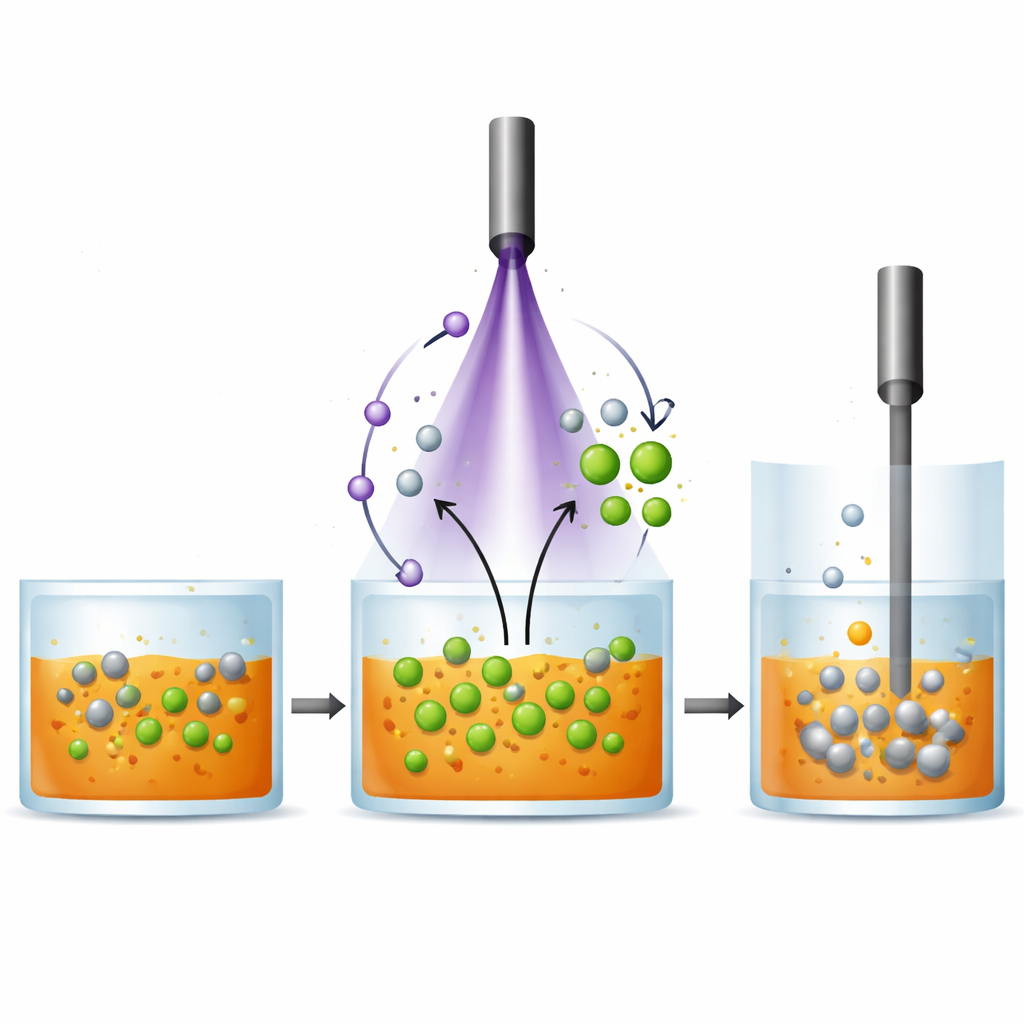
The researchers replace the solid carbon anode with a glowing column of argon plasma—a hot, electrically conducting gas that hovers just above the molten salt rather than sitting inside it. In their setup, a thin tungsten wire acts only as a current collector, while a jet of argon gas between the wire and the melt is energized into plasma by a high‑voltage power supply. This "non‑contact" anode is physically separated from the corrosive salt, so there is no solid material to be eaten away by chlorine. The team shows that the plasma operates in two stages: at very high voltage, argon atoms are ionized; at lower, more stable voltages, chloride ions in the melt are turned into chlorine gas, just as in conventional electrolysis—but without consuming carbon.
How the plasma helps the reaction along
To understand what happens inside this shimmering gas, the authors use optical emission spectroscopy, which reads the colors of light emitted by excited atoms and ions. They detect clear signatures of positively charged argon ions, and find that their intensity—and thus their concentration—increases as the current rises. Thermodynamic calculations support a simple picture: by itself, forcing chloride ions to release electrons and form chlorine gas is not favorable under the conditions studied. But when argon ions are present, they can momentarily grab electrons from chloride and then hand them back, effectively "catalyzing" the oxidation of chloride to chlorine while turning back into neutral argon. This cycle makes the overall step spontaneous, allowing chloride to be stripped from the melt while the argon is continuously recycled.
Protecting the hardware and capturing the metal
Although the plasma is the active anode, practical details still matter. Chlorine gas can corrode the tungsten wire that launches the plasma, so the team coats it with a thin layer of boron nitride, a ceramic that withstands high temperatures. Tests show that this coating cuts tungsten contamination of the melt by about a factor of four, though the harsh environment and mechanical handling still damage the coating over time. On the cathode side, where magnesium metal forms, the researchers use a separate chamber and a protective tube so that the light, freshly made liquid magnesium can be collected without drifting into the chlorine‑rich anode region and reacting back to salt. Microscopy and X‑ray measurements confirm that the deposits are nearly pure magnesium, with only traces of trapped electrolyte.
Trade‑offs between energy and emissions
One major cost of this cleaner approach is electricity. Keeping an argon plasma alive requires much higher voltages than traditional graphite anodes, and the calculated energy use per kilogram of magnesium is an order of magnitude larger than that of current industrial practice. The authors argue that this is the price of ionizing an inert gas instead of oxidizing carbon. They suggest that future improvements could come from choosing gases that ionize more easily, redesigning the electrode geometry, and powering the process with renewable electricity so that high energy use does not translate into high emissions.
What this work means for greener metals
In everyday terms, this study shows that it is possible to strip magnesium out of molten salt using a reusable, glowing argon "flame" instead of burning up blocks of carbon. The method virtually eliminates direct CO2 emissions from the anode and resists the severe corrosion that plagues solid inert materials. While the approach is currently energy‑intensive and demonstrated only at laboratory scale, it opens a new path for making magnesium—and potentially other metals—in a way that better fits a low‑carbon future. With further engineering and integration with clean power sources, such plasma‑based systems could help decouple vital metal production from greenhouse gas pollution.
Citation: Feng, S., Jiang, X., Ni, C. et al. Towards green magnesium preparation using a recyclable argon plasma anode for continuous electrolysis in molten chlorides. Commun Chem 9, 153 (2026). https://doi.org/10.1038/s42004-026-01958-z
Keywords: green metallurgy, magnesium production, molten salt electrolysis, plasma anode, inert electrodes