Clear Sky Science · en
Design of benzo[1,2-b:4,3-b′]dithiophene-4,5-dione based donor-acceptor-donor small molecules for efficient near-infrared photothermal therapy
Turning Light into Targeted Heat
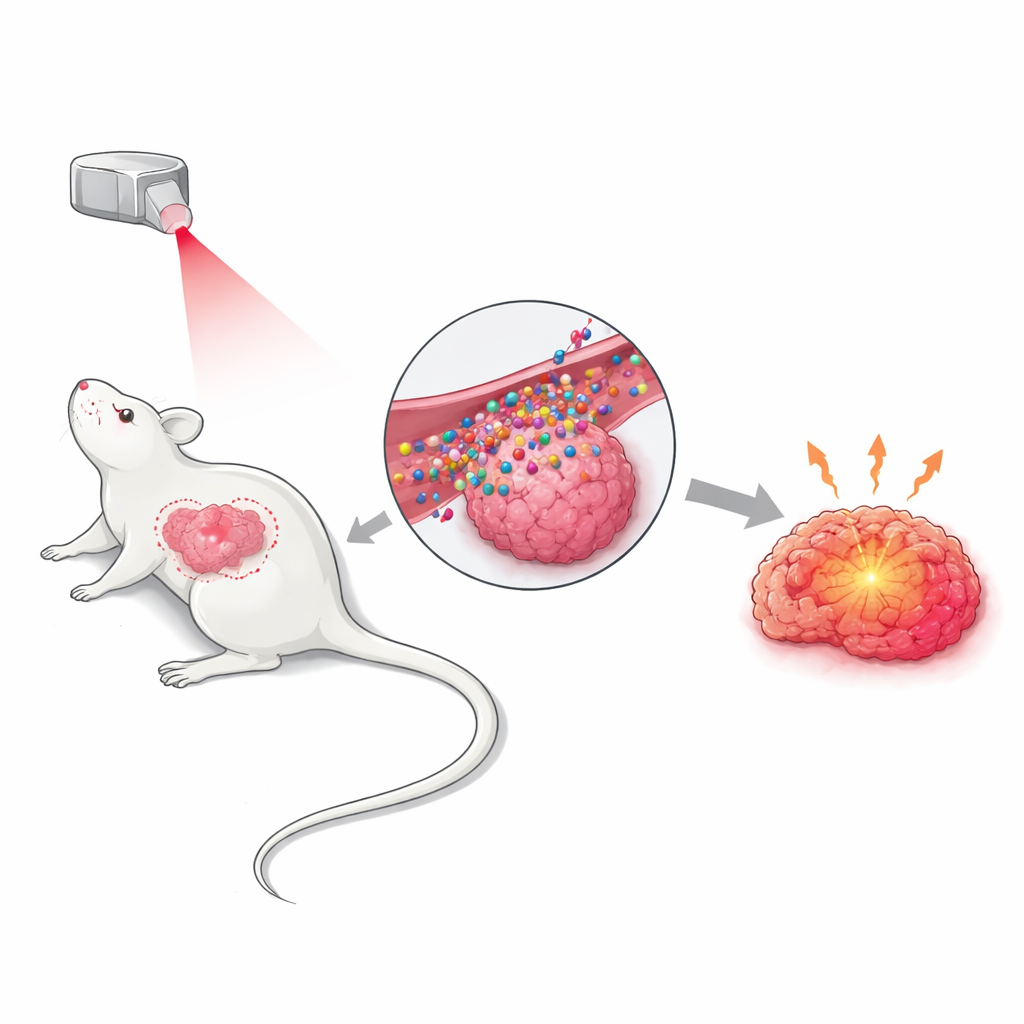
Cancer treatments often struggle to kill tumors without harming healthy tissue. This study explores a promising alternative: using gentle near‑infrared light to heat up tiny organic particles that gather inside tumors, cooking cancer cells from within while sparing the rest of the body. The researchers designed a new kind of small organic molecule that absorbs invisible near‑infrared light very efficiently and turns it into heat, then packaged these molecules into stable nanoparticles that can be used to shrink tumors in mice with minimal side effects.
Why Gentle Light Can Reach Deep
For light‑based cancer treatments to work inside the body, the light must penetrate several centimeters of tissue without being strongly absorbed by blood or water. Near‑infrared light, just beyond the red we can see, is ideal for this. When special particles in a tumor absorb this light and warm up, they can selectively overheat cancer cells. However, many existing materials that do this well are made of metals or inorganic components that may linger in the body and raise safety concerns. Organic small molecules built from carbon‑based frameworks offer a cleaner alternative, but it has been difficult to push their light absorption far enough into the near‑infrared and to keep them efficient and stable once they clump into particles inside the body.
Building a Better Heat‑Making Molecule
The team tackled this challenge by engineering a family of “donor–acceptor–donor” molecules, where an electron‑poor central unit is flanked by electron‑rich arms. This push‑pull design encourages electrons to shift within the molecule when light is absorbed, which naturally shifts absorption toward longer, near‑infrared wavelengths. They used a rigid core called BDTD‑4,5‑dione as the accepting center and attached different versions of a well‑known donor fragment, triphenylamine, at both ends. By gradually making these donor arms more electron‑rich, especially by adding dimethylamino groups, they could finely tune how strongly the molecules interacted with light and how much of that energy was released as heat instead of glow.
From Molecules to Nanoparticles that Act Like Tiny Heaters
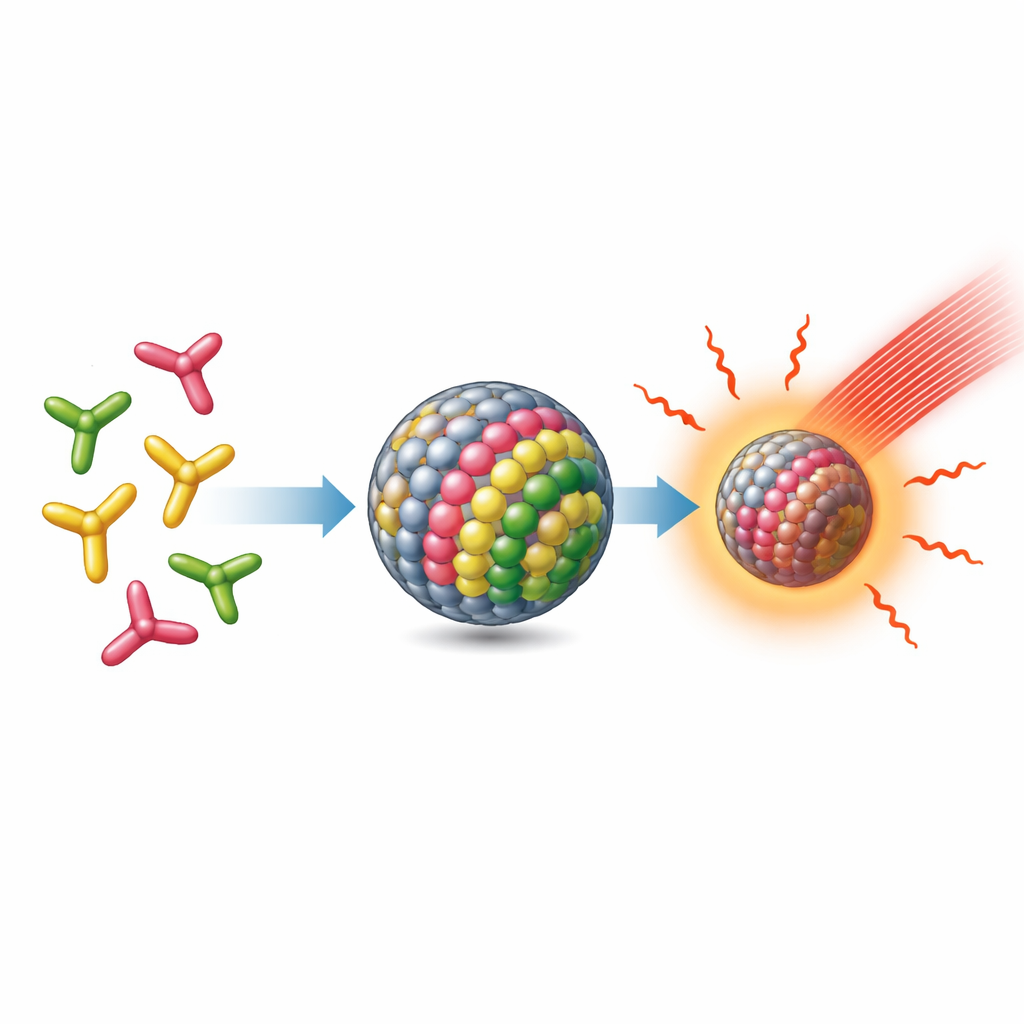
Among the three molecules they built, one named BDQ‑NPA stood out. It absorbed light further into the near‑infrared than the others and showed a narrow energy gap that favors non‑glowing relaxation, ideal for heating. Calculations confirmed that in this molecule, the electron‑rich ends and electron‑poor center are strongly coupled, promoting charge separation and rapid conversion of light energy into molecular motion. When BDQ‑NPA was mixed with a biocompatible coating material in water, it spontaneously formed uniform, roughly 130‑nanometer‑wide nanoparticles. These particles remained stable in salt solutions, blood‑like fluids, and cell culture media for at least two weeks and withstood repeated near‑infrared laser exposure without breaking down or clumping.
Heating, Imaging, and Killing Tumors
In water, these BDQ‑NPA nanoparticles warmed up by more than 50 degrees Celsius within minutes under near‑infrared light and showed a photothermal conversion efficiency of about 35%, on the high end for organic agents. At the same time, they produced strong ultrasound‑like “photoacoustic” signals, allowing the same particles to be used both for imaging where they accumulate and for delivering heat once they get there. In cell tests, the nanoparticles were readily taken up by lymphoma cells and caused little harm on their own, but when illuminated, they triggered widespread cell death, with more than half the cancer cells undergoing apoptosis at modest doses. Importantly, normal kidney cells remained largely unharmed at similar concentrations, pointing to a usable safety margin.
Fighting Tumors in Living Mice
In mice bearing lymphoma tumors, the nanoparticles gradually accumulated at the tumor sites, as visualized by both fluorescence and photoacoustic imaging, peaking around six hours after injection. When the tumors were then exposed to near‑infrared light, the local temperature rapidly rose above 50 degrees Celsius, enough to kill cancer cells. Over a ten‑day treatment period, tumors in treated mice shrank dramatically or nearly disappeared, while animals maintained stable body weight. Microscopic analysis of organs and blood tests for liver and kidney function showed no significant damage, indicating good overall biocompatibility. Compared head‑to‑head with an approved dye used clinically, the new particles converted light to heat more efficiently, degraded less under repeated irradiation, and killed cancer cells more effectively.
What This Means for Future Cancer Care
This work demonstrates that careful tuning of organic molecule structure can produce compact, metal‑free nanoparticles that both show where a tumor is and precisely heat it when activated by near‑infrared light. By strengthening the electron‑donating parts of a donor–acceptor–donor framework, the researchers pushed absorption deeper into the near‑infrared and favored pathways that release energy as heat rather than light. The resulting BDQ‑NPA nanoparticles combine strong heating, imaging capability, and encouraging safety in animals, offering a blueprint for next‑generation light‑activated therapies that could one day complement or reduce the need for traditional chemotherapy and radiation.
Citation: Kang, Y., Deng, Y., Ding, H. et al. Design of benzo[1,2-b:4,3-b′]dithiophene-4,5-dione based donor-acceptor-donor small molecules for efficient near-infrared photothermal therapy. Commun Chem 9, 149 (2026). https://doi.org/10.1038/s42004-026-01955-2
Keywords: photothermal therapy, near infrared nanoparticles, organic small molecules, cancer nanomedicine, photoacoustic imaging