Clear Sky Science · en
A state-switchable TADF macrocycle for multi-analyte sensing and hydrogen gas-driven emission enhancement
Light That Listens to Its Surroundings
Imagine a tiny glowing ring of matter that can “feel” what chemicals are nearby and change its color and brightness in response. This study introduces exactly that: a man‑made molecule called CPCQ that behaves like a smart light bulb at the nanoscale. It can sense different dissolved molecules and gases, switching between dim and bright states, or even turning completely off, all without changing its own basic structure. Such responsive light sources could underpin future detectors for pollutants, industrial gases, and even components in advanced displays and electronics.
A Ring Inspired by Nature’s Shape‑Shifters
In living systems, a single light‑absorbing unit can play many roles depending on its environment. The pigment retinal, for example, produces very different signals in different proteins inside our eyes and in microbes, even though its chemical core stays the same. The researchers borrowed this idea and moved it into man‑made chemistry. They used a “host–guest” strategy, where a rigid molecular ring, or macrocycle, provides a pocket that can temporarily hold smaller “guest” molecules. Instead of building a new dye for every task, they designed one versatile ring, CPCQ, whose glow can be tuned simply by changing which guests visit its cavity or which gas surrounds it. 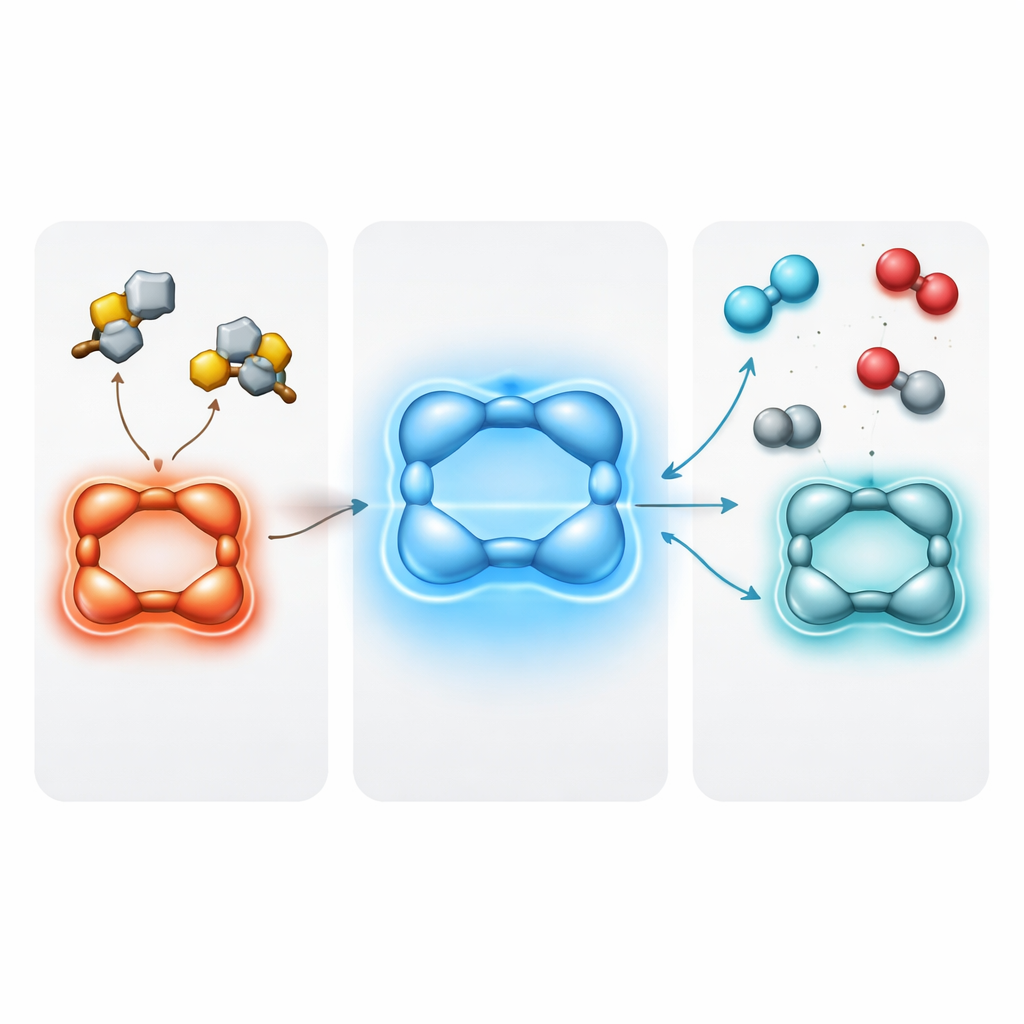
A Special Kind of Glow with Built‑In Delay
CPCQ is not just any fluorescent molecule; it belongs to a class that can recycle normally wasted energy. When light excites such a molecule, energy typically splits into two paths: one bright but short‑lived, the other long‑lived but usually dark. CPCQ can tap into that darker reservoir and thermally up‑convert it back into light, a process known as delayed emission. In solution, the bare ring emits a strong blue glow with high efficiency and a measurable delayed component lasting hundreds of billionths of a second. Its circular architecture arranges four donor–acceptor units closely together, favoring the special excited states that make this delayed glow possible. This built‑in sensitivity makes CPCQ an ideal testbed to see how subtle environmental changes reshape light emission.
Guests That Dim, Guests That Boost
To probe how CPCQ reacts, the team first invited different flat aromatic molecules into its cavity. Electron‑poor guests, which are good at accepting electrons, caused the glow to shift toward red and become weaker. Detailed measurements suggested the ring and guest form a loose excited‑state partnership, called an exciplex, that opens up extra non‑glowing pathways and shortens the light’s lifetime. In contrast, an electron‑rich guest bearing heavy atoms nestled into the cavity without shifting the color. Here the brightness and the delayed component both increased. The heavy atoms help mix otherwise separate energy states, making the recycling of dark excitations into light more efficient. Binding studies and computer simulations confirmed that all these guests form one‑to‑one complexes with CPCQ, but they interact with its electronic “wiring” in very different ways.
Gases That Flip the Light Switch
The most striking behavior emerged when the ring encountered simple gases. Oxygen, a well‑known quencher of excited states, gradually dimmed CPCQ’s broad, charge‑transfer glow and replaced it with a narrower, more structured blue band. The delayed component vanished, showing that the recycling path had been shut down. Importantly, this change was fully reversible: purging with an inert gas restored the original emission. Hydrogen, on the other hand, produced the opposite emotional response from the molecule. Under low‑pressure hydrogen, CPCQ’s glow became about three times as bright and much sharper, again dominated by a localized type of emission, but now with a dramatically higher rate of light production. The researchers argue that the four closely packed light‑emitting units in the ring begin to act cooperatively, a phenomenon akin to several antennas radiating in phase, which greatly boosts brightness. Other gases, notably sulfur‑containing species and methane, simply switched the light off in a largely irreversible way, hinting at much stronger or longer‑lived interactions. 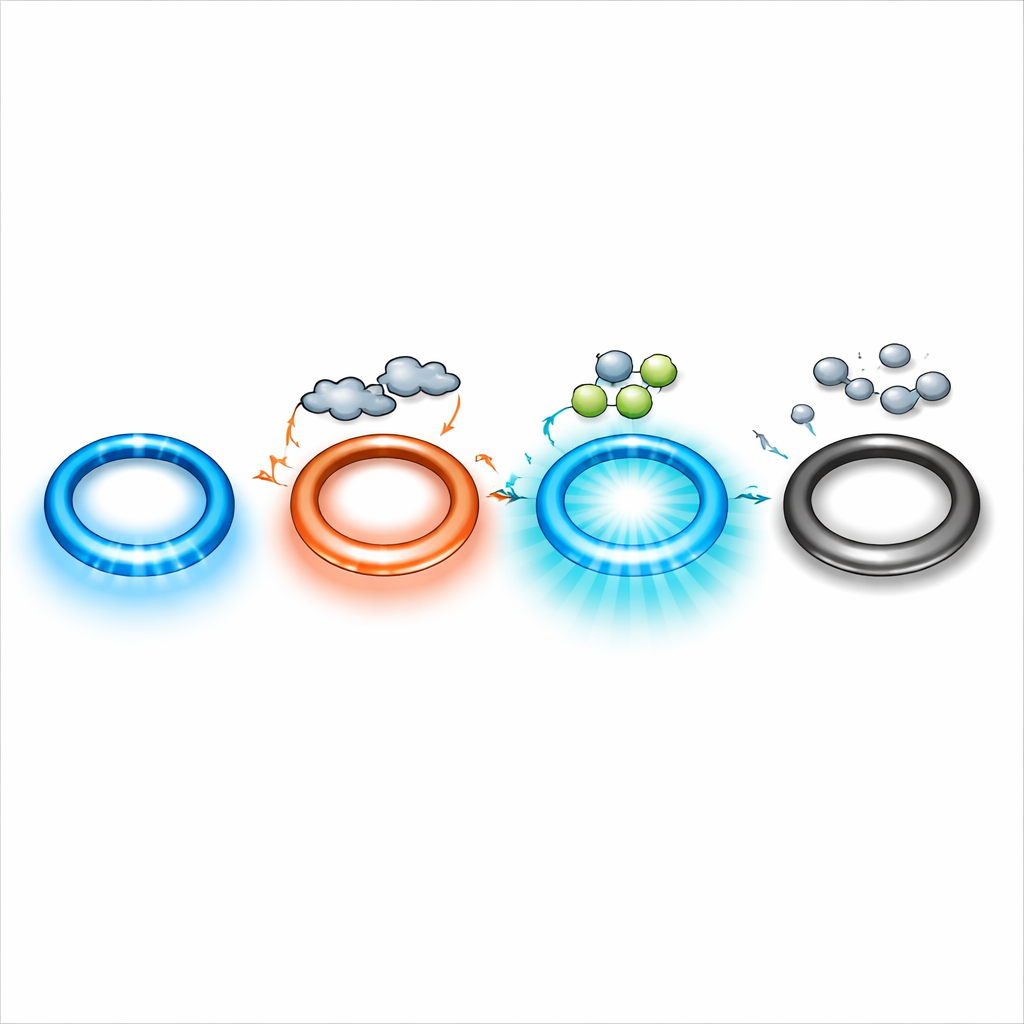
From Smart Glow to Real‑World Sensing
For a non‑specialist, the key takeaway is that CPCQ is a single molecular device whose color, brightness, and timing of light emission can be predictably tuned by its surroundings. Without altering its basic scaffold, the ring can tell apart electron‑hungry and electron‑rich molecules, distinguish between hydrogen and oxygen, and permanently flag the presence of certain heavier gases. The responses are not just on–off; they involve specific shifts in color, intensity, and lifetime that serve as a rich optical fingerprint. Because many of these changes are reversible, CPCQ could be cycled multiple times in practical sensors. In essence, the study showcases a tiny molecular ring that behaves like an adaptive pixel—one that reads out its chemical environment through light—and points the way toward more sophisticated, nature‑inspired materials for gas detection and light‑based technologies.
Citation: Deka, R., Singh, D., Singh, M. et al. A state-switchable TADF macrocycle for multi-analyte sensing and hydrogen gas-driven emission enhancement. Commun Chem 9, 152 (2026). https://doi.org/10.1038/s42004-026-01953-4
Keywords: gas sensing, macrocycle, delayed fluorescence, hydrogen detection, host–guest chemistry