Clear Sky Science · en
On the unexpected mechanism of isomerization in tautomerizable azo photoswitches
Light-Driven Molecules That Act Like Tiny Switches
Imagine a material that changes its shape or function when you shine light on it, and then quietly resets itself when the lights go off. This paper explores exactly that kind of molecular behavior in a special family of dye molecules called azo photoswitches, which are already used in sensors, soft materials, and even drug design. The authors uncover an unexpected way these molecules flip between shapes when conditions such as acidity (pH) change, revealing design rules that could help engineers build faster, more precise light-responsive materials.
Why Chemists Care About Molecular Shape-Flipping
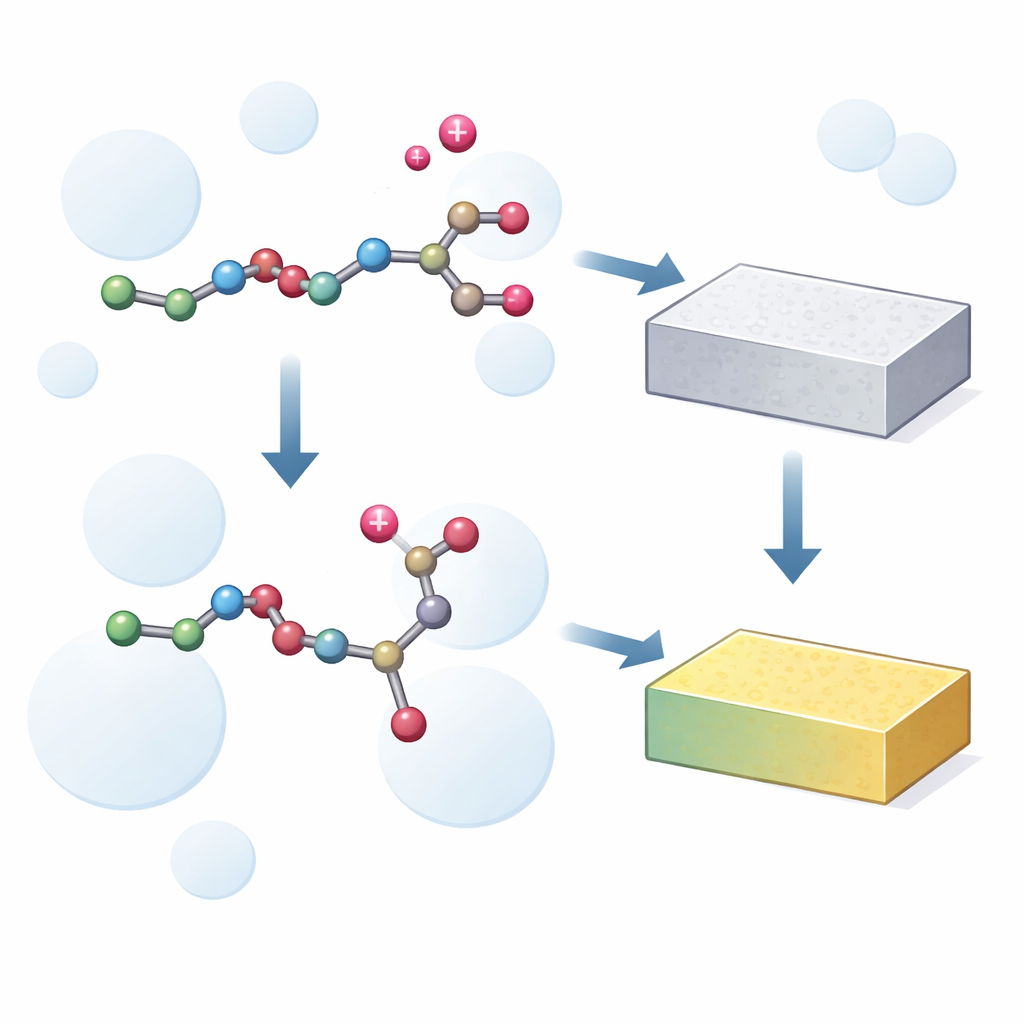
Azo photoswitches work like nanoscale hinges. Light pushes them from a straight (trans) shape into a bent (cis) shape, and then heat nudges them back again. How quickly they relax back matters a lot: slow switches can store information for a long time, while fast ones are better for rapid signaling or actuation. Chemists know that adding or removing protons (tiny positively charged particles that define acidity) can speed this relaxation up or slow it down by orders of magnitude. But for an important subclass of these dyes, which contain an -OH group and can rearrange internally to a so‑called hydrazone form, the detailed "how" of this speed-up has remained murky and theory has repeatedly run into mathematical roadblocks.
A Model Molecule With Real-World Uses
The team focuses on a versatile dye called HPAS, which carries both an acid-sensitive group and a metal-binding unit. HPAS is already used to build light-responsive gels, coordination polymers, and metal sensors, so understanding its behavior has practical payoffs. Depending on the pH, HPAS can take on different protonation states and can shuffle a proton from an oxygen atom to the central nitrogen–nitrogen unit, toggling between an azo form and a hydrazone form. Using advanced quantum-chemical calculations, the authors map out which atoms pick up protons first, how charge is redistributed, and how this sets up a delicate balance between the azo and hydrazone arrangements in solution.
Rewriting the Playbook for Thermal Relaxation
For the fully deprotonated version of HPAS—the form that dominates under basic conditions—the authors first ask whether relaxation from the bent to the straight shape goes through a more complex path involving a temporary change in the molecule’s electronic spin (a singlet–triplet crossing), a mechanism suggested for some related dyes. By applying multireference wavefunction methods that track many electronic configurations at once, they find that for HPAS the relevant energy surfaces never cross in a helpful way. Instead, the molecule simply twists around its nitrogen–nitrogen bond on the ordinary ground-state surface. This result adds weight to a growing view that not all azo switches rely on more exotic spin-changing pathways, even when they are strongly "push–pull" in their electronic design.
An Unexpected Shortcut in the Hydrazone Form
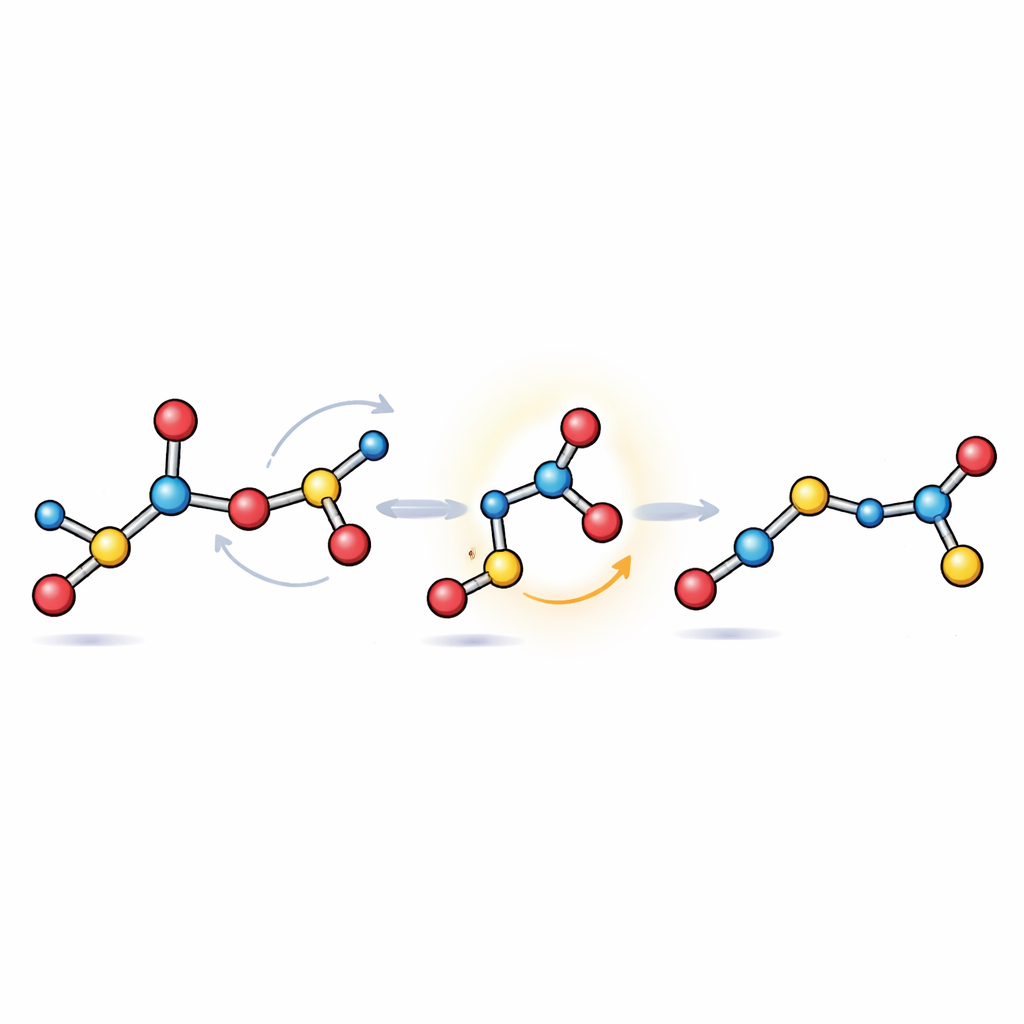
The most surprising insight comes from the hydrazone form that appears near neutral pH, where experiments show thermal relaxation becomes dramatically faster. Earlier theoretical attempts produced unphysical sharp cusps in the calculated energy landscape, suggesting something important was missing. The authors solve this by treating two linked twisting motions at once: the usual twist around the nitrogen–nitrogen axis and a second twist involving the proton-bearing nitrogen. When they explore this full two-dimensional landscape, a smooth path emerges. Along this path, the key nitrogen atom does not flatten as in a classic "umbrella inversion"; instead, it becomes maximally puckered, and the bond between the two nitrogens temporarily weakens to less than single-bond character. This highly distorted, puckered state serves as an easy-to-reach gateway that lets the whole unit rotate rapidly, explaining why the hydrazone pathway is so fast.
Designing Smarter Light-Responsive Materials
By showing that protonation can steer HPAS into a hydrazone form that cleverly uses nitrogen puckering to weaken a key bond and lower the energy barrier for rotation, this work turns a puzzling experimental observation into a clear design rule. In plain terms, adding protons in the right places gives the molecule a flexible elbow that swings much more easily. The authors suggest that introducing extra electron-donating groups could enhance this puckering effect even further, offering a rational way to tune switching speeds. These insights should help chemists craft next-generation azo-based materials whose light response and thermal reset times can be dialed in simply by adjusting molecular structure and pH.
Citation: Hillel, C., Barrett, C.J., Pietro, W.J. et al. On the unexpected mechanism of isomerization in tautomerizable azo photoswitches. Commun Chem 9, 142 (2026). https://doi.org/10.1038/s42004-026-01952-5
Keywords: azo photoswitches, hydrazone tautomer, protonation and pH, light-responsive materials, molecular isomerization