Clear Sky Science · en
Cobalt single-atom and nano catalysts for efficient transfer hydrodeoxygenation of vanillin with formic acid
Turning Plant Waste into Cleaner Fuel
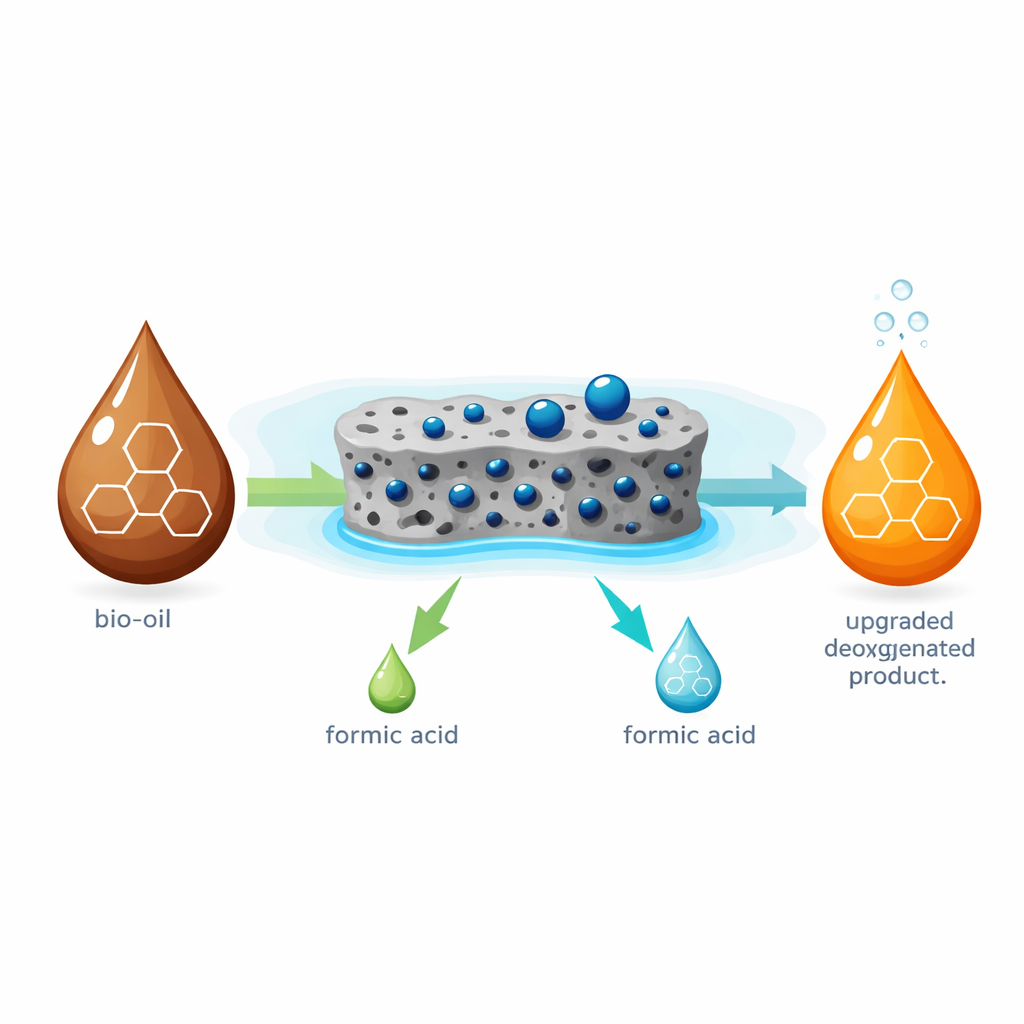
As the world looks for alternatives to fossil fuels, scientists are learning how to turn plant leftovers into useful liquid energy. One especially promising ingredient is vanillin, a molecule that comes from lignin, the tough material that helps give wood its strength. This study shows how a carefully designed cobalt-based catalyst can transform vanillin into a more energy-rich, stable liquid using formic acid—a simple, green chemical—instead of pressurized hydrogen gas. The work points toward safer, cheaper ways to upgrade biomass into fuels and chemicals.
Why Vanillin Matters Beyond Flavor
Vanillin is best known as the compound that gives vanilla its familiar aroma, but in this context it stands in for a much bigger story: it is a typical fragment produced when lignin, a major component of plant biomass, is broken down. These lignin-derived oils are rich in oxygen, which makes them less energy-dense and unstable as fuels. A key step toward using them as fuel is to remove this extra oxygen in a controlled way. The reaction studied here converts vanillin into 2-methoxy-4-methylphenol, a molecule with lower oxygen content and more fuel-like properties, while avoiding unwanted side reactions that would destroy useful parts of the molecule. Doing this efficiently with affordable materials is a central challenge for sustainable energy technologies.
Building a Smarter Cobalt Catalyst
The researchers tackled this challenge by engineering a catalyst made of cobalt atoms anchored on a nitrogen-doped carbon support. Uniquely, their best-performing material, called Co1+Con/N-C, contains two kinds of cobalt sites at once: isolated single atoms and tiny metallic nanoparticles. They created these structures using a sacrificial magnesium oxide template and high-temperature treatment, then removed the template with acid. Microscopy and spectroscopy confirmed that one version of the catalyst held only single cobalt atoms, another held only nanoparticles, and the hybrid combined both in a porous carbon matrix with many defects. These structural details turned out to be crucial for how well the catalyst worked.
How Water and Formic Acid Team Up
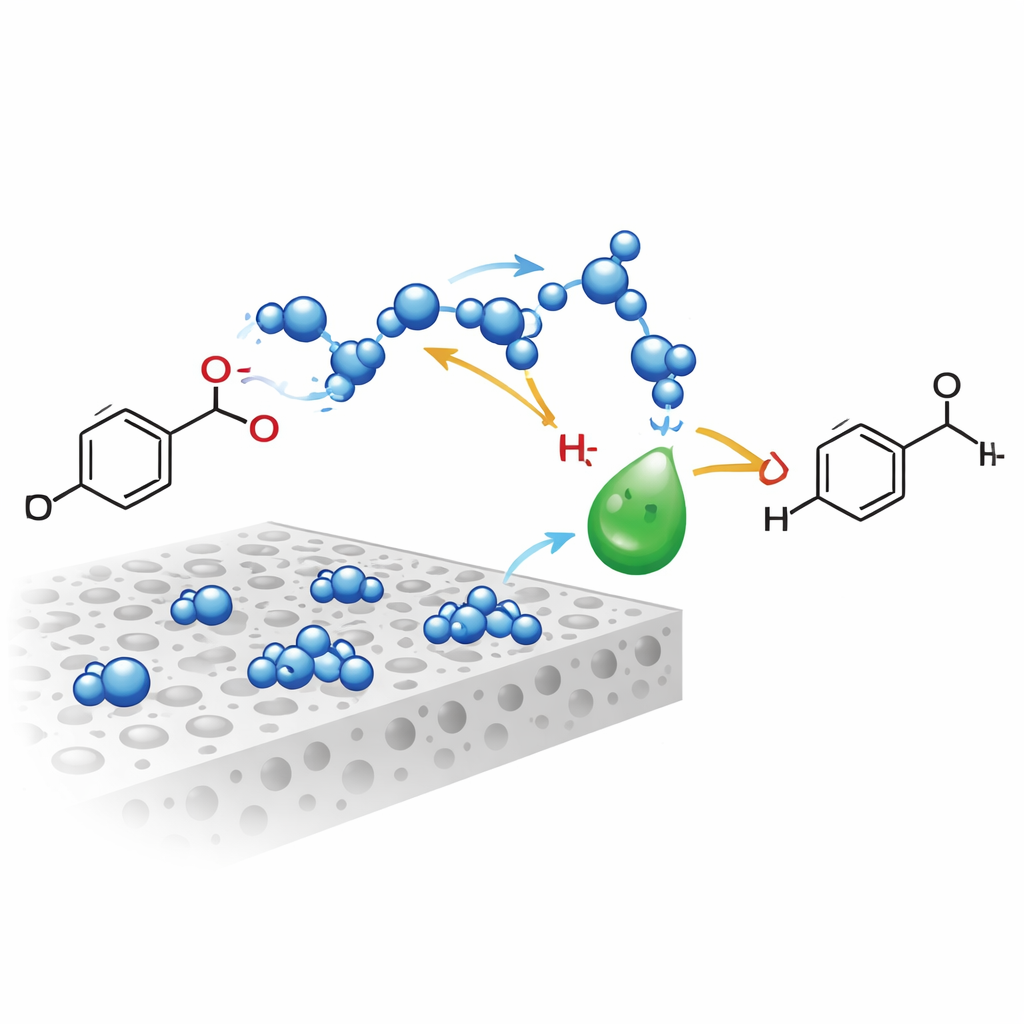
Instead of using compressed hydrogen gas, the reaction relies on formic acid, a simple molecule that can release hydrogen under mild conditions. The team found that the hybrid cobalt catalyst converted vanillin almost completely to the desired product at 160 °C, with over 99% selectivity, and kept about 95% of its activity over many cycles. Careful tests showed that water was not just a passive solvent: reactions in water were far more effective than in other liquids. By using heavier isotopes of hydrogen (deuterium) in either water or formic acid, the researchers measured how changes in hydrogen motion slowed the reaction. These experiments revealed that both proton movement through water and hydride transfer from formic acid are central, linked steps in the process.
A Dual Hydrogen Pathway at Work
The data support a picture in which water forms a hydrogen-bonded network across the catalyst surface, letting positively charged hydrogen species hop between molecules and spill over to the reacting vanillin. At the same time, formic acid provides negatively charged hydrogen (a hydride) through its breakdown on the cobalt sites. First, the vanillin’s oxygen-containing group is protonated—made more reactive—by water-linked hydrogen. Then the hydride from formic acid attacks, transforming the group into a less oxygen-rich form and ultimately yielding the target product. The presence of both cobalt single atoms and nanoparticles appears to lower the energy barriers for these steps, explaining why the mixed catalyst outperforms either type alone.
What This Means for Future Green Fuels
For non-specialists, the bottom line is that this work shows how a carefully tuned, low-cost metal catalyst can upgrade plant-derived molecules into more fuel-like products using a safer hydrogen source. By revealing that water actively helps shuttle hydrogen in a dual pathway—rather than simply acting as a background liquid—the study offers practical design rules for future catalysts. The approach could be extended to many other biomass-derived compounds, moving us closer to turning plant waste into stable, efficient fuels and chemicals without relying on expensive noble metals or risky high-pressure hydrogen.
Citation: Li, J., Shi, G., Xu, Z. et al. Cobalt single-atom and nano catalysts for efficient transfer hydrodeoxygenation of vanillin with formic acid. Commun Chem 9, 141 (2026). https://doi.org/10.1038/s42004-026-01947-2
Keywords: biomass conversion, vanillin upgrading, cobalt catalyst, formic acid hydrogen source, green fuel production