Clear Sky Science · en
Adsorption of organic donor-acceptor molecules on graphene/SiC preserves light-induced charge transfer
Turning Light into Tiny Electric Currents
Modern solar cells and molecular electronics all rely on the same basic trick: turning incoming light into moving charges. This paper explores how to support special light‑sensitive organic molecules on a solid surface without ruining the way they move charge after a flash of ultraviolet or visible light. The authors show that a carefully chosen platform made of graphene on silicon carbide can hold these molecules in place while largely preserving their natural light‑driven behavior, a key step toward real devices that track and steer electrons on their fastest, femtosecond time scales.
Why These Molecules Matter
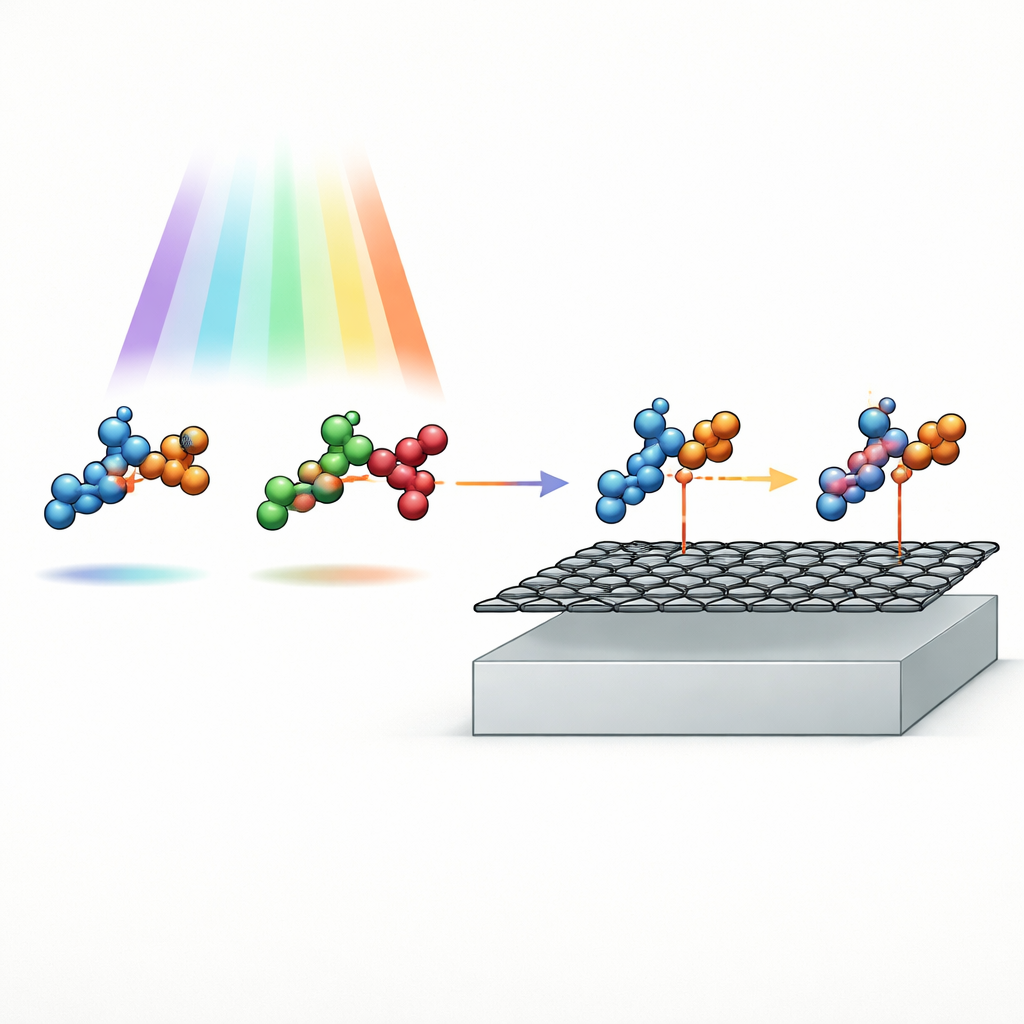
The study focuses on “donor–acceptor” molecules, which are built like tiny push‑pull systems: one end tends to give up electrons, the other end tends to attract them. When light hits such a molecule, an electron can jump from the donor side to the acceptor side, creating a built‑in separation of charge. This internal shift is central to processes as varied as photosynthesis and organic solar cells, and makes these molecules promising ingredients for switches, sensors, and molecular diodes. Here, the authors examine three related molecules—based on benzene and pyrene rings with different chemical side groups—that span stronger and weaker forms of this push‑pull behavior.
Finding the Right Surface
To build practical devices or perform precision experiments, these molecules cannot stay in the gas phase; they must be anchored on a solid. But the supporting material can easily spoil the effect researchers care about, either by reacting too strongly with the molecule or by contributing its own unwanted currents when light shines. Metals, for example, have mobile electrons that tend to swamp the subtle motion inside the molecule itself, while very insulating materials may not hold the molecule securely. The team argues that a hybrid surface made of a single graphene sheet grown on hexagonal silicon carbide strikes a useful balance: it offers enough attraction to keep the molecules in place, but its electrons respond to light in a relatively gentle way.
How the Molecules Sit and Interact
Using advanced computer simulations that explicitly track how electrons respond to each other, the authors first determine how the molecules attach to the graphene/silicon carbide surface. They find that all three lie flat, about three and a half angstroms above the graphene layer, bound mainly by weak van der Waals forces rather than strong chemical bonds. Only a tiny amount of charge flows from the surface into the molecules, mostly toward their electron‑hungry ends, confirming that the bonding is gentle. At the same time, the electric environment created by the surface substantially lowers the energy cost of adding or removing electrons from the molecules—a kind of “screening” that shrinks the gap between their filled and empty electronic levels by more than one electron volt compared with free molecules.
Surprising Stability of Light‑Driven Excitations
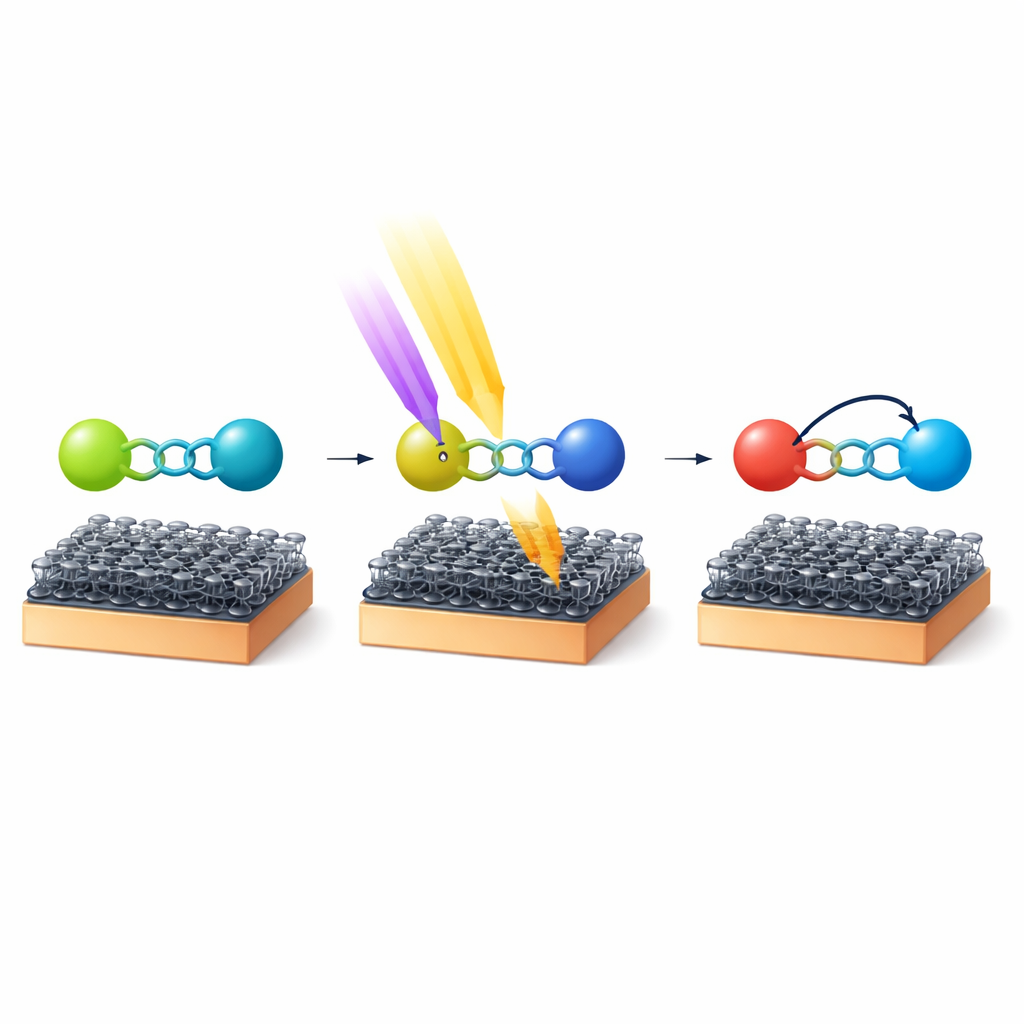
This large reshaping of the molecules’ energy levels might be expected to strongly alter how they absorb light. However, detailed calculations of their absorption spectra tell a subtler story. When the molecules rest on graphene/silicon carbide, their main light‑driven excitations shift only slightly toward lower energies—by just 0.1 to 0.2 electron volts—relative to the same molecules in isolation or in a non‑interfering solvent. Crucially, the pattern of where electrons and holes reside after excitation remains largely the same: charge still moves from donor to acceptor within the molecule, and the excited states stay localized on the molecular framework rather than spilling into the surface. In other words, the surface strongly affects charged states involved in adding or removing an electron, but only gently perturbs the neutral excitations created by light.
What This Means for Future Devices
For non‑experts, the bottom line is that graphene on silicon carbide behaves like a nearly invisible stage for these light‑active molecules. It holds them in known orientations and modifies some of their deep electronic details, yet leaves the basic act of moving charge from one end to the other after a light pulse almost unchanged. This makes the interface an appealing test bed for ultrafast experiments that aim to watch electrons move in real time and, ultimately, for molecular components in optoelectronic devices where the supporting material should assist, but not dominate, the delicate dance of light‑induced charge transfer.
Citation: Mansouri, M., Díaz, C., Alcolea-Cerdán, J.T. et al. Adsorption of organic donor-acceptor molecules on graphene/SiC preserves light-induced charge transfer. Commun Chem 9, 137 (2026). https://doi.org/10.1038/s42004-026-01943-6
Keywords: donor-acceptor molecules, graphene, charge transfer, optoelectronics, silicon carbide