Clear Sky Science · en
Enhanced third-order optical nonlinearity in a dipolar carbene-metal-amide material with two-photon excited delayed fluorescence
Lighting Up Tiny Worlds with Gentler Light
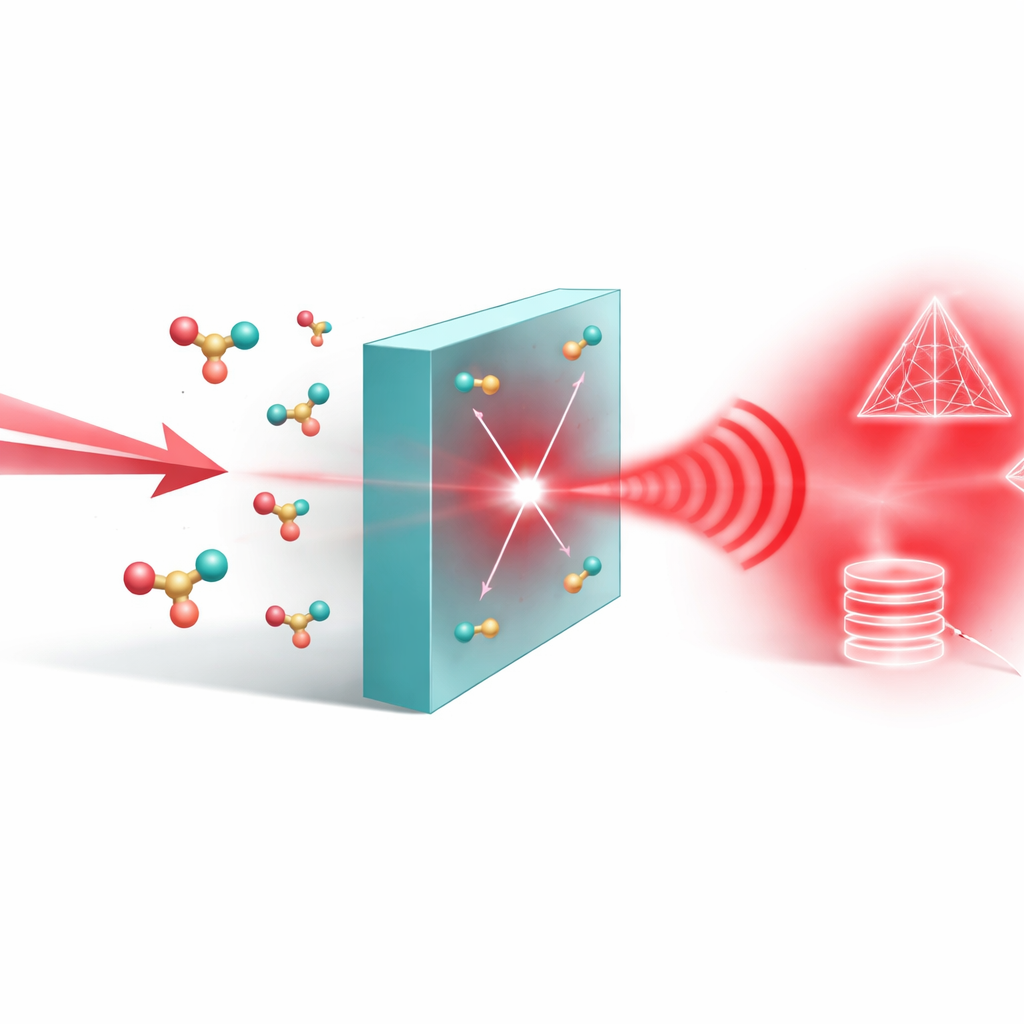
Many of today’s most exciting technologies—from 3D bio‑printing to deep‑tissue imaging—depend on special materials that can absorb faint, tightly focused beams of infrared light and then shine brightly in return. This paper reports a new molecule that does exactly that: it can swallow two infrared photons at once and emit intense red light, all while remaining remarkably stable under harsh laser conditions. For anyone interested in faster data processing, sharper microscopes, or more precise medical tools, this work shows how chemists are redesigning light‑responsive materials from the atom up.
A New Kind of Light-Sensitive Building Block
The researchers focus on a family of compounds called carbene–metal–amides, in which an atom of gold sits between two organic fragments that push and pull electrons in different ways. Earlier members of this family were already excellent light emitters for energy‑efficient display technologies, but they did not respond strongly enough to the simultaneous absorption of two photons—a nonlinear optical effect crucial for 3D imaging and microfabrication. The team redesigned this basic scaffold to create a new molecule, dubbed LAuCz, by extending one side of the structure with an electron‑hungry framework and using a robust, light‑loving carbazole group as the partner. This combination was chosen to make the electron cloud more easily distorted by light while keeping the molecule thermally and chemically tough.
How the Molecule Catches and Reuses Energy
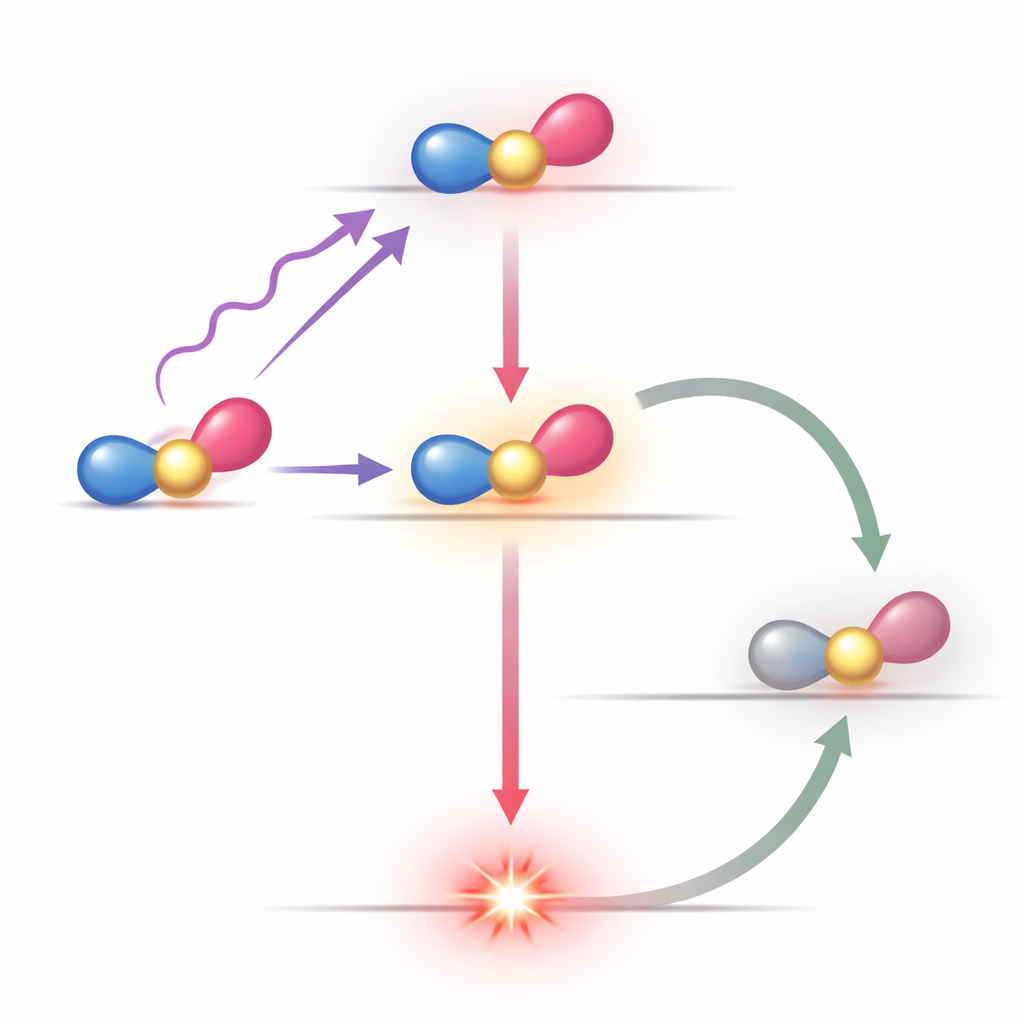
When LAuCz absorbs light, electrons move from one side of the molecule to the other, creating a strongly polarized excited state. The authors show that in a rigid plastic film this excited state can follow two closely linked paths: a prompt flash and a delayed flash. The delayed route relies on a process called thermally activated delayed fluorescence, where energy temporarily hides in a dark triplet state before being thermally promoted back to a bright singlet state. Careful measurements across temperatures reveal that the energy gap between these states is extremely small, and that the gold atom’s heavy core greatly boosts the rate at which the dark and bright states exchange. As a result, nearly all the stored energy can be funneled into red light rather than lost as heat.
From Single-Photon to Double-Photon Excitation
To test the nonlinear behavior that matters for advanced optics, the team excited LAuCz with ultrafast infrared laser pulses. Instead of absorbing a single high‑energy photon, the molecule can take in two lower‑energy photons at nearly the same moment and still reach the same excited state. In a dilute polystyrene film, this two‑photon process becomes especially efficient: the two‑photon absorption cross‑section reaches about 105 Göppert–Mayer units, three orders of magnitude higher than in solution. Importantly, the light emitted after two‑photon excitation is indistinguishable from that produced by ordinary one‑photon excitation, confirming that the same bright delayed‑fluorescence pathway is at work. The arrangement within the plastic is disordered, ruling out crystal‑packing tricks and highlighting that the molecular design itself drives the strong response.
Built to Survive Harsh Laser Conditions
High‑performance optical devices demand not only brightness but also durability. Many existing two‑photon emitters, especially purely organic ones, slowly burn out under continuous laser exposure. LAuCz stands out in this regard. When embedded at low concentration in a polymer film and exposed either to ultraviolet light or to intense femtosecond pulses at 1000 nanometers, its red emission decays only slowly, with half‑life times of hours. Comparisons with a widely used organic delayed‑fluorescence material show that the gold‑containing design resists photodamage far better. The authors tie this resilience to the ultrafast shuttling of energy between dark and bright states: the molecule spends less time in the vulnerable configurations that typically trigger chemical breakdown.
Why This Matters for Future Devices
In plain terms, this work demonstrates a small, gold‑based molecule that can absorb gentle infrared light two photons at a time and convert it into strong, stable red emission. By carefully tuning how electrons move within the structure—making the excited state highly polarizable, keeping the energy gap between dark and bright states tiny, and exploiting the heavy gold atom to speed state switching—the researchers achieve one of the fastest radiative rates and most robust performances seen for this class of materials. Such a combination of high two‑photon response, deep‑red color, and long‑term stability is precisely what is needed for future 3D displays, optical data storage, precision surgery, and other photonic technologies that rely on controlling light in three dimensions without damaging the medium.
Citation: Nwosu, I.D., Matasović, L., Ramos, T.N. et al. Enhanced third-order optical nonlinearity in a dipolar carbene-metal-amide material with two-photon excited delayed fluorescence. Commun Chem 9, 135 (2026). https://doi.org/10.1038/s42004-026-01928-5
Keywords: two-photon absorption, delayed fluorescence, gold complexes, nonlinear optics, photonic materials