Clear Sky Science · en
A plasmid toolbox for the easy autodisplay of recombinant proteins and its optimization
Turning Bacteria into Tiny Test Benches
Many modern medicines and industrial processes depend on proteins that have been carefully engineered in the lab. This study explores a clever way to use common bacteria as customizable test benches for such proteins, making it faster and easier to find versions that work well on a cell surface for tasks like sensing, binding, or breaking down chemicals.
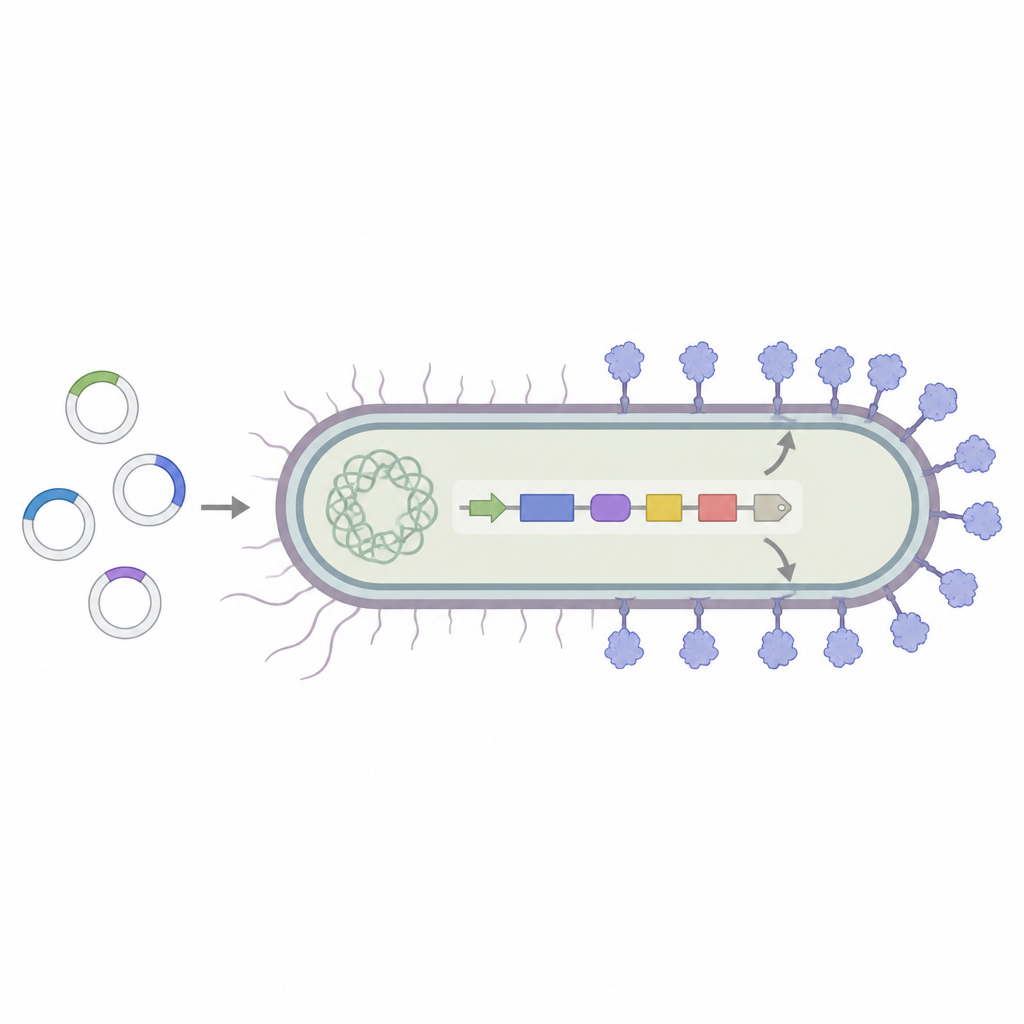
Why Put Proteins on a Cell’s Skin
When a protein sits on the outside of a living bacterium, scientists can probe how it behaves without purifying it first. Whole cells can be used directly to screen huge libraries of protein variants for stronger binding to a drug molecule or for better catalytic activity. Bacterial display complements the well-known phage display method and offers advantages for larger proteins, higher copy numbers, and simple growth of successful cells. In Gram negative species such as Escherichia coli, a natural secretion route called the autotransporter pathway can move a protein from the inside of the cell to the outer membrane, where it ends up anchored and exposed like bristles on a brush.
Building a Plug and Play Plasmid Toolbox
The authors created a collection of 81 plasmids, which they call the Autodisplay ToolBox, or ATB. Each plasmid carries a standardized layout for an autotransporter construct but with different interchangeable parts. These parts include the on switch that controls expression, the signal peptide that guides the nascent protein through the inner membrane, a linker region that spaces and orients the cargo, and one of two outer membrane anchors. By mixing and matching four signal peptides, six linkers, three promoters, and either a classical or inverted anchor, the toolbox lets researchers systematically test which combination works best for displaying their protein of interest on the bacterial surface.
Trying the Toolbox on Enzymes
To show what the toolbox can do, the team first tested a sugar cutting enzyme called β glucosidase, using it as a model passenger protein on E. coli. They compared a labor intensive, plasmid by plasmid construction strategy with two streamlined library methods, where all plasmids are pooled or recovered from a mixed strain stock before swapping in the enzyme gene. Screening dozens of cell clones in microtiter plates revealed that certain combinations of signal peptide and linker produced far higher whole cell enzyme activity than the commonly used reference design. The best construct boosted apparent β glucosidase activity by about 4.9 fold, without evidence of extra cell breakage that could have skewed the results. They then applied a similar library approach to a copper containing enzyme, a laccase called CotA, in both E. coli and Pseudomonas putida, and again identified plasmid designs that raised activity on the cell surface by up to 4.7 fold.
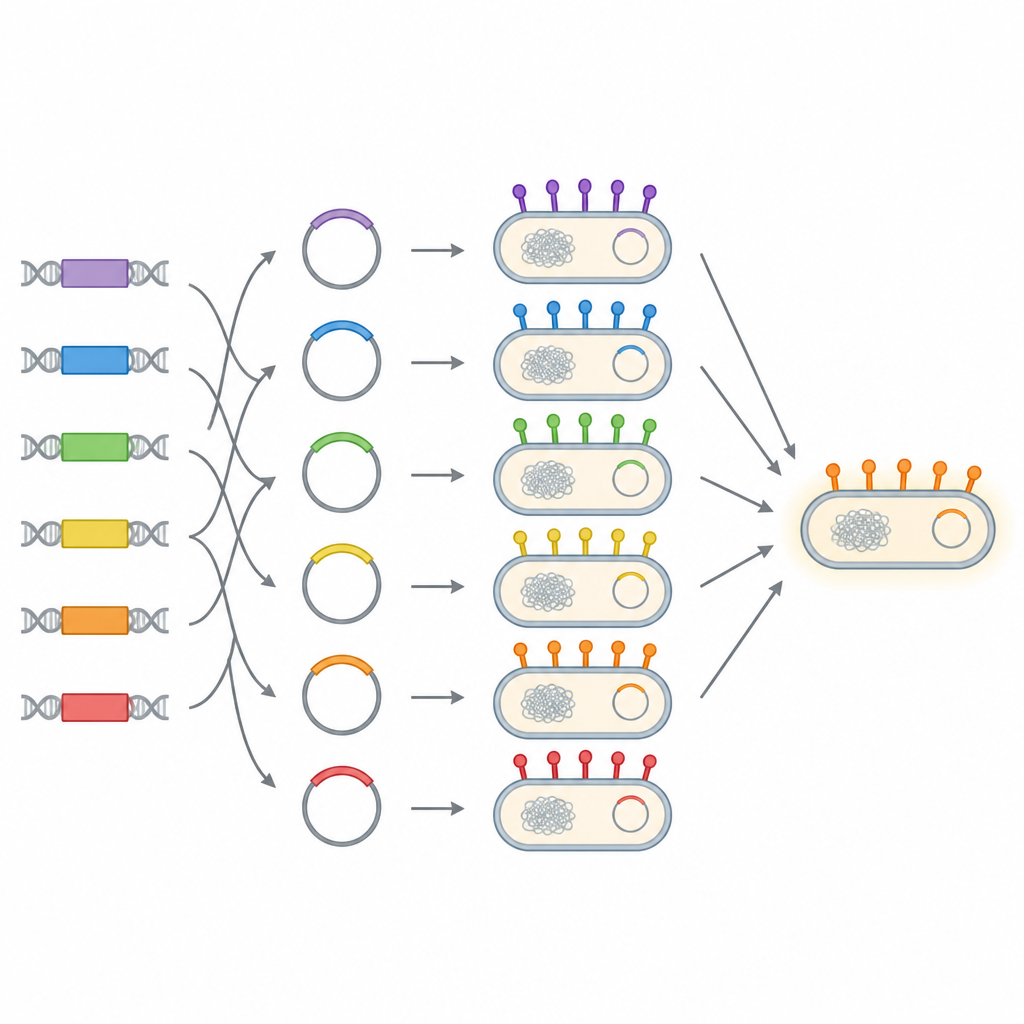
Adapting the System for Protein Binding
Surface display is also valuable for studying how proteins recognize small molecules. As a third test, the authors turned to a human ion channel fragment known as the cyclic nucleotide binding domain of HCN2, which naturally binds signaling molecules similar to cAMP. They fused this domain to many ATB variants and screened bacteria for binding of a fluorescent cAMP like probe, reading out single cell fluorescence by flow cytometry. Several plasmid combinations produced much stronger signals than the reference, with the best increasing fluorescence, and therefore binding capacity, by about 10.3 fold. Antibody staining confirmed that these gains reflected more accessible binding sites at the cell surface rather than widespread cell damage.
What This Means for Future Experiments
In simple terms, the study delivers a ready made set of genetic building blocks that lets scientists quickly tune how a protein is displayed on a bacterial cell. Instead of guessing a suitable design, they can drop their favorite protein into the ATB library, run a single round of growth and screening, and pick the cell clone that shows the strongest activity or binding. Because the plasmids are available through a public repository and work in more than one bacterial species, this toolbox should help many labs convert ordinary microbes into efficient, customizable platforms for protein engineering, biocatalysis, and ligand discovery.
Citation: Furtmann, C., Röhe, P., Gesing, K. et al. A plasmid toolbox for the easy autodisplay of recombinant proteins and its optimization. Commun Biol 9, 694 (2026). https://doi.org/10.1038/s42003-026-10324-7
Keywords: bacterial surface display, autotransporter, plasmid library, enzyme engineering, protein binding