Clear Sky Science · en
Neurons in the bat auditory cortex encode class and complexity of future vocalizations
How bats plan their own sounds
Bats are famous for using sound to navigate in the dark, but their brains must also keep track of what they are about to say before any sound leaves their mouths. This study looks inside the hearing centers of a small fruit bat to find out whether its brain can predict not only which type of call will be produced, but also how simple or complex that call will be. The work offers a glimpse into how the brain prepares for future sounds, a process that may share principles with human speech planning.
Two kinds of bat voices
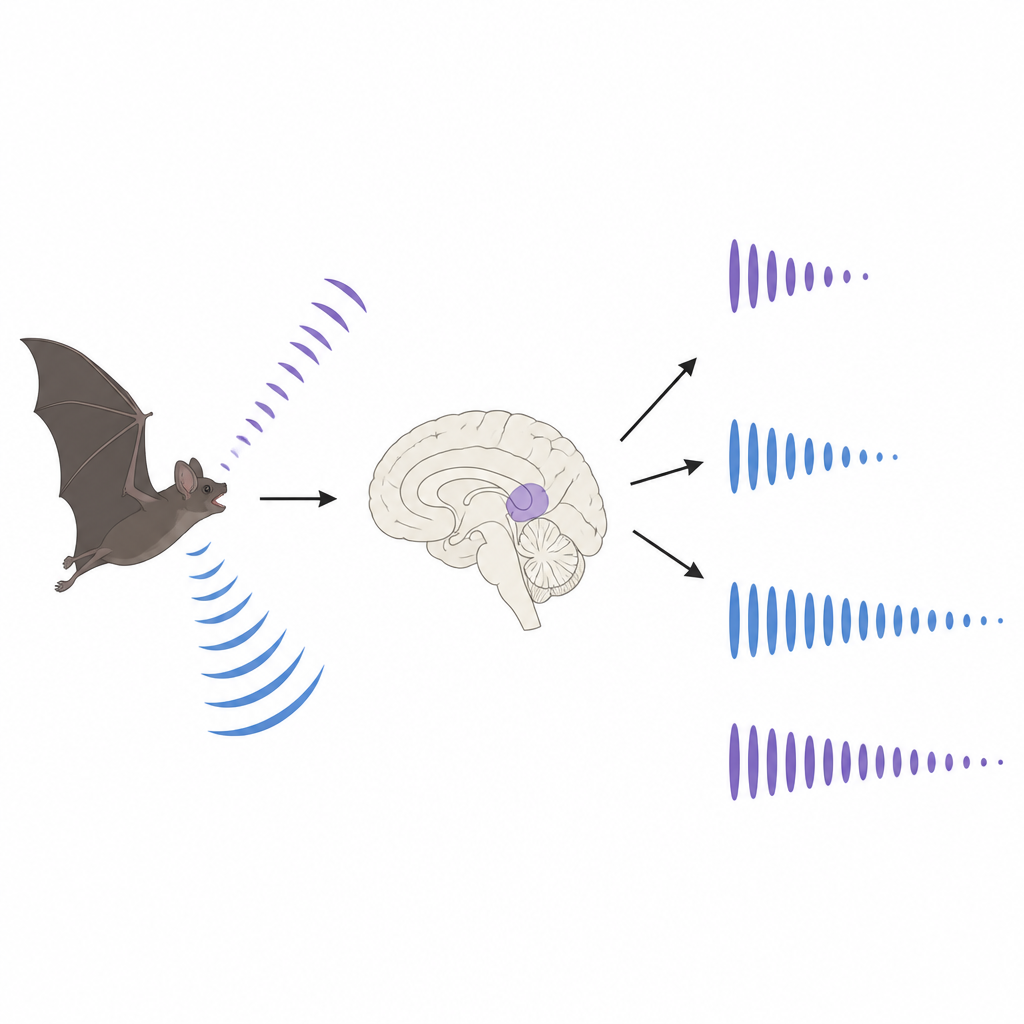
Seba’s short tailed bat relies on two broad categories of vocalizations. One consists of very high pitched, ultra short bursts used for echolocation, where the bat listens to returning echoes to sense nearby objects. The other consists of lower pitched communication calls used for social interaction. In the lab, researchers recorded both kinds while bats sat awake but head fixed, capturing individual calls and also short sequences of repeated syllables or pulses. They sorted each vocal event into four groups: single echolocation pulses, single communication syllables, sequences of echolocation pulses, and sequences of communication syllables, each separated by at least half a second of silence at the start to keep the analysis clean.
Listening neurons that look ahead
At the same time, the team measured electrical spikes from single neurons in the bats’ auditory cortex, the brain region that usually processes incoming sounds. Surprisingly, many of these neurons changed their firing rates several hundred milliseconds before a call began. Some cells became more active before echolocation pulses, others before communication calls. When the researchers summarized activity across the population and used standard statistical tools, patterns of firing diverged clearly for the two call types even before the bat opened its mouth. Computer classifiers trained on these patterns could reliably guess which call category was coming, showing that the future vocal class was already encoded in the hearing area.
Signaling simple versus complex calls
The auditory cortex did more than mark broad call categories. It also reflected how many syllables or pulses the bat was about to produce. For communication calls, certain neurons fired more strongly when a multi syllable sequence was coming than when only a single syllable would be produced, and this scaling with syllable count appeared even before the first sound. Across the whole population, firing rates increased steadily with the number of communication syllables, both before and after vocal onset. For echolocation, spike rates also grew with the number of pulses in a sequence, but mainly after the first pulse, suggesting that the timing of prediction differs between social calls and sonar pulses.
Specialists for pitch and pattern
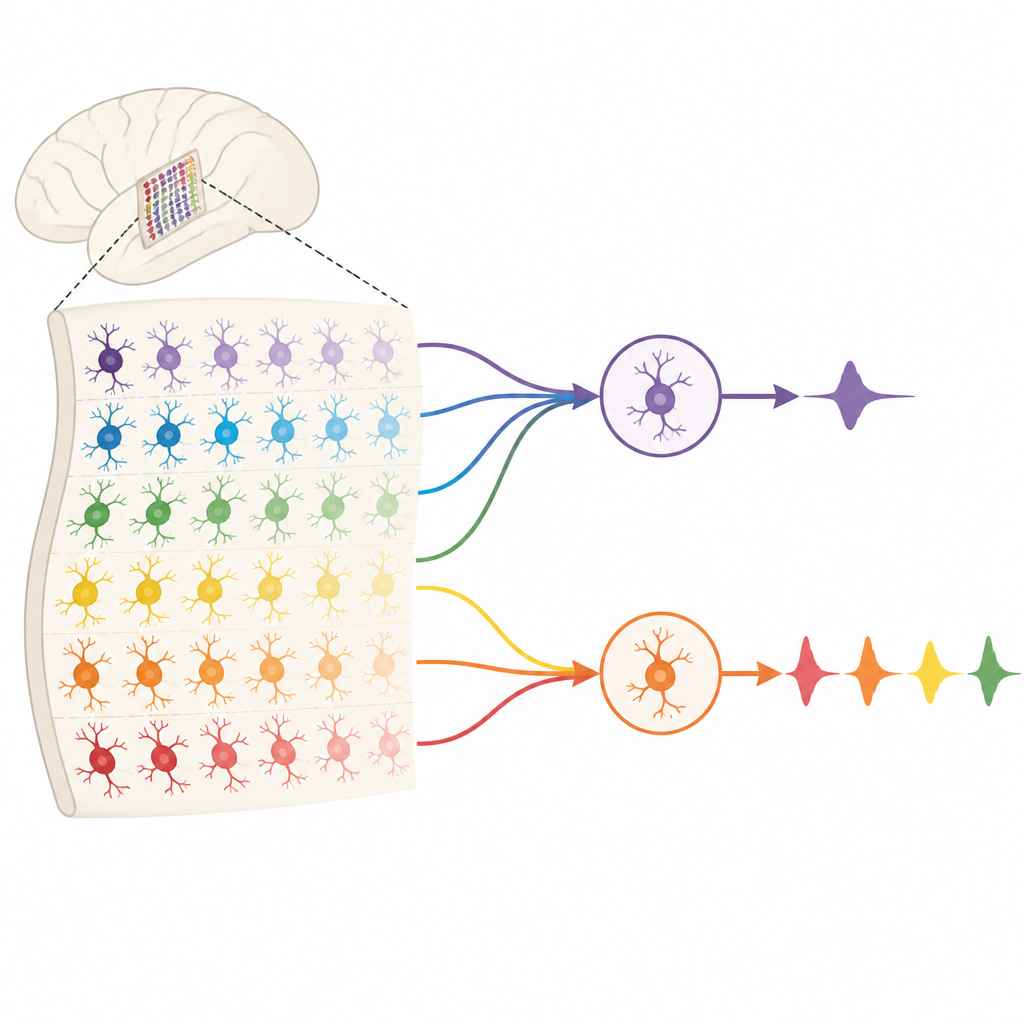
Not all neurons behaved the same. When the researchers played pure tones, they found that some neurons preferred low frequencies, others high frequencies, and many responded to both low and high tones. These tuning profiles matched how neurons behaved around vocalizations. Cells tuned to higher frequencies, similar to echolocation calls, were more active before and after echolocation pulses. Cells tuned to lower frequencies favored communication calls. Broadly tuned neurons were especially sensitive to whether a communication call would be a single syllable or a multi syllable sequence, hinting that they help encode temporal complexity rather than just pitch.
Why this matters for understanding brains and voices
Overall, the study shows that neurons in the bat auditory cortex do not simply react to sounds after they occur but also carry detailed information about upcoming vocal output. They signal whether the animal will emit a navigation pulse or a social call and whether that call will be short and simple or extended into a sequence. To a layperson, this means that the part of the brain usually thought of as a listener also takes on the role of a planner. Such predictive signals may help the bat prepare for the rapid echoes and social replies that follow its own calls, and they may share principles with how human brains prepare for spoken words.
Citation: Babl, S.S., Röhrig, D. & Hechavarría, J.C. Neurons in the bat auditory cortex encode class and complexity of future vocalizations. Commun Biol 9, 699 (2026). https://doi.org/10.1038/s42003-026-10319-4
Keywords: bat vocalizations, auditory cortex, echolocation, neural prediction, vocal control