Clear Sky Science · en
The formation and function of intercellular bridges in male germlines
Hidden bridges that help make sperm
Deep inside the testes, young germ cells must coordinate their growth, share resources, and safely reshuffle DNA to produce sperm. This review article explains how tiny open tunnels called intercellular bridges link developing germ cells into networks, allowing them to share contents and messages. Understanding these bridges sheds light on male fertility, how genes are passed on, and why similar cell-to-cell connections appear across the animal kingdom.
Cell assemblies linked by tiny tunnels
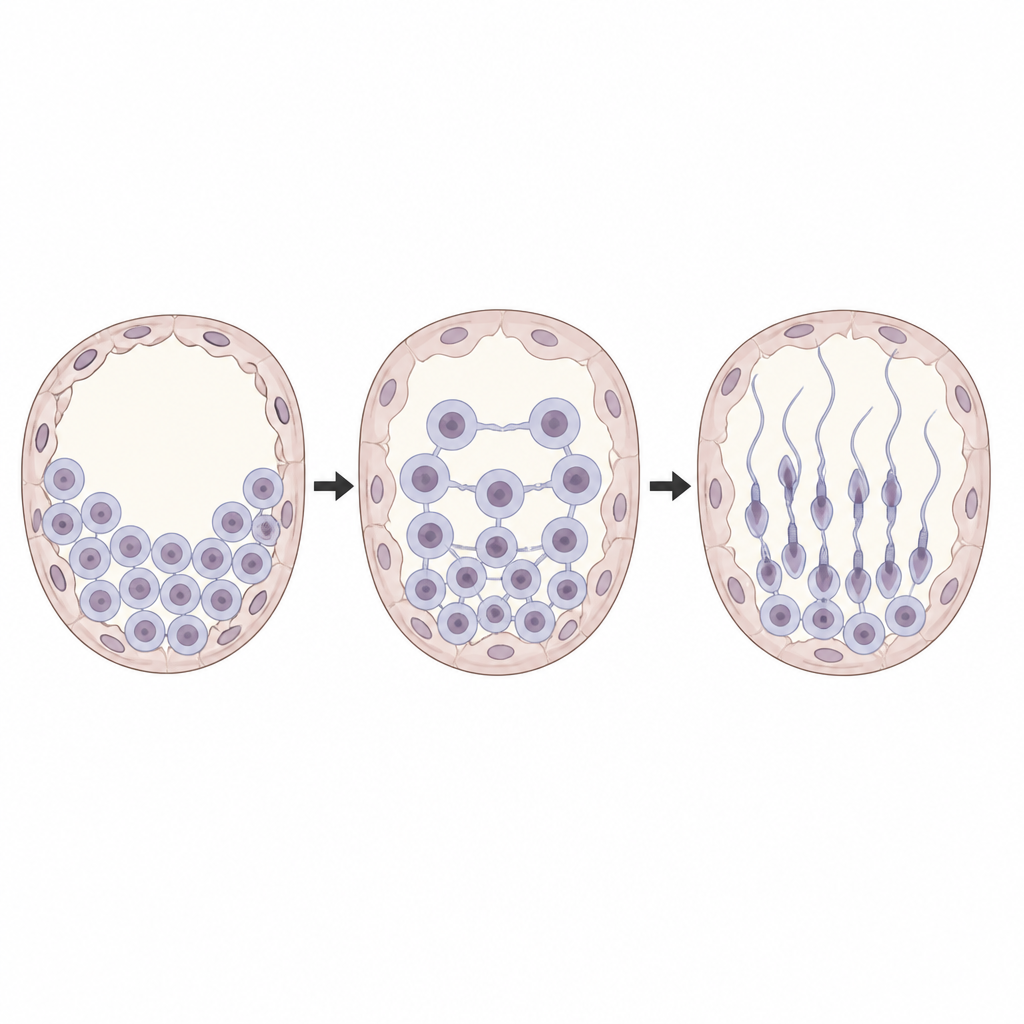
Rather than developing as isolated units, male germ cells often form clusters called cysts, in which sister cells stay connected by intercellular bridges. These bridges are surprisingly wide for a cell structure, large enough to let not only small molecules but also RNA, proteins, and even organelles pass from one cell to another. First noticed under the microscope more than a century ago and once thought to be short lived, the bridges are now known to be stable channels that can knit together hundreds of related cells from their first divisions to the final stages of sperm formation. The way cells are connected, whether in chains, branches, or spoke-like patterns around a central hub, records the history of cell divisions within each cyst.
How bridges are built and kept open
The authors describe how bridges form when cell division stops just short of completion, a process called incomplete cytokinesis. Work in fruit flies and mice shows that the same core machinery that normally pinches cells apart is reused to produce a lasting tunnel between them. Proteins that organize the shrinking ring of contractile fibers and the dense midbody at the center of a dividing cell are rearranged into a stable ring that rims the bridge. In fruit flies, this ring is rich in scaffold proteins and a family of structural proteins called septins, while in mice it relies more heavily on actin fibers and testis specific proteins such as TEX14, which blocks the final cut that would normally separate daughter cells. Special lipids with unusual long tails help the highly curved bridge membrane stay intact, and defects in these lipids or in key bridge proteins often lead to abnormal cell clusters and male infertility in animal models.
Sharing tools and keeping pace
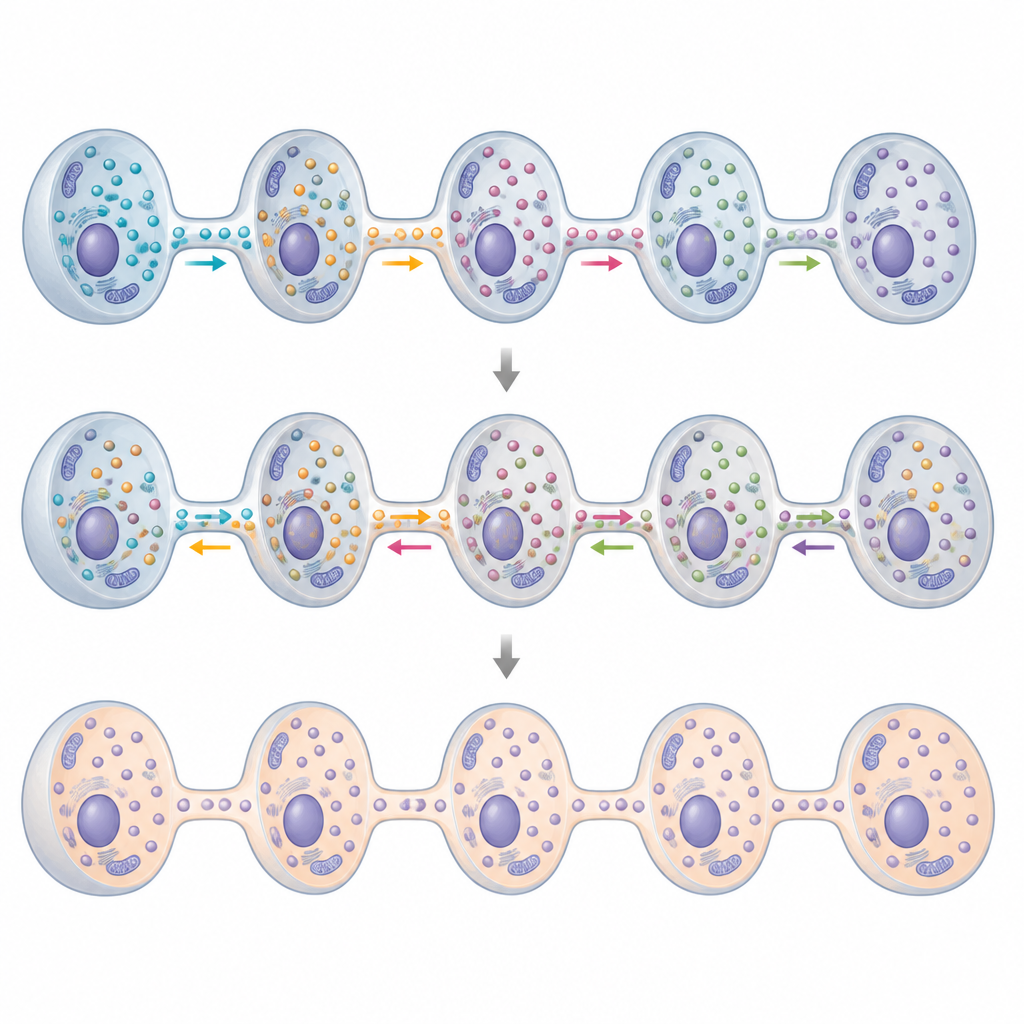
Once formed, the bridges act as miniature highways between germ cells. Experiments in flies and rats show that fluorescent proteins, small vesicles, and RNA rich structures can move through these passages, suggesting that cells share many of the products of their genes. This sharing appears especially important after meiosis, when sperm precursors carry either an X or a Y chromosome and so do not all have the same set of active genes. Bridges allow gene products made in one haploid cell to reach its neighbors, helping equalize their contents so that all developing sperm can function properly. The same connections also seem to help cells within a cyst divide and mature in step, as animals lacking bridges show delayed and unsynchronized germ cell development.
Guarding quality and tracing deep evolutionary roots
Intercellular bridges may also serve as quality control hubs. In fruit flies, for example, DNA damage in only a few cells of a connected cluster can trigger the loss of the entire group, suggesting that connectivity makes the system more sensitive to problems that could threaten future offspring. Across animals, bridges between male germ cells are strikingly widespread, from simple sponges to mammals, although some species appear to have lost them and may rely on alternative strategies. A comparison of genomes shows that some bridge building proteins are ancient and conserved, while others, such as TEX14 in vertebrates, are more recent additions that refine how bridges are stabilized and regulated.
Open questions for future fertility research
The review concludes that while the basic picture of how bridges form and what they can carry is emerging, many questions remain. Researchers still need to clarify exactly how specific RNAs and proteins are selected for transport, why some gene products are shared while others are kept private, and how bridge components work together with unusual lipids to maintain the right shape over long periods. New live imaging, high resolution microscopy, and tools that can rapidly remove individual proteins in model organisms such as fruit flies promise to reveal how these cellular tunnels contribute to safeguarding genetic information, coordinating cell behavior, and ultimately producing healthy sperm.
Citation: Cui, J., Cheng, J., Wu, B. et al. The formation and function of intercellular bridges in male germlines. Commun Biol 9, 723 (2026). https://doi.org/10.1038/s42003-026-10200-4
Keywords: spermatogenesis, intercellular bridges, germ cells, male fertility, cell communication