Clear Sky Science · en
Phage bioaugmentation reveals the potential of lysogeny for soil bioremediation
Viruses That Help Clean Dirty Soil
Across the world, soils are laced with toxic metals, pesticides, and industrial chemicals that threaten our health, food, and water. Traditional clean-up methods often struggle because the very microbes that can break down pollutants are weakened by the harsh conditions they are meant to fix. This article explores an unexpected ally in the fight against pollution: bacteriophages, the viruses that infect bacteria. Instead of seeing them only as microbial killers, the authors show how certain phages can lend new abilities to soil bacteria, turning them into stronger, more versatile clean-up crews.
Why Polluted Soils Are Hard to Fix
Soil is not a uniform sponge but a patchwork of particles, pores, water, and air. This complexity hides pollutants in tiny pockets, limits how easily they move, and shapes which microbes can reach them. Heavy metals, pesticides, and petroleum compounds can cling tightly to clay or organic matter, making them hard for microbes to access. At the same time, many pollutants are toxic to the very bacteria that might degrade them, reducing microbial diversity and leaving behind only a few hardy survivors. Conventional bioaugmentation—adding selected bacteria, enzymes, or DNA—often fails in this setting because added microbes are outcompeted, introduced enzymes break down quickly, and free DNA carrying useful genes is unstable in soil.
Viruses as Gene Couriers, Not Just Killers
Certain bacteriophages, especially lysogenic phages, follow a different script from their more familiar lytic cousins. Instead of immediately bursting their bacterial hosts, they can slip their DNA into the host’s genome and lie low as “prophages,” copying themselves each time the bacterium divides. Many of these phages carry auxiliary metabolic genes—extra pieces of genetic code that tweak how their hosts use energy, handle stress, or interact with chemicals. In polluted soils, these bonus genes can include functions that help bacteria resist metals, cope with toxins, or even transform pollutants into less harmful forms. By spreading such genes among native microbes, phages can quietly reshape entire soil communities from within. 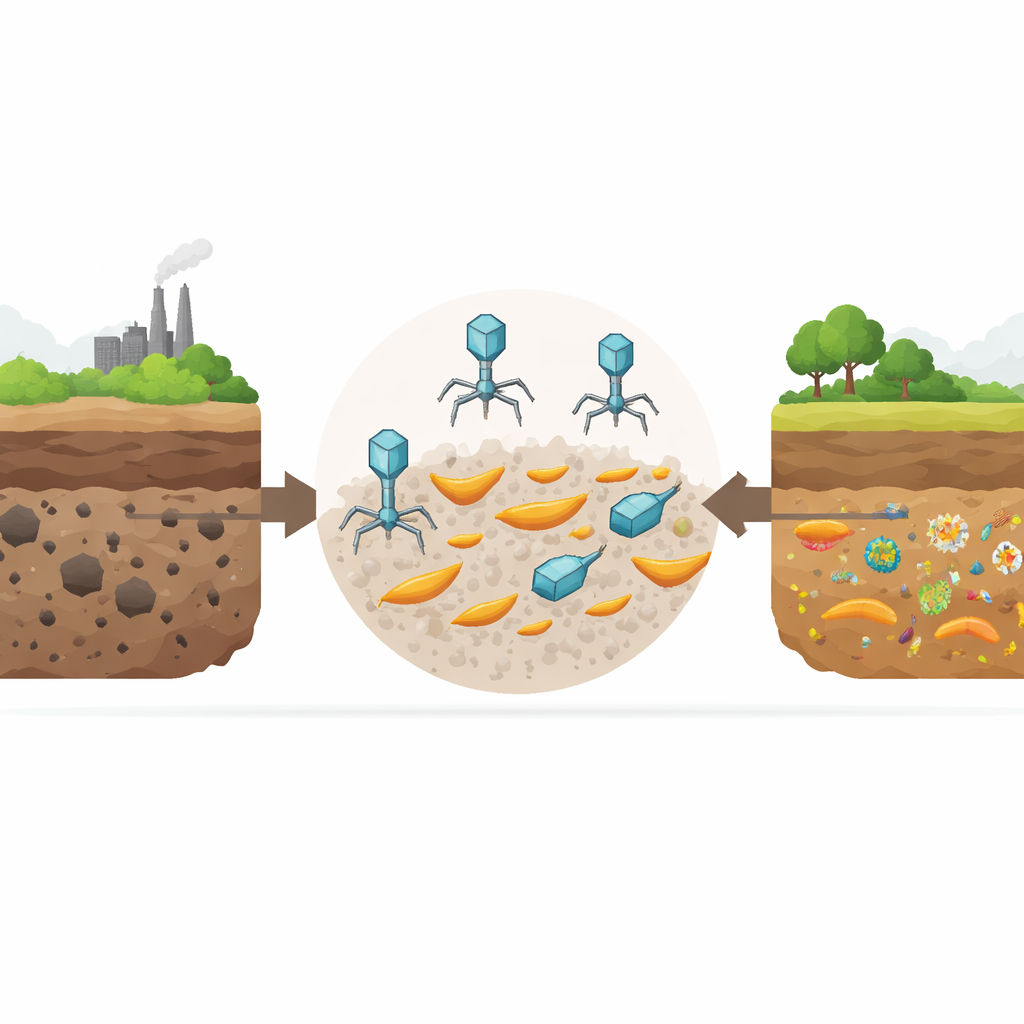
Hints From Metal- and Pesticide-Contaminated Fields
Studies of soils tainted with chromium, arsenic, and organochlorine pesticides show that phage communities respond strongly to pollution. In highly contaminated sites, lysogenic phages become more common and are enriched for genes involved in detoxification, metal transport, and resistance. Experiments in soil microcosms have found phages carrying arsenic-related genes that change the chemical form of arsenic and boost its transformation by more than a hundredfold. In pesticide-laden soils, viral genes linked to breaking down chlorinated compounds and supporting microbial metabolism are more abundant, and higher diversity of these viral genes closely tracks faster pollutant degradation. Overall, the evidence suggests that phages mainly improve clean-up by toughening and retooling bacterial communities, with occasional cases where phage-encoded functions directly attack pollutants.
A New Strategy for Helping Soil Microbes
The authors propose “phage bioaugmentation” as a next-generation approach to soil bioremediation. Instead of adding large numbers of foreign bacteria, we would select or engineer phages that carry pollutant-degrading or stress-protection genes and introduce them into contaminated sites. Because phages package and protect their DNA inside sturdy protein shells, they disperse better than naked DNA and can reach native bacteria more effectively. Once integrated, their genes are copied as the bacteria grow, meaning a small inoculum could eventually influence a large community. Carefully designed phage mixtures could spread helpful traits across several compatible host species, building redundancy into the clean-up system so that if one microbe struggles, others can take over. 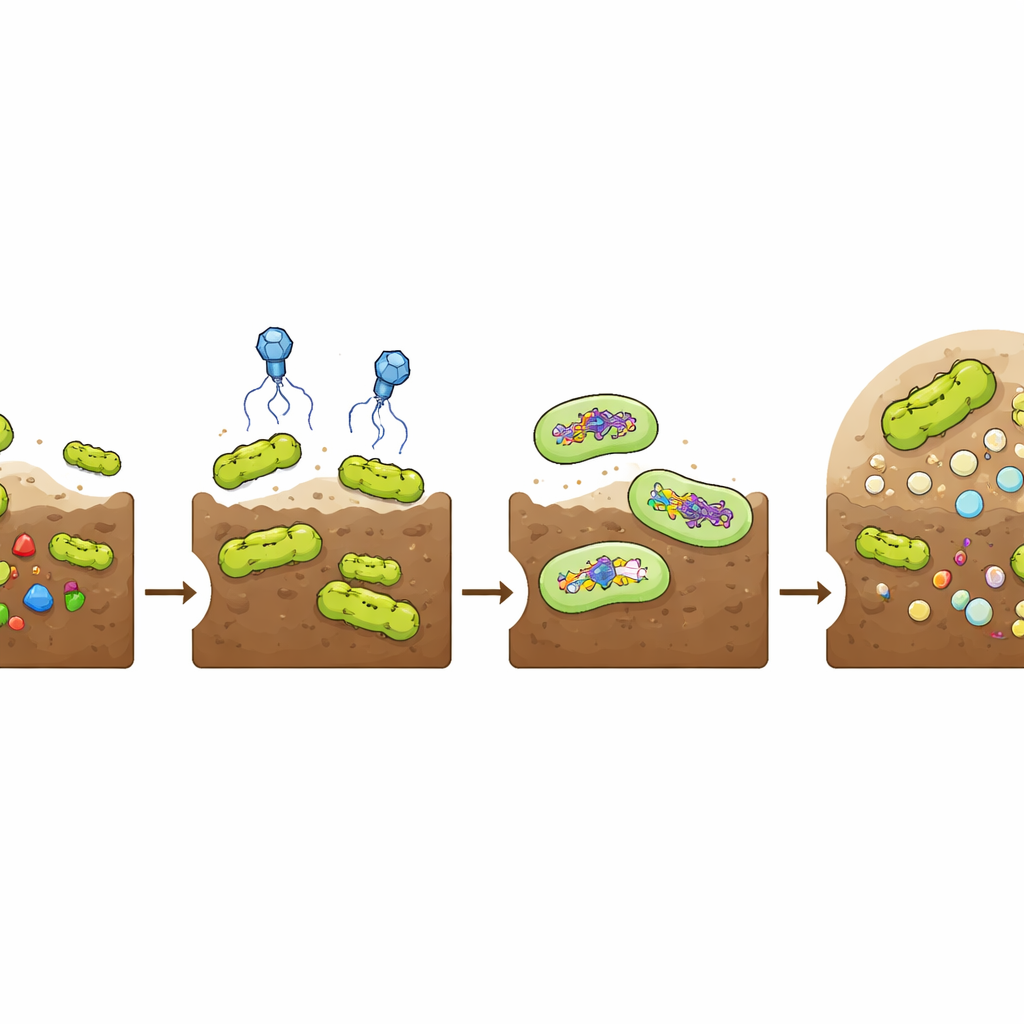
Practical Hurdles and Safety Questions
Turning this concept into field practice is far from straightforward. Soils differ in pH, texture, moisture, and mineral content, all of which influence how phages move, attach to particles, and infect hosts. Environmental stresses like drought, cold, or metal toxicity tend to favor lysogeny, which is helpful for long-term gene delivery but may shift toward more destructive lytic cycles as conditions change. Engineered phages also face evolutionary pressures: added genes may be lost or silenced if they weigh down the virus or fail to help the host enough. There are ecological and regulatory concerns as well—releasing engineered viruses into open environments demands robust tests of stability, unwanted gene spread, and potential harm to non-target organisms, along with clear oversight and risk assessment frameworks.
Looking Ahead to Cleaner, Resilient Soils
The article concludes that phage bioaugmentation is a promising but still experimental way to restore polluted soils. By using lysogenic phages as targeted gene couriers, we might help native microbial communities tolerate stress and break down contaminants more efficiently, overcoming some limitations of current bioaugmentation methods. To reach that point, researchers must better understand how phages choose between killing and integrating, how long their helpful genes stay active in complex soils, and how to monitor these processes in the field. With careful design, testing, and regulation, phage-based tools could become precise and adaptable instruments for cleaning up contaminated land while supporting robust, self-sustaining soil microbiomes.
Citation: Romeo, N., Hauptfeld, E., Yang, Q. et al. Phage bioaugmentation reveals the potential of lysogeny for soil bioremediation. Commun Biol 9, 624 (2026). https://doi.org/10.1038/s42003-026-10106-1
Keywords: soil bioremediation, bacteriophages, lysogeny, pollution, microbial ecology