Clear Sky Science · en
Astrocyte-mediated higher-order control of synaptic plasticity
How helper cells keep brain circuits in balance
Brains work because nerve cells constantly talk to each other, yet this chattering must stay under control. If activity snowballs unchecked, circuits can become noisy and unresponsive. This study explores how a lesser-known group of cells called astrocytes help keep that balance by quietly steering the strength of signals between neurons, especially in small feedback loops that can easily run away with themselves.
Signals that change from moment to moment
When one neuron signals another, it releases chemical messengers across a tiny gap called a synapse. These connections are not fixed. Their strength can change over milliseconds to seconds, a feature known as short-term plasticity. Some synapses briefly boost their output after a burst of activity, while others weaken as their supply of messenger runs low. Traditional models treat these changes as driven only by the sending neuron. The new work builds on these models but asks what happens when another player, the astrocyte, is added to the picture.
Astrocytes as quiet coordinators
Astrocytes are star-shaped cells that surround many nearby synapses at once. They can sense when synapses are active and, after building up their own internal calcium signals, release substances called gliotransmitters back onto those synapses. This feedback can raise or lower the chances that a neuron will release its chemical messengers the next time it fires. Because each astrocyte watches several connections at once, it naturally creates “higher-order” interactions: instead of each synapse acting on its own, groups of synapses become linked through a shared astrocyte.
A simple loop that easily runs wild
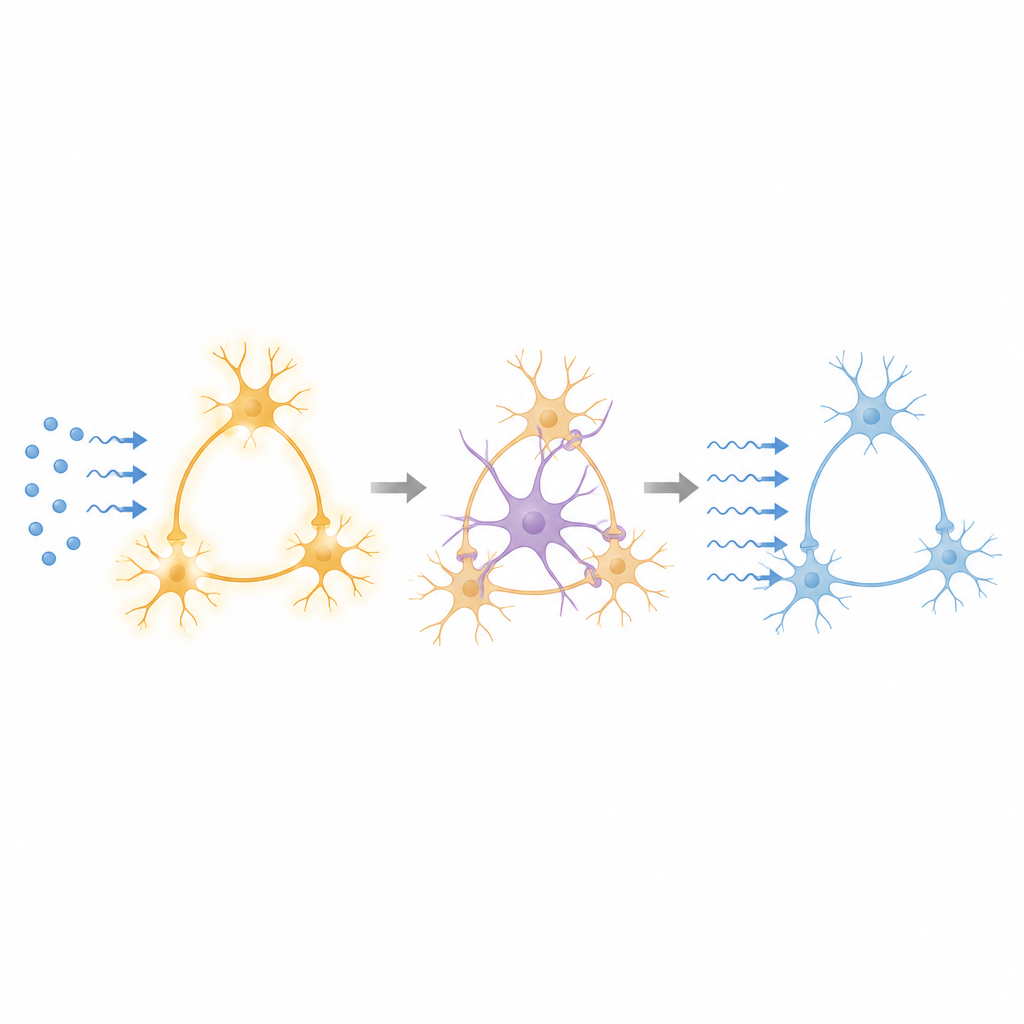
To see how this plays out, the authors built a mathematical model of a tiny circuit: three excitatory neurons arranged in a ring, where each one activates the next. One neuron receives a pulse-like input from outside, and another is treated as the output of the circuit. Without astrocytes, this loop is prone to self-sustained activity. Once signals start to circulate strongly enough, each spike triggers the next in a chain, and the circuit keeps firing even if the outside input barely changes. In this state, the loop becomes almost deaf to new information, behaving more like a stuck echo than a responsive device.
When one astrocyte watches several links
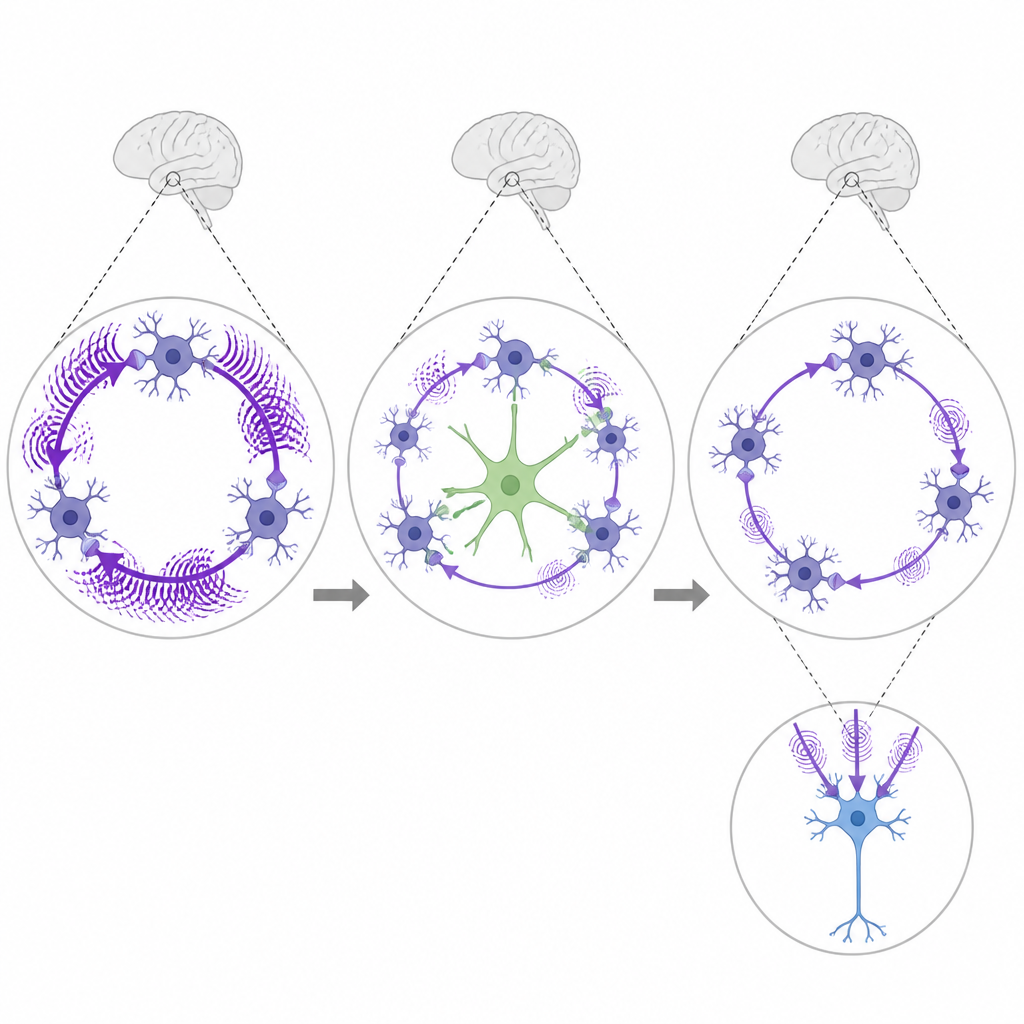
The researchers then allowed astrocytes to tap into the same chemical messengers used by the synapses. They compared “low-order” setups, where each astrocyte regulates just one synapse, with “higher-order” setups, where a single astrocyte oversees several synapses in the loop. In the higher-order case, signals from multiple synapses add up in the astrocyte, which responds by releasing gliotransmitters back onto all of them at once. This coordinated feedback lowers release probability when activity grows too strong, preventing the loop from locking into runaway firing and widening the range of conditions under which the output neuron tracks the incoming stimulus in a smooth, predictable way.
Why internal connections matter most
The model also shows that where astrocytes act is crucial. When they mainly regulate “internal” synapses that are driven by the circuit’s own activity, they stabilize the loop and let the output neuron respond reliably across a broad span of input rates. But if an astrocyte strongly controls the very first synapse that receives outside input, it can shut down signal propagation at high input frequencies, silencing the output. In larger rings of five or twenty neurons, the same pattern holds: astrocytes that link together key feedback connections help the circuit stay sensitive without tipping into chaos.
What this means for understanding the brain
To a lay reader, the main message is that astrocytes act like local supervisors of information flow. By integrating activity across several neighboring synapses and feeding back onto them, they keep small, highly connected brain circuits from becoming either overexcited or unresponsive. This higher-order style of control may be especially important in brain regions rich in feedback loops, such as the hippocampus and cerebellum, where stable yet flexible signal processing is vital for memory and coordination.
Citation: Menesse, G., Millán, A.P. & Torres, J.J. Astrocyte-mediated higher-order control of synaptic plasticity. Commun Biol 9, 684 (2026). https://doi.org/10.1038/s42003-026-10044-y
Keywords: astrocytes, synaptic plasticity, neural circuits, gliotransmission, recurrent networks