Clear Sky Science · en
The role of transthalamic pathways in perception
How the Brain’s “Middleman” Shapes What We Perceive
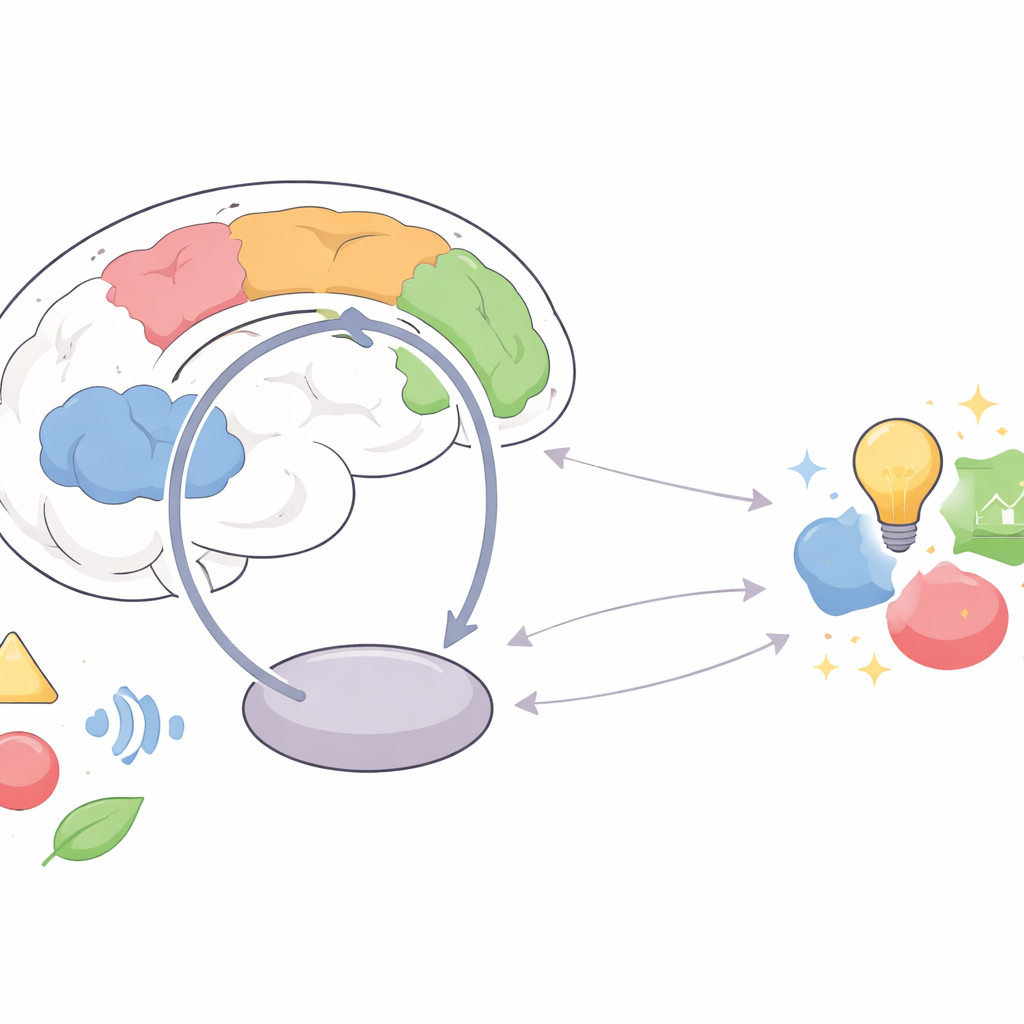
Our everyday experience feels seamless: we see, hear, and touch the world while also tracking our goals, expectations, and emotions. For decades, scientists thought that this smooth perception mostly arose from direct conversations between different regions of the brain’s outer layer, the cortex. This review argues that a hidden player—the thalamus, a structure deep in the brain—quietly reshapes this view. By acting as a powerful middleman in so‑called “transthalamic” pathways, the thalamus appears to help tie together what we sense with how we move, what we want, and what we expect, fundamentally revising how we think the brain builds perception.
A Hidden Highway Between Brain Areas
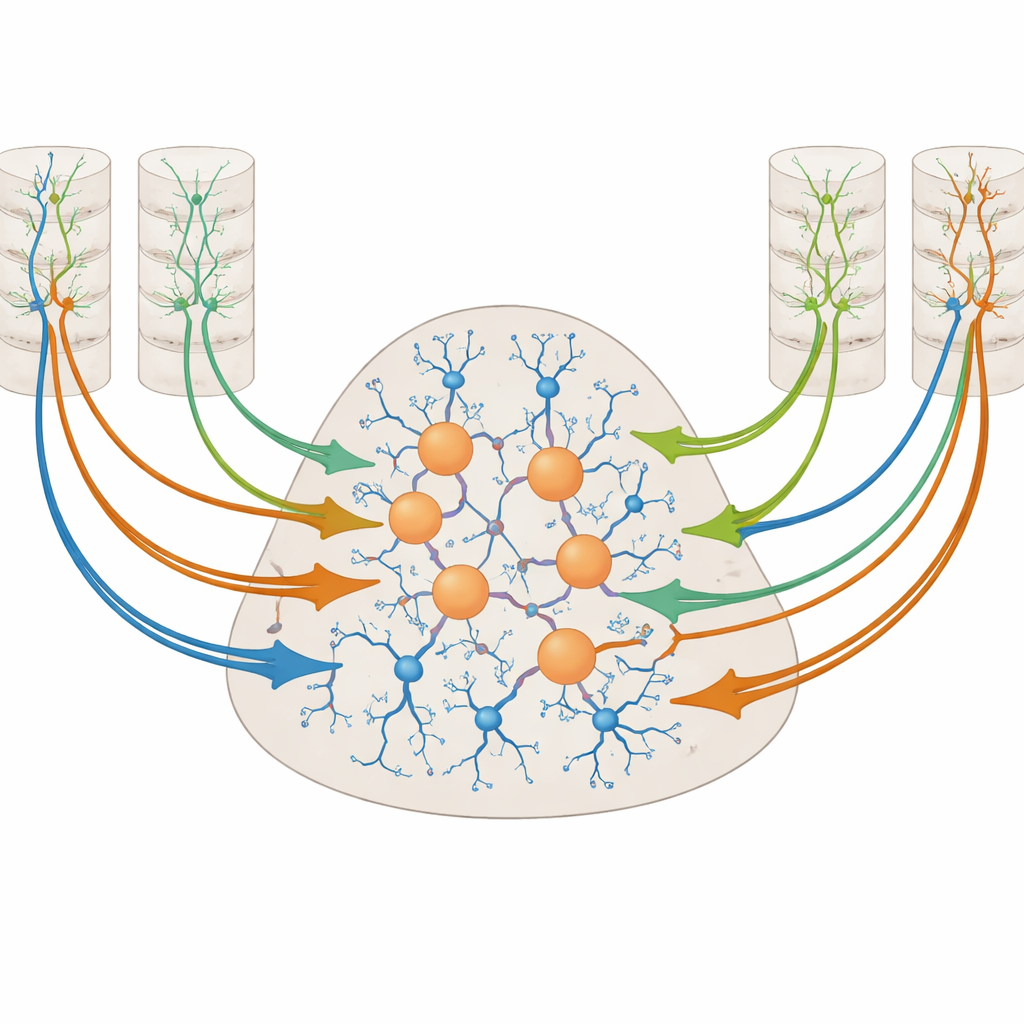
The authors describe a network motif that repeats across the brain: signals leave one cortical area, dive down to higher‑order thalamic nuclei, and then are sent on to other cortical regions. These cortico‑thalamo‑cortical, or transthalamic, routes differ from the classic direct links between cortical areas. They originate mainly from large layer‑5 neurons, the major output cells of cortex, and use unusually strong “driver” connections at their thalamic synapses. This means that, rather than gently tweaking activity, they can strongly determine what downstream cortical regions do. The same thalamic cells often branch to several target areas, creating an efficient hub that can broadcast and mix information across widespread parts of the brain.
From Touch and Sight to Movement and Thought
Drawing on recent experiments in awake animals, the review shows that transthalamic pathways are not just anatomical curiosities; they are essential for behavior. In the whisker (touch) system of mice, silencing the pathway from primary touch cortex to a higher‑order thalamic nucleus called POm severely impairs an animal’s ability to detect and discriminate textures. In the visual system, disrupting the pathway from primary visual cortex to the pulvinar thalamus makes it harder for mice to tell different orientations of visual patterns apart. In both cases, performance drops across easy and hard trials, indicating that these pathways help support the quality of perception itself rather than only fine‑tuning at the margins.
Blending Sensation with Context and Internal State
One of the most striking themes is that transthalamic routes seem specialized for weaving together raw sensory input with context, rewards, and internal state. Recordings from thalamic relays show that they carry information about movement, arousal, and the learned value of particular stimuli, not just the physical features of a sight or texture. For example, pulvinar outputs to higher visual areas encode both how the visual scene moves and how the animal is moving itself, helping the brain distinguish changes caused by self‑motion from those in the outside world. Similarly, higher‑order thalamic activity tracks which textures are rewarded and can shift how downstream cortical areas favor those stimuli. In frontal brain circuits, related transthalamic loops linking prefrontal cortex and mediodorsal thalamus support working memory, rule switching, and flexible decision‑making.
Gating, Prediction, and the Stability of Experience
The review highlights that higher‑order thalamic nuclei are not simple relays; they are dynamic gates. Individual thalamic neurons receive converging input from multiple cortical and subcortical sources, as well as strong inhibitory control from regions such as the basal ganglia and zona incerta. This wiring allows the thalamus to turn particular cortical‑to‑cortical routes on or off, or to favor bottom‑up sensory signals, top‑down expectations, or a blend of both depending on context. Such gating may underlie predictive processing—using motor commands to anticipate upcoming sensations and flagging mismatches when predictions fail. Persistent activity in thalamo‑cortical loops also positions these pathways as candidates for maintaining short‑term percepts and working memories, and their specialized action on key cortical neurons has led some theorists to propose a central role in conscious experience itself.
Why This Rethinks How the Brain Computes
Overall, the article concludes that transthalamic pathways are core components of how the brain computes, not side channels. By carrying strong, carefully integrated signals from layer‑5 cortical neurons through higher‑order thalamus and back into cortex, they help determine what we perceive, how we link perceptions to actions and rewards, and how flexibly we adjust behavior when circumstances change. Future advances in circuit‑specific tools will be needed to manipulate entire transthalamic loops at once, but the emerging picture is clear: the thalamus functions as a flexible hub that transforms and routes information across the cortical hierarchy, challenging cortex‑centric models and reshaping theories of perception, learning, and consciousness.
Citation: Koster, K.P., Mo, C. The role of transthalamic pathways in perception. Commun Biol 9, 585 (2026). https://doi.org/10.1038/s42003-026-10042-0
Keywords: thalamus, perception, cortical circuits, neural pathways, cognitive flexibility