Clear Sky Science · en
Anticipatory postural control emerges from a predictive and optimized strategy for movement preparation
How the Body Prepares for a Sudden Sway
Imagine standing on a train just before it starts to move. Without thinking, you tense certain muscles and subtly lean so you do not lose your balance. This study explores how people prepare their bodies in advance for an expected disturbance, such as the floor tilting beneath their feet, and asks whether these quiet adjustments can be explained as the brain predicting the future and planning movements in an efficient way.
A Subtle Lean Before the Floor Moves
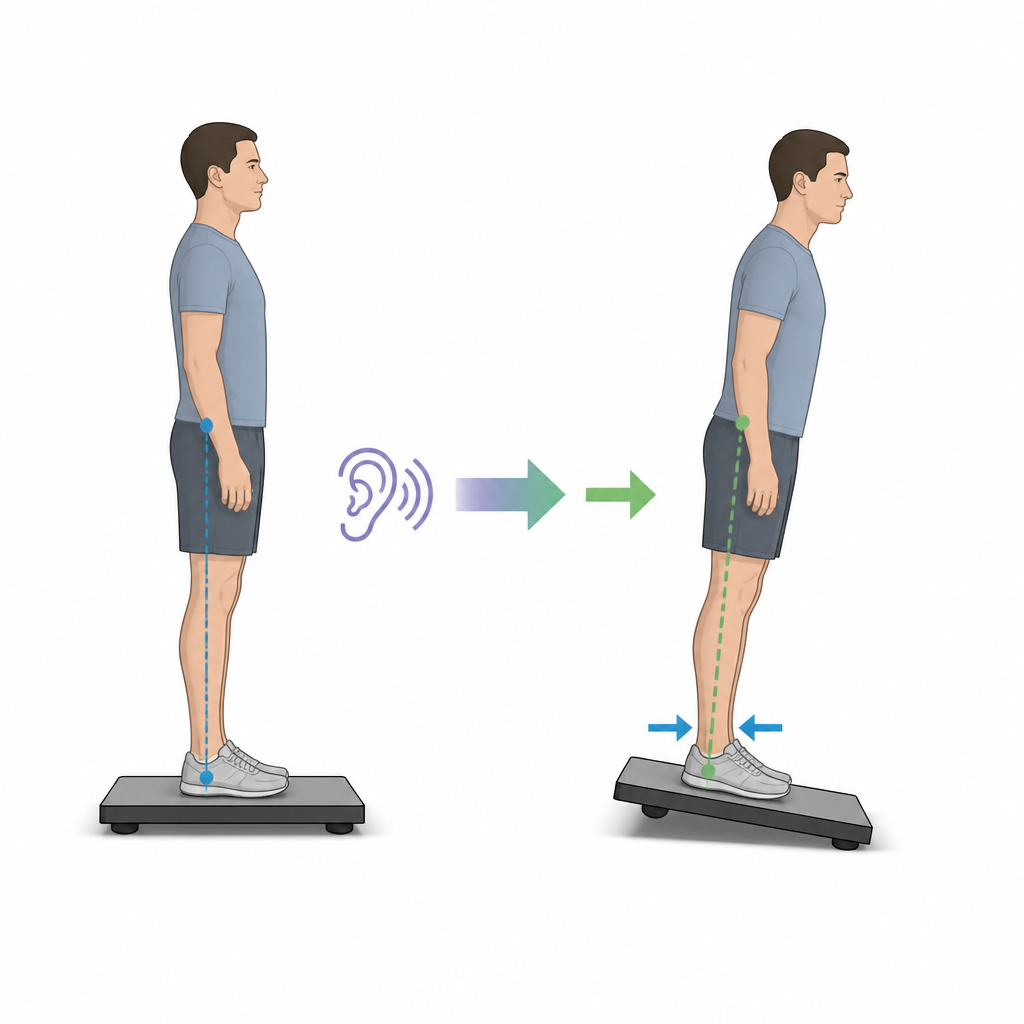
In the experiments, volunteers stood upright on a platform that could slowly tilt their toes upward, pushing their bodies backward. Sometimes the platform tilted without warning. Other times, a brief sound signaled that the tilt would begin about two seconds later. With this advance warning, many participants shifted their body weight forward before the floor actually moved. The center of mass, a point that captures where the body’s weight is concentrated, crept a few centimeters toward the toes, and the resulting tilt of the body helped reduce how much they swayed once the platform started to move.
The Surprising Role of the Calf Muscles
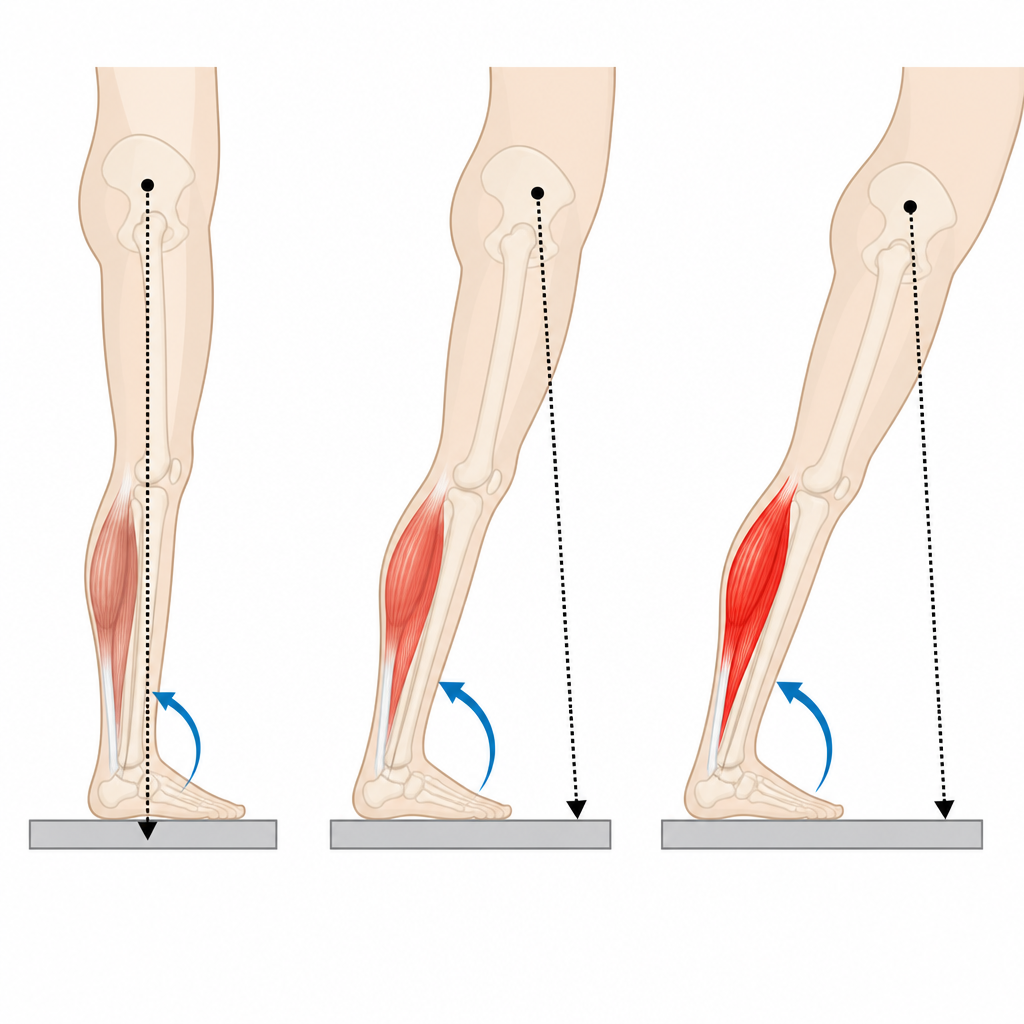
When the body leans forward, it might seem natural to expect the muscles on the front of the lower leg to pull the body in that direction. Instead, the researchers found that the key player was the large calf muscle at the back of the lower leg. As the center of mass moved forward after the warning sound, activity in this muscle steadily increased, while the muscle on the front of the shin stayed mostly quiet. At first glance, this is puzzling, because the calf muscle pulls the body backward at the ankle. The data showed that the more the body’s center of mass shifted forward, the more strongly this backward-acting muscle was engaged.
Letting Gravity Do Part of the Work
To make sense of this counterintuitive pattern, the team used ideas from control engineering and built a computer model of a simplified human body. In this model, two linked rigid segments stood on a tilting floor and were driven by virtual muscles. A control system continuously predicted how the body would move over the next few seconds and picked muscle signals that would keep the body stable while using as little effort as possible. When the model “knew” a backward floor tilt was coming, it naturally produced the same behavior as the human volunteers: the body’s center of mass shifted forward and the simulated calf muscle grew more active, even though its pull was backward. The model showed that by briefly relaxing muscles first, gravity could tip the body forward like a gentle fall, and then the calf muscle could act as a brake, catching the body at a safer position before the floor began to tilt.
Efficient Planning, Not Just Reflexes
The researchers also explored how changing the rules of the control system affected these preparatory moves. When muscle effort was not penalized, the model relied more on active pulling to hold posture. When the system was pushed to save energy, the strategy that emerged was to exploit gravity, shifting the body forward mostly through passive tipping and using the calf muscles to prevent collapse. The amount of forward shift depended on how large a disturbance the model expected, but it did not lock the body into one fixed posture; instead, it produced a similar size of forward move across different starting stances. Additional model tweaks reproduced quick, reflex-like muscle bursts that occur right after the floor starts to move, suggesting that predictive planning and rapid reflexes can work together.
Why This Matters for Balance and Health
Overall, the study supports the idea that anticipatory postural control arises from the brain’s ability to predict upcoming changes and to choose muscle patterns that use gravity to its advantage while keeping balance. Rather than simply reacting when the floor moves, the nervous system quietly adjusts posture ahead of time, shifting the center of mass and tuning muscle activity so that the coming disturbance is easier to handle. Understanding these predictive strategies may help explain why some neurological conditions, such as disorders affecting the cerebellum or Parkinson’s disease, lead to difficulties with standing and walking, and could guide new training or rehabilitation methods that restore the body’s ability to prepare for the unexpected.
Citation: Funato, T., Ogawa, M., Konosu, A. et al. Anticipatory postural control emerges from a predictive and optimized strategy for movement preparation. Commun Biol 9, 629 (2026). https://doi.org/10.1038/s42003-026-10016-2
Keywords: postural control, balance, anticipatory movement, gravity and movement, motor control