Clear Sky Science · en
A compatible gravity-driven organoid perfusion (GDOP) platform for drug screening with sensitivity and toxicity process evaluation
Why tiny lab grown tissues matter for cancer care
Choosing the right cancer drug is often a race against time, and current tests do not always predict how a person will respond. This study introduces a small, gravity powered chip that grows miniature versions of human tissues, called organoids, and uses them to test cancer drugs more quickly and more safely. The work points toward lab tools that could one day help doctors match treatments to each patient while also checking for harmful side effects on healthy organs.
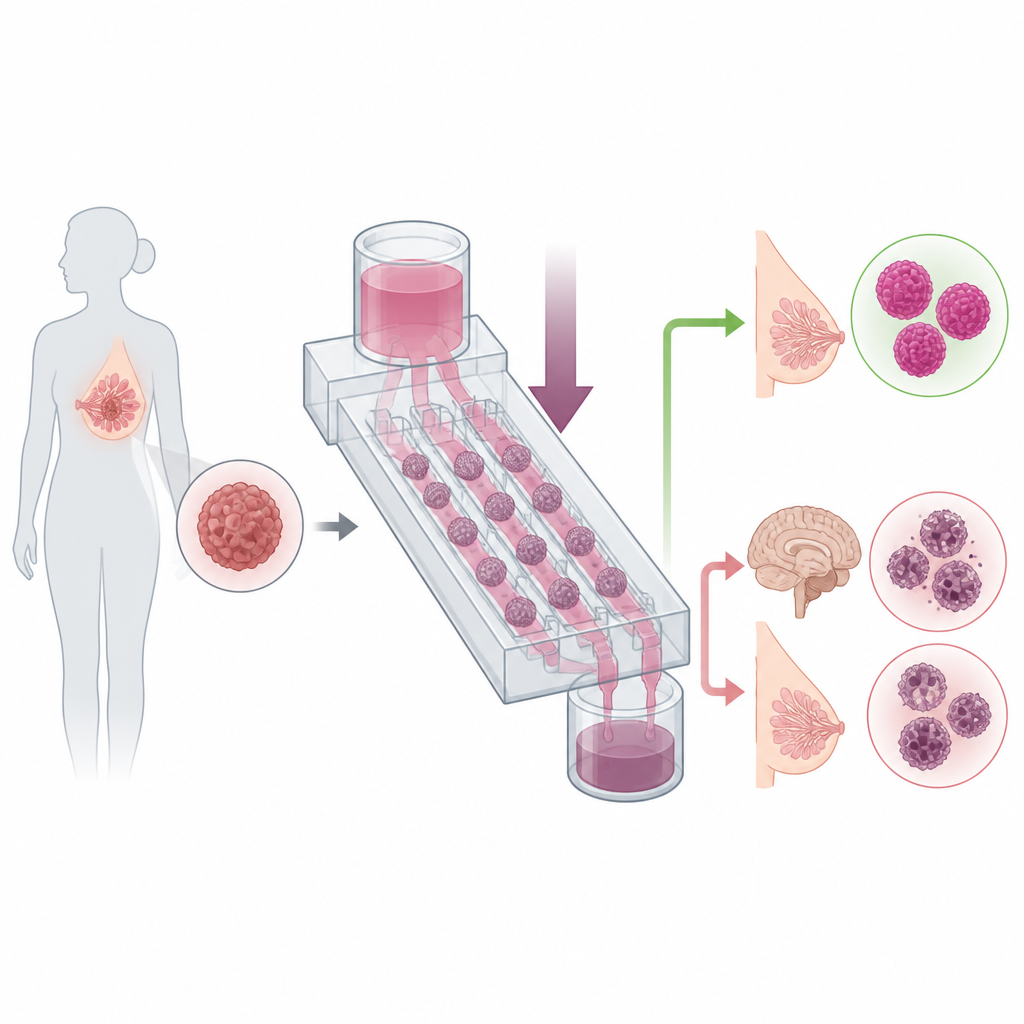
A small chip with many tiny rooms
At the heart of the study is a clear plastic chip about the size of a matchbox. Inside, six narrow channels each hold eight cup shaped chambers where organoids can grow in three dimensions. A small reservoir at one end holds fresh nutrient liquid, while a lower waste container at the far end collects used fluid. Because the reservoir is slightly higher, gravity gently pulls liquid in one direction across all the chambers, washing the organoids with a steady stream of food and oxygen without any pumps or tubing. Special traps catch air bubbles and side pockets collect stray cells, helping each chamber form organoids of similar size.
Letting gravity do the hard work
The team used computer simulations and experiments to fine tune how fast liquid and cells move through the chip. By adjusting the speed at which cell containing liquid is added, they found settings that avoid air pockets and spread cells evenly across the chambers. Further tests showed that the slow, smooth flow inside each chamber stays calm rather than turbulent, and that nutrients are carried efficiently downstream while waste products are flushed away. This simple layout keeps the growing organoids in a stable environment that resembles the gentle flow of fluid around tissues inside the body.
Testing cancer drugs and healthy tissue side by side
To show what the chip can do, the researchers grew organoids from a highly aggressive form of breast cancer called triple negative breast cancer, along with ball shaped clusters from a normal breast cell line. They then exposed both types to several chemotherapy drugs at different doses by letting drug containing liquid flow across the chip twice a day. Over several days, cameras recorded changes in organoid size and brightness, and a deep learning program traced their outlines automatically. Cancer organoids shrank, darkened, or broke apart as drug strength increased, while normal breast spheroids showed harmful changes only at higher doses. A final light based test of living cells confirmed that the patterns seen in the images matched actual cell survival and allowed the team to estimate the drug concentration range that hit tumors hard while sparing normal cells.
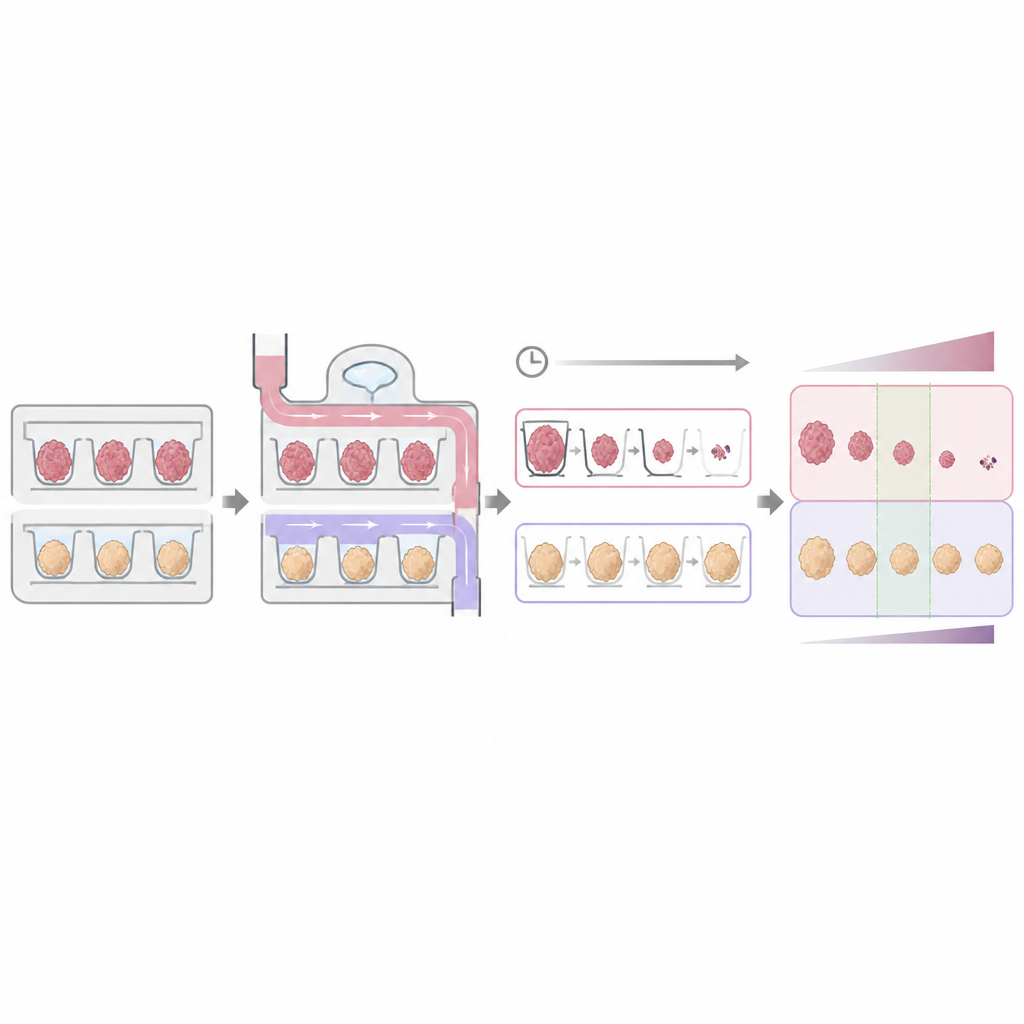
Extending the approach to brain like tissues
Drug safety is not just about tumors and nearby tissue; the brain, heart, and liver can all be affected. The researchers therefore used the same chip to grow brain organoids from human induced stem cells. Starting from single cells, the organoids formed tiny, layered brain like structures over several weeks under continuous gravity driven flow. Genetic tests, fluorescent staining, and calcium imaging showed that these organoids developed key features of early human brain tissue and displayed electrical activity, and they did so with similar quality across all channels of the chip. This suggests that the platform can host more complex organoids for future studies of how drugs might harm the nervous system.
What this could mean for future treatments
Together, these results show that a simple gravity fed chip can grow both tumor and healthy organoids, monitor their behavior in real time, and measure how they respond to cancer drugs and potential side effects. While this device is not yet a clinical tool, it offers a practical way to run many parallel tests using small patient samples and fewer animals. With further refinement and closer ties to hospital practice, similar platforms could help doctors compare options on a patient’s own organoids, finding treatment plans that are more effective against the cancer and kinder to the rest of the body.
Citation: Wang, S., Zhang, X., Ma, H. et al. A compatible gravity-driven organoid perfusion (GDOP) platform for drug screening with sensitivity and toxicity process evaluation. Commun Biol 9, 718 (2026). https://doi.org/10.1038/s42003-026-09973-5
Keywords: organoid chip, drug screening, breast cancer, microfluidics, brain organoids