Clear Sky Science · en
Genomic and transcriptomic basis of morphological and life cycle diversity in the prasinophyte alga Pseudoscourfieldia marina
Tiny algae that live two very different lives
In the open ocean, many of the most important organisms are too small to see. This study looks at a single-celled green alga called Pseudoscourfieldia marina that can look and behave in two strikingly different ways, yet both forms belong to the same species. By probing its DNA and RNA, the researchers show how one genetic blueprint can support two life stages that differ in shape, lifestyle, and possibly ecological role.
One species, two faces
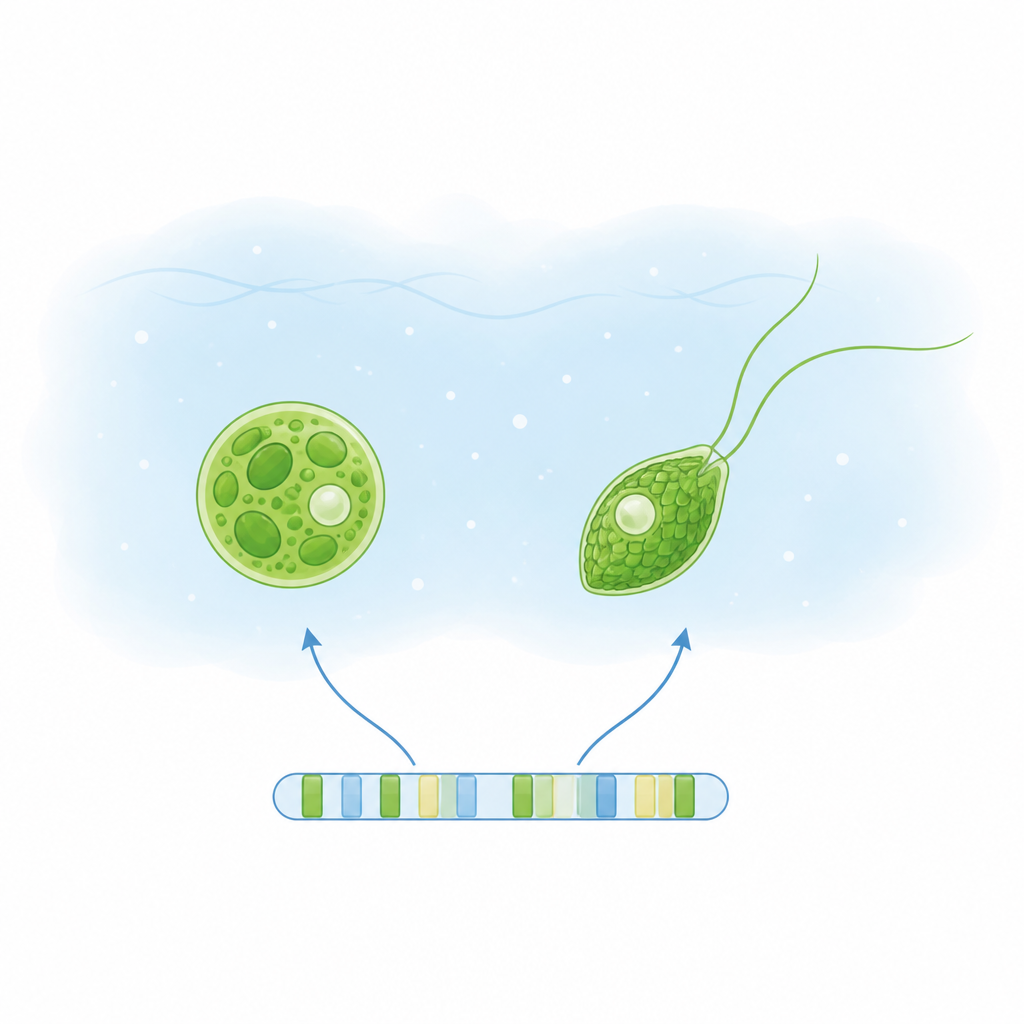
Pseudoscourfieldia marina has long puzzled scientists because it appears either as a tiny, smooth, non-swimming sphere or as a slightly larger, oval cell covered in scales and equipped with a pair of beating tails. Traditionally, such differences would suggest two separate species. Earlier work on the energy-producing and photosynthetic compartments of these cells had already hinted they were the same organism. In this study, the authors sequenced and compared the main nuclear genomes and gene activity patterns of a coccoid, non-flagellated strain and a scaly, flagellated strain to understand how such contrasting forms arise.
Similar genomes, different settings
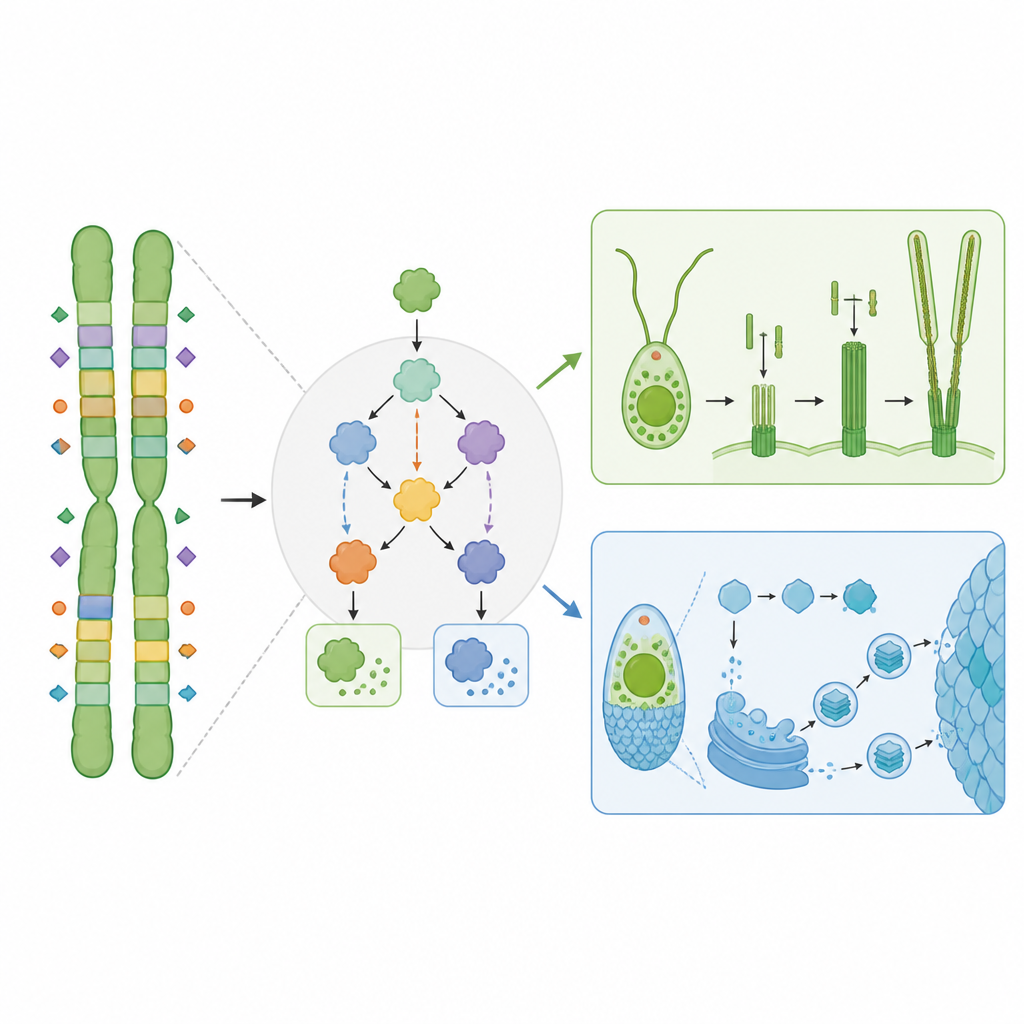
The two strains turned out to share very similar genomes. They have almost the same number of chromosomes, physical gene order, and types of genes. Yet they differ in how many copies of each chromosome they carry and in how actively their genes are used. The round, non-swimming strain is mostly diploid, carrying two copies of each chromosome, while the scaly swimming strain is mainly haploid, with one copy. Both strains also carry unusual "outlier" chromosomes rich in repeating DNA and mobile genetic elements. These special chromosomes are packed with genes involved in sugar chemistry and cell-surface molecules, and in the flagellated strain many of these genes are highly active, hinting that these regions may help the alga rapidly adjust its outer coat, perhaps as part of defense against viruses.
Building tails and coats
A central difference between the two forms is the presence of beating tails and a complex coat of scales in the swimming cells. The researchers identified 274 genes that build and run the tails, including motors, scaffolding parts, and transport machinery. Nearly all of these genes are present and intact in both strains, but in the flagellated form they are switched on at much higher levels, while in the non-flagellated form they are mostly quiet. The team also traced the molecular steps that produce a special sugar, known from land plants, that forms a key part of the scale material. They found complete pathways for making and transporting this sugar into the cell’s internal shipping center, along with large families of enzymes that assemble complex sugar-based structures on the cell surface. These enzymes are especially expanded and strongly active in the scaly strain.
A hidden sexual life cycle
Beyond shape and movement, the genomic data reveal clues to a more complicated life cycle than previously seen in single-celled green algae. The authors found nearly all of the genes that other organisms use for meiosis, the cell division process that halves chromosome number, as well as genes known to fuse haploid cells into diploid ones. Many of these genes are more active in the diploid, non-swimming strain, while others are more active in the haploid, swimming strain. This pattern suggests that the smooth coccoid cells and the scaly flagellated cells represent alternating stages in a sexual life cycle, with each ploidy linked to a distinct way of living in the water column.
Why this matters for ocean life
By combining genome structure with patterns of gene use, this work shows how a single-celled alga can shift between two life stages that look and function very differently. Rather than needing separate species or entirely different gene sets, Pseudoscourfieldia marina appears to rely on flexible control of when and where its shared genes are active, backed by dynamic chromosomes that may respond to viruses and other stresses. This kind of hidden complexity in tiny marine algae affects how they move, where they thrive, and how they interact with predators, parasites, and changing environments, adding a new layer of richness to our picture of life in the oceans.
Citation: Crépeault, O., Turmel, M., Otis, C. et al. Genomic and transcriptomic basis of morphological and life cycle diversity in the prasinophyte alga Pseudoscourfieldia marina. Commun Biol 9, 719 (2026). https://doi.org/10.1038/s42003-026-09965-5
Keywords: marine algae, life cycle, genome, cell morphology, gene expression