Clear Sky Science · en
Context-dependent indirect effects mediate ecological transitions between parasitism and mutualism
Why tiny hitchhikers on beetles matter
On the forest floor, burying beetles turn small animal carcasses into nurseries for their young. They do not arrive alone. Microscopic hitchhikers such as mites and nematodes travel on the beetles and share this rich but risky resource. This study shows that these tiny passengers can switch between helping and harming their beetle hosts depending on how many are present and how they interact with each other and with the microbes that rot the carcass.
The beetle family and its hidden companions
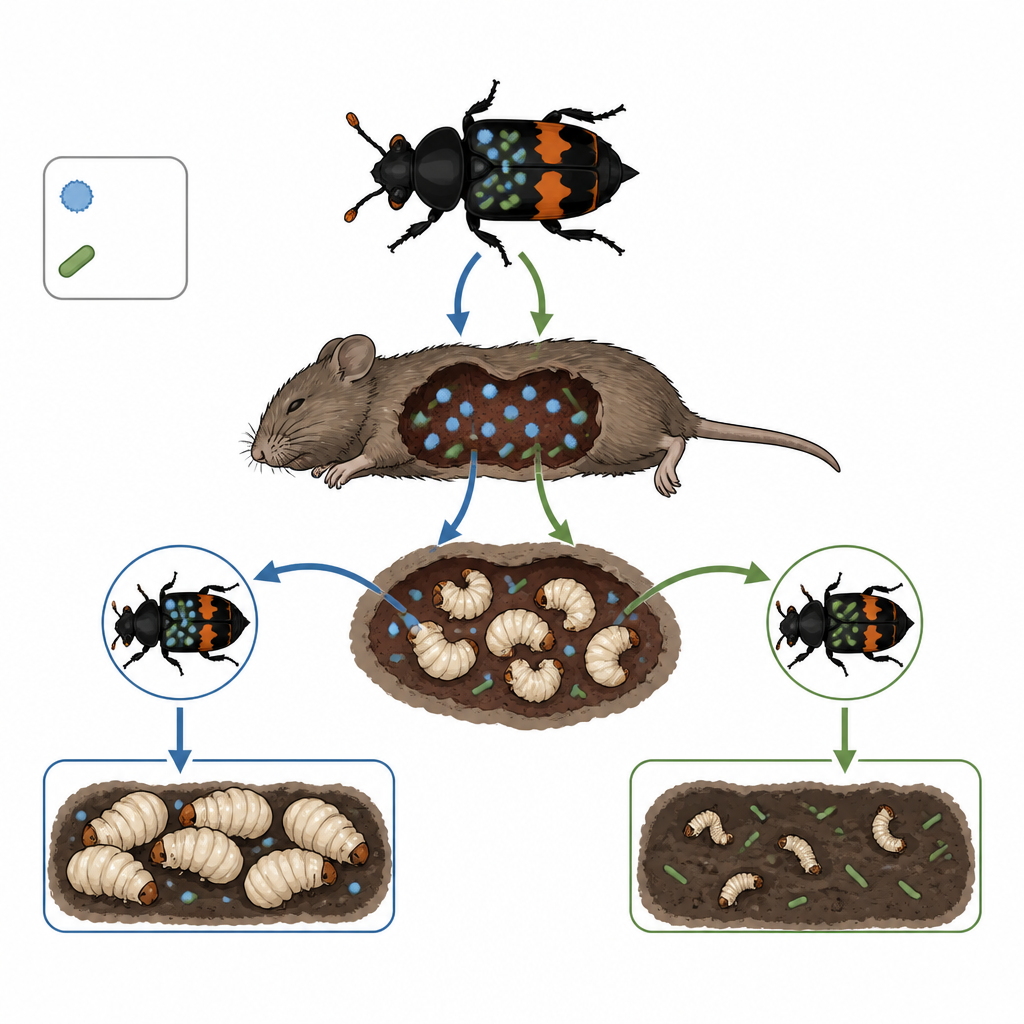
Burying beetles use the body of a small dead animal as food and shelter for their larvae. Before breeding, adult beetles pick up specialized mites and nematodes that cling to their bodies for transport. Once the beetles find a carcass and begin to prepare it, the hitchhikers drop off and start their own life cycles in the same nest. Both mites and nematodes feed on bacteria growing on the carcass, and later their offspring reattach to beetle adults or emerging young, spreading to the next breeding site. This close coexistence creates a miniature community whose members can either support or undermine beetle reproduction.
When enemies of enemies become friends
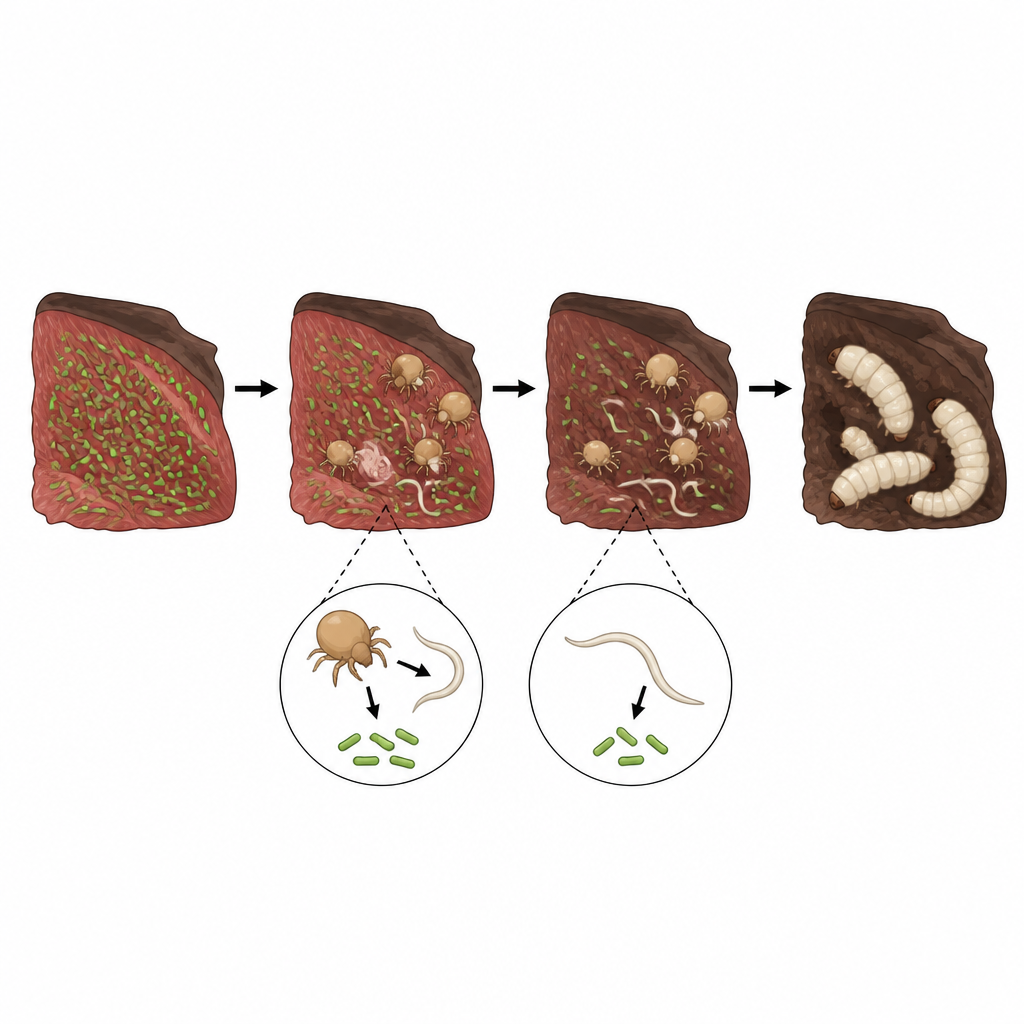
The researchers combined field surveys with controlled breeding experiments to examine how different starting numbers of nematodes and the presence or absence of mites affect beetle offspring. In the wild, many beetles carried both kinds of hitchhikers, often at modest numbers. In the lab, high nematode densities cut down the survival of beetle offspring during the vulnerable stage when larvae transform into adults. However, when mites were present alongside many nematodes, beetle survival improved. Detailed tests showed that mites actively ate nematodes, especially in a carcass-like setting, and also reduced the number of nematodes passed from parent beetles to their young.
Helping hands that can still hurt
The story was not one of simple friendship. When nematodes were rare or absent, mites became more costly to beetles. In these conditions, mites slightly boosted the body mass of surviving larvae, but overall fewer larvae made it to adulthood. This suggests that mites may sometimes compete with larvae for carcass resources or disturb them at sensitive stages. As nematode numbers rose, the balance shifted. Mites no longer increased larval mass but did protect more offspring from dying, so the net effect of carrying mites changed from mildly harmful to clearly helpful. The key point is that beetle fitness emerged from an indirect chain of interactions, rather than from the mites alone.
Shaping the unseen world on a carcass
Because beetle broods develop in a microbe-rich environment, the team also asked how mites and nematodes change the bacterial community on carrion. Both hitchhikers reduced the total number of culturable bacteria in simple lab tests, and together they reduced it the most. Using DNA sequencing, the researchers then showed that carcasses exposed to beetles plus both mites and nematodes had the strongest shifts in bacterial composition compared with untreated carcasses. Some bacteria linked to foul decay were less common, while other groups associated with different modes of breakdown became more prominent. These patterns suggest that beetles, mites, and nematodes jointly remodel the microscopic neighborhood in which larvae grow.
What this means for life’s partnerships
This work reveals that the same mite species can act like a parasite in some circumstances and like a protective partner in others, depending on nematode density and the shared microbial environment. Rather than being passive passengers, phoretic mites help control nematode numbers and reshape bacteria on carcasses, with knock-on effects for beetle survival. For a lay observer, the take-home message is that even tiny, unseen players can tip the balance between harm and help in nature, and that many of life’s partnerships are flexible relationships that shift with context instead of fixed roles of friend or foe.
Citation: Lee, YH., Lin, WJ., Tsai, MT. et al. Context-dependent indirect effects mediate ecological transitions between parasitism and mutualism. Commun Biol 9, 706 (2026). https://doi.org/10.1038/s42003-026-09945-9
Keywords: burying beetles, symbiosis, mites, nematodes, microbiome