Clear Sky Science · en
Fine mapping of a powdery mildew resistance gene PmCWI16926 from cultivated emmer wheat
Why wheat disease resistance matters
Wheat is a cornerstone of the human diet, yet its yields are constantly threatened by diseases. One of the most damaging is powdery mildew, a white, fuzzy growth that coats leaves and weakens plants. Farmers often turn to fungicides, which cost money and can affect the environment. This study explores a natural form of protection hidden in an old variety of emmer wheat, with the goal of helping modern wheat defend itself more reliably against this disease.
A tough old wheat with clean leaves
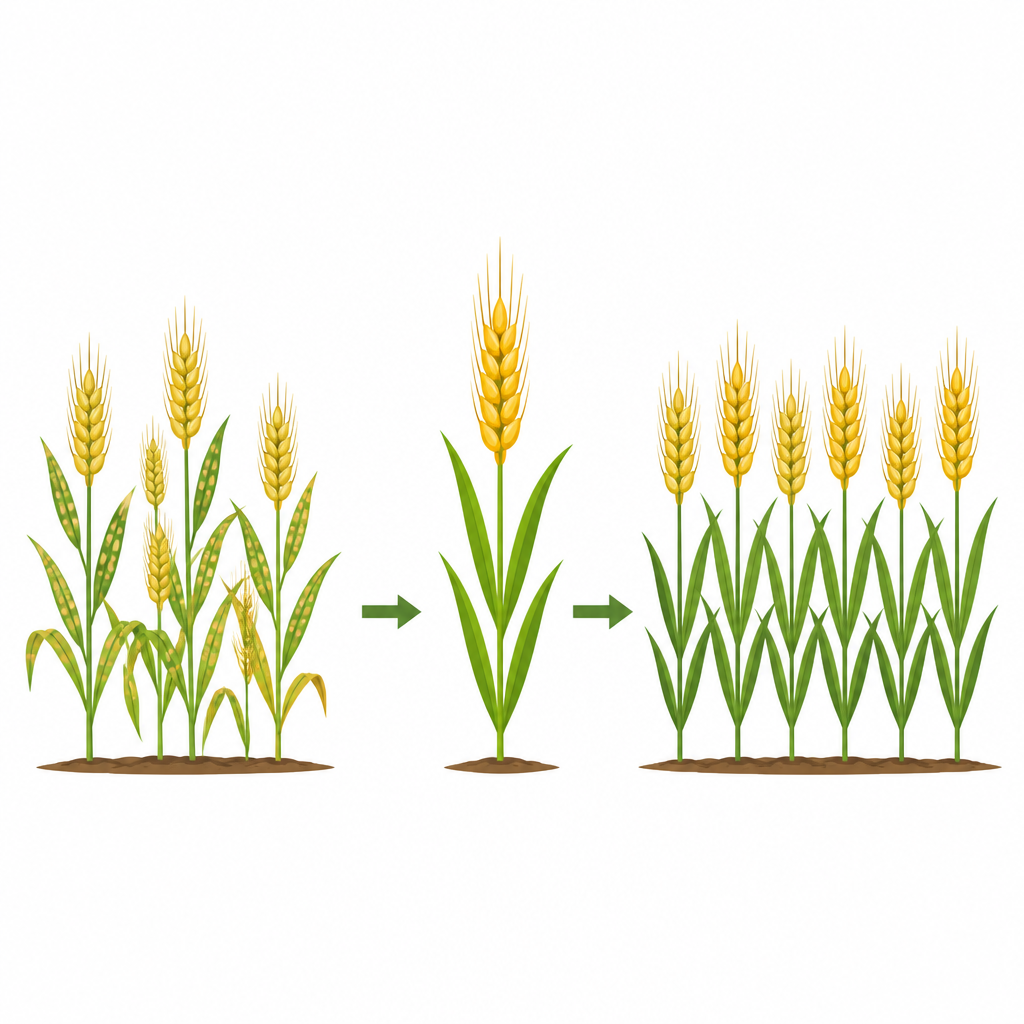
The researchers focused on a cultivated emmer wheat line called CWI16926-4Y. Unlike common bread wheat, this older relative has taller plants, dense heads, and lower yield, but it showed striking resistance to powdery mildew. Across multiple years in the field and in greenhouse tests, CWI16926-4Y stayed free of visible disease when exposed to many different strains of the mildew fungus, while a standard modern variety became heavily infected. Careful crossing experiments with a susceptible emmer variety showed that this strong protection is controlled mainly by a single dominant gene, named PmCWI16926.
Pinpointing the resistance region
Finding the exact position of a useful gene in the huge wheat genome is like locating a single house in a very large city. To narrow it down, the team used a strategy that combines classical genetics with RNA sequencing. They pooled plants that were clearly resistant and clearly susceptible, read which genes were active, and then searched for small DNA differences that tracked with resistance. This led them to a specific stretch on the short arm of chromosome 2B. By designing and testing many DNA markers in thousands of plants, they shrank the search area to a small segment of about 590 thousand DNA letters, a very fine resolution for wheat genetics.
Zeroing in on a likely defense gene
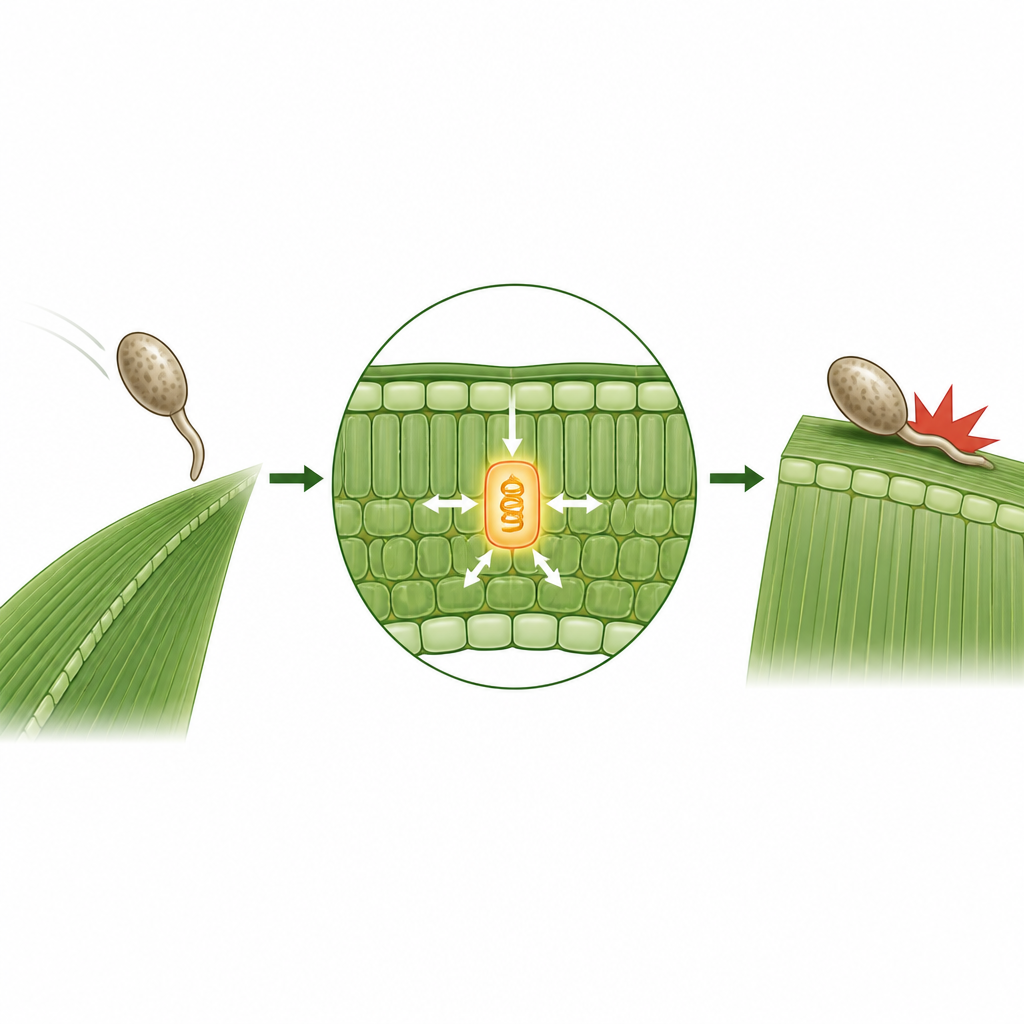
Within this narrow DNA segment, only three high-confidence genes were predicted. Two of them looked promising because they belong to a family often involved in plant immunity. The scientists then watched how these genes switched on after infection with the mildew fungus. One gene turned on more strongly in susceptible plants, suggesting it may be involved in disease rather than defense. The other, called TRITD2Bv1G010140, switched on quickly and strongly in the resistant emmer but stayed quiet in the susceptible one. When they compared its DNA sequence across many resistant and susceptible lines, they found a unique version in CWI16926-4Y that differed at four key positions in the protein, marking it as a strong candidate for being the actual resistance gene behind PmCWI16926.
Tools for breeders, not just for the lab
A discovery like this is most useful when breeders can easily move it into high-yielding wheat. To make that possible, the team developed several DNA markers that sit right next to PmCWI16926, plus one marker that directly tracks the candidate gene itself. These markers act like barcodes that can be scanned in young seedlings, allowing breeders to select plants carrying the resistance without waiting for disease outbreaks. Tests on dozens of popular Chinese wheat varieties showed that these markers clearly distinguished the resistant donor from current susceptible wheats, indicating they are ready to be used in breeding programs.
What this means for future wheat crops
For non-specialists, the main takeaway is that an old type of wheat has yielded a powerful new tool for protecting modern crops. The study identifies a compact genetic region, and a very likely single gene, that help wheat stop powdery mildew before it takes hold. Because this gene provides broad and stable resistance and comes from a close wheat relative, it should be easier to combine with other traits in breeding. Over time, using this resistance alongside others could reduce reliance on fungicides and help keep wheat harvests more secure under changing disease pressures.
Citation: Xu, X., Li, D., Wang, F. et al. Fine mapping of a powdery mildew resistance gene PmCWI16926 from cultivated emmer wheat. Commun Biol 9, 717 (2026). https://doi.org/10.1038/s42003-026-09944-w
Keywords: wheat powdery mildew, disease resistance gene, emmer wheat, marker assisted selection, PmCWI16926