Clear Sky Science · en
Reversal of ATP synthase is a key attribute accompanying cellular differentiation of Trypanosoma brucei insect forms
Why tiny parasites and their power plants matter
Sleeping sickness parasites live a double life, shuttling between the gut of tsetse flies and the bloodstream of mammals. To survive these drastic changes, they must rewire how their internal “power plants,” the mitochondria, make and use energy. This study reveals that a key molecular switch controlling a rotary enzyme in the mitochondrion helps the parasite progress through its life cycle and become infectious for humans and animals.
A molecular turbine that can run backward
Inside mitochondria sits ATP synthase, a rotary machine that normally produces most of the cell’s ATP, the basic unit of energy. Under some conditions, this turbine can flip direction and burn ATP instead, helping to maintain the electrical voltage across the mitochondrial membrane that many processes depend on. A small protein called IF1 acts as a brake that selectively blocks this backward, ATP-burning mode. Because IF1 is found in most oxygen-breathing organisms, it is thought to be a widespread way to safeguard cellular energy.
How a parasite juggles two very different lives
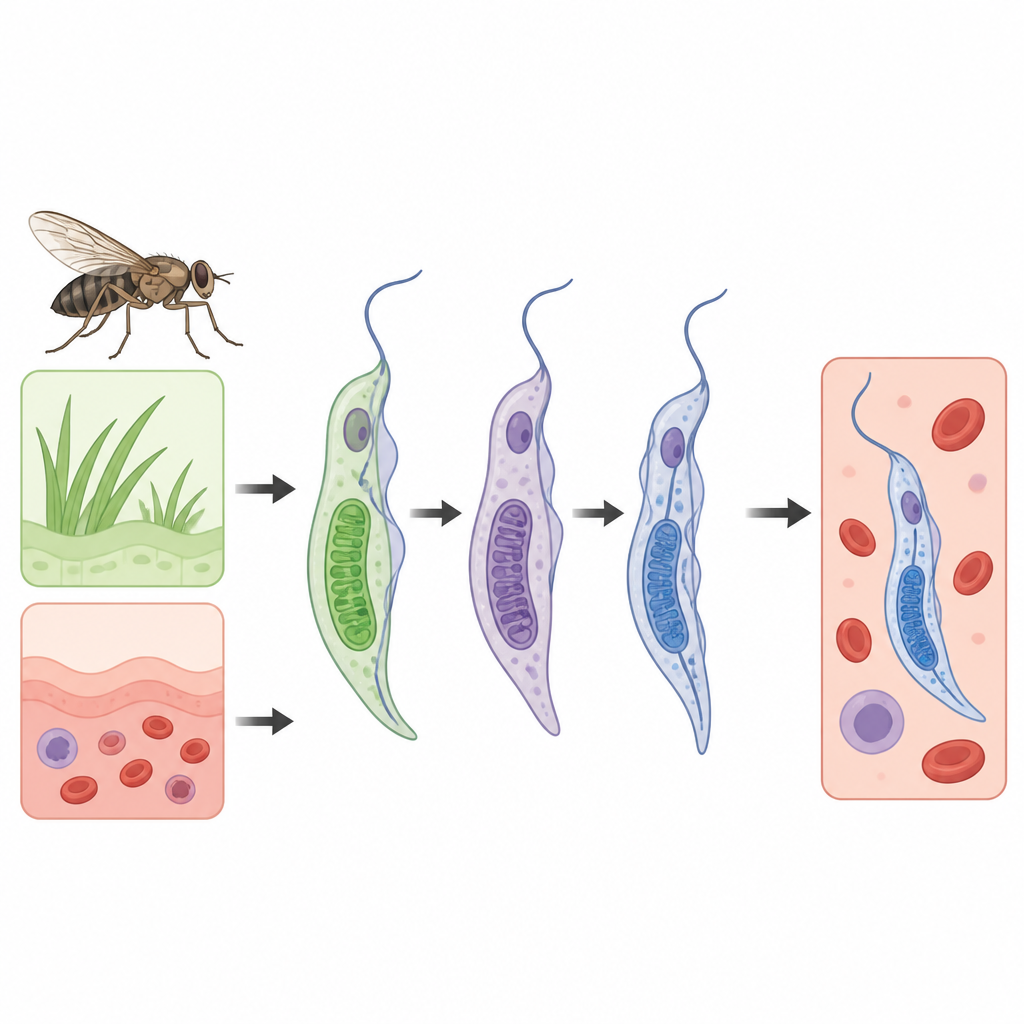
The parasite Trypanosoma brucei must adapt to sugar-rich blood in mammals and to amino acid–based diets in tsetse flies. In the bloodstream, its single mitochondrion is pared down, and ATP synthase mainly runs in reverse to keep the organelle energized while the parasite relies on glycolysis in the cytosol for ATP. In the insect midgut, by contrast, the mitochondrion is fully active, burning nutrients such as proline to drive ATP synthase in the forward direction. As the parasite moves through several insect stages and finally prepares to infect a mammal, its surface coat, metabolism, and gene activity all change in a tightly choreographed sequence.
Turning off the brake to move to the next stage
The researchers used an established laboratory system in which overproducing a regulatory protein called RBP6 forces insect-stage parasites to differentiate stepwise into epimastigote forms and then into metacyclic forms that can infect mammals. During this transition, the parasite boosts levels of an enzyme called alternative oxidase, which shunts electrons in the respiratory chain without helping to build membrane voltage, and at the same time naturally lowers levels of its IF1 protein, here called TbIF1. By genetically deleting TbIF1, the team found that parasites differentiated more efficiently, producing a higher share of mature metacyclic cells, while forced overproduction of TbIF1 largely froze the cells in an early insect-like state.
A power plant running in reverse during transition
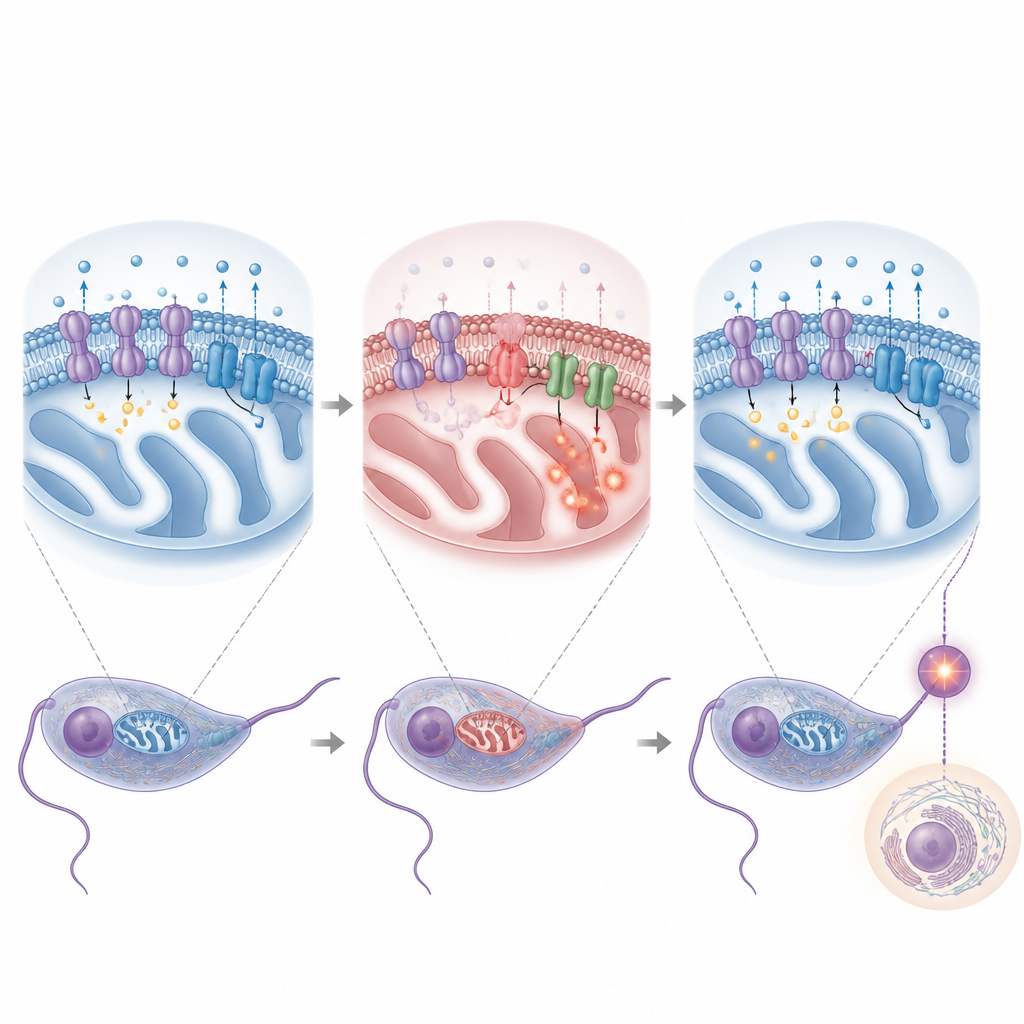
To probe what happens in the mitochondrion, the authors measured oxygen use, membrane voltage, and reactive oxygen species in different parasite lines. Loss of TbIF1 led to higher respiration on the amino acid proline and to increased mitochondrial reactive oxygen, indicating a busier electron transport chain. Using permeabilized cells and a voltage-sensitive dye, they showed that adding ATP could strongly raise mitochondrial voltage and that this effect depended on ATP synthase running in reverse, especially when alternative oxidase was active and TbIF1 was absent. In intact cells with high TbIF1, the membrane voltage dropped when alternative oxidase was induced, consistent with the idea that the brake prevents sufficient ATP synthase reversal to compensate for the leak in the system.
Energy stress signals guide parasite development
Running ATP synthase backward consumes ATP and shifts the balance toward ADP. The team measured the ADP/ATP ratio and found it rose during differentiation, more strongly when TbIF1 was missing. This was accompanied by higher total cellular reactive oxygen and by activation of AMPK, a well-known energy sensor that becomes switched on when fuel is scarce or stress is high. Parasites overproducing TbIF1 did not show AMPK activation and failed to complete differentiation, suggesting that the energy and redox changes driven by ATP synthase reversal and alternative oxidase are part of a signaling network that pushes cells into a nondividing, transmission-ready state.
Completing the life cycle and what it means
Metacyclic parasites lacking TbIF1 could be coaxed in vitro to become the long slender bloodstream forms that thrive in mammals, something that parental metacyclics in this system rarely achieved. These resulting bloodstream parasites showed the expected reliance on alternative oxidase and loss of standard respiratory complexes, confirming that proper tuning of TbIF1 is essential for a successful switch to the mammalian stage. For a lay observer, the key message is that this parasite uses a reversible molecular turbine and its dedicated brake as part of a broader control circuit that senses energy stress and helps it navigate between hosts. Understanding this finely balanced ATP synthase–IF1 axis may open ways to disrupt the parasite’s life cycle without harming our own cells.
Citation: Kunzová, M., Doleželová, E., Moos, M. et al. Reversal of ATP synthase is a key attribute accompanying cellular differentiation of Trypanosoma brucei insect forms. Commun Biol 9, 680 (2026). https://doi.org/10.1038/s42003-026-09933-z
Keywords: Trypanosoma brucei, mitochondrial ATP synthase, cell differentiation, energy metabolism, sleeping sickness