Clear Sky Science · en
The coexistence of r and K strategy in a unicellular microalga Haematococcus lacustris
How Tiny Algae Juggle Growth and Survival
All living things face a basic choice: invest in fast growth or in tough survival. This study looks at a single-celled freshwater alga, Haematococcus lacustris, and shows that it can do both. By switching between a fast-growing swimmer and a hardy, resting form, this microalga appears to combine two classic life strategies once thought to be mutually exclusive.
Two Classic Ways to Live
Biologists often describe organisms using two broad strategies. One is the "r" style, where creatures produce many offspring that grow quickly but are fragile. The other is the "K" style, where organisms produce fewer offspring that are much better at coping with stress. These ideas help explain how plants, animals, and microbes adapt to environments that may be rich or poor in resources. Until now, most species were treated as mainly one type or the other, not both at once.
One Cell, Two Very Different Lifestyles
Haematococcus lacustris is a single-celled green alga that lives in small, changeable pools of freshwater. Under comfortable conditions, it appears as small, pear-shaped swimming vegetative cells that divide quickly and soak up nutrients. In long-term cultures, the population gradually shifts to round, non-swimming cells that sink to the bottom. These non-swimming cells grow larger and heavier, build thicker outer layers, and stockpile protective materials. 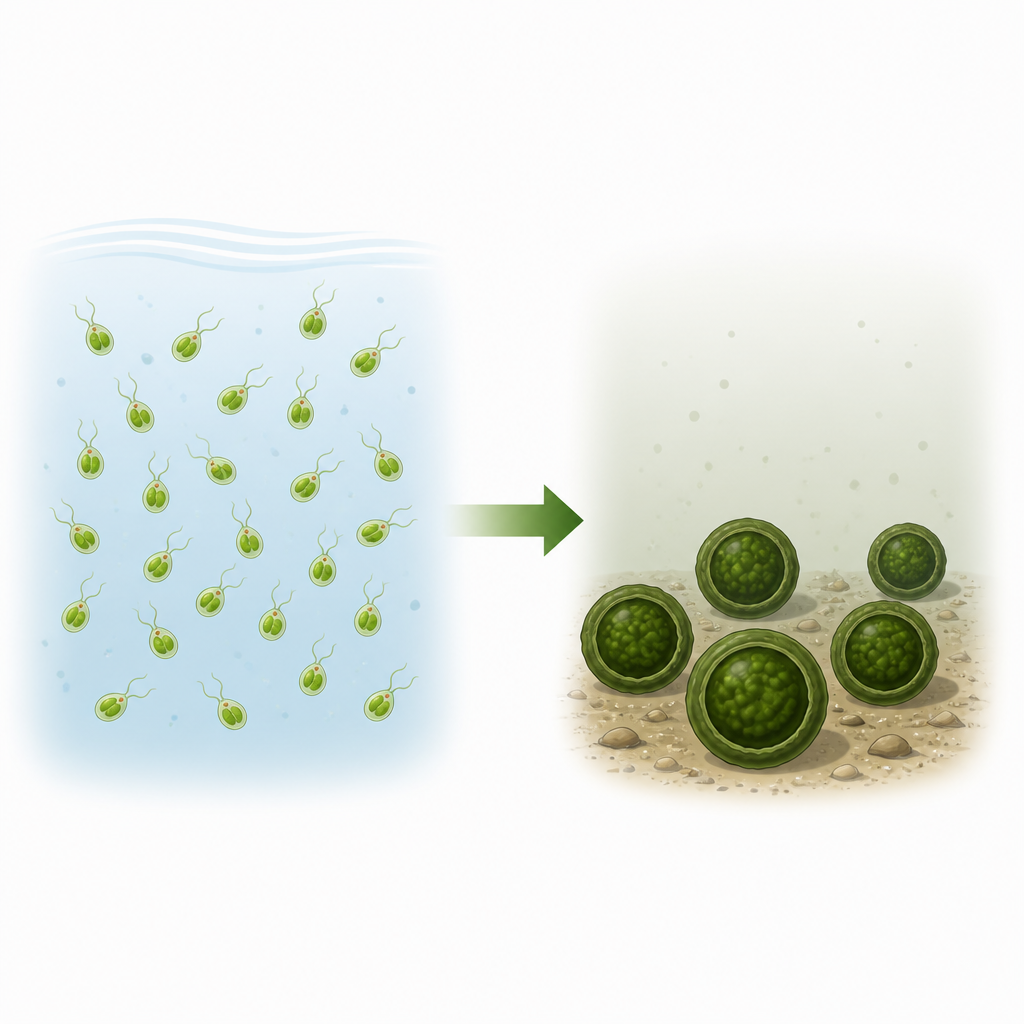
Hidden Reproduction in the Resting Form
The team combined growth measurements, microscope images, and gene activity data to test whether these resting-like cells truly stop reproducing. They noticed that older cultures contained many small non-swimming cells, even though cell division seemed almost stalled. Size measurements suggested these small cells could not all have come from the original swimmers. Under the microscope, the researchers saw large non-swimming cells filling with many internal daughter cells and then cracking open to release them. This multiple fission pattern is different from the usual two-way split seen in the swimming cells. The newborn non-swimmers were already tough, surviving intense light, drought, and high salt far better than the offspring of swimmers.
What the Genes Reveal
To probe the inner workings of these two lifestyles, the scientists analyzed which genes were active in each cell type. Swimming cells showed strong activity in genes linked to photosynthesis and nutrient use, matching their role as rapid growers in resource-rich conditions. In contrast, non-swimming cells turned on many genes involved in cell division and maintained machinery needed to keep reproducing, even though their visible growth was slow. They also boosted pathways tied to storage and protection, such as thicker outer coatings and a higher carbon-to-nitrogen balance that signals a shift toward defence rather than rapid protein building. 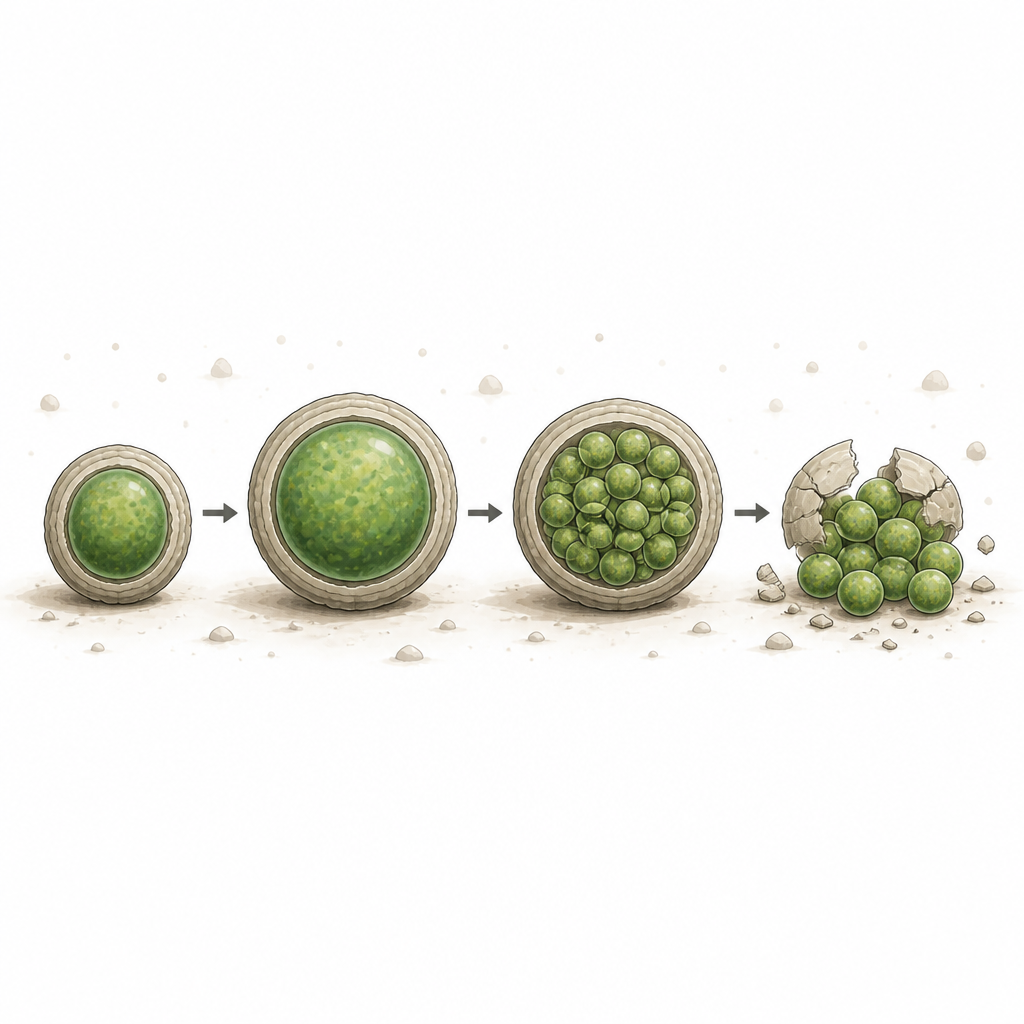
Why This Matters for Life in Changing Waters
Taken together, the findings suggest that Haematococcus lacustris does not simply switch from growth to sleep. Instead, it shifts from an r-like phase, with fast-growing swimmers, to a K-like phase, where fewer but more stress-resistant offspring are produced inside hardy resting cells. This blend of strategies may help the alga persist in shallow ponds that quickly swing from pleasant to harsh. The work challenges the long-held view that microbial resting stages are only waiting rooms for better times, and hints that other algae with cyst-like forms may quietly reproduce under stress as well.
Citation: Liu, L., Liu, Y., Tang, S. et al. The coexistence of r and K strategy in a unicellular microalga Haematococcus lacustris. Commun Biol 9, 704 (2026). https://doi.org/10.1038/s42003-026-09922-2
Keywords: microalgae, life history strategy, stress tolerance, cell division, resting cysts