Clear Sky Science · en
3D morphology of the Cambrian bivalved arthropod Sunella informs about head segmentation, arthrodization, and arthropodization
Ancient seas and the roots of modern bugs
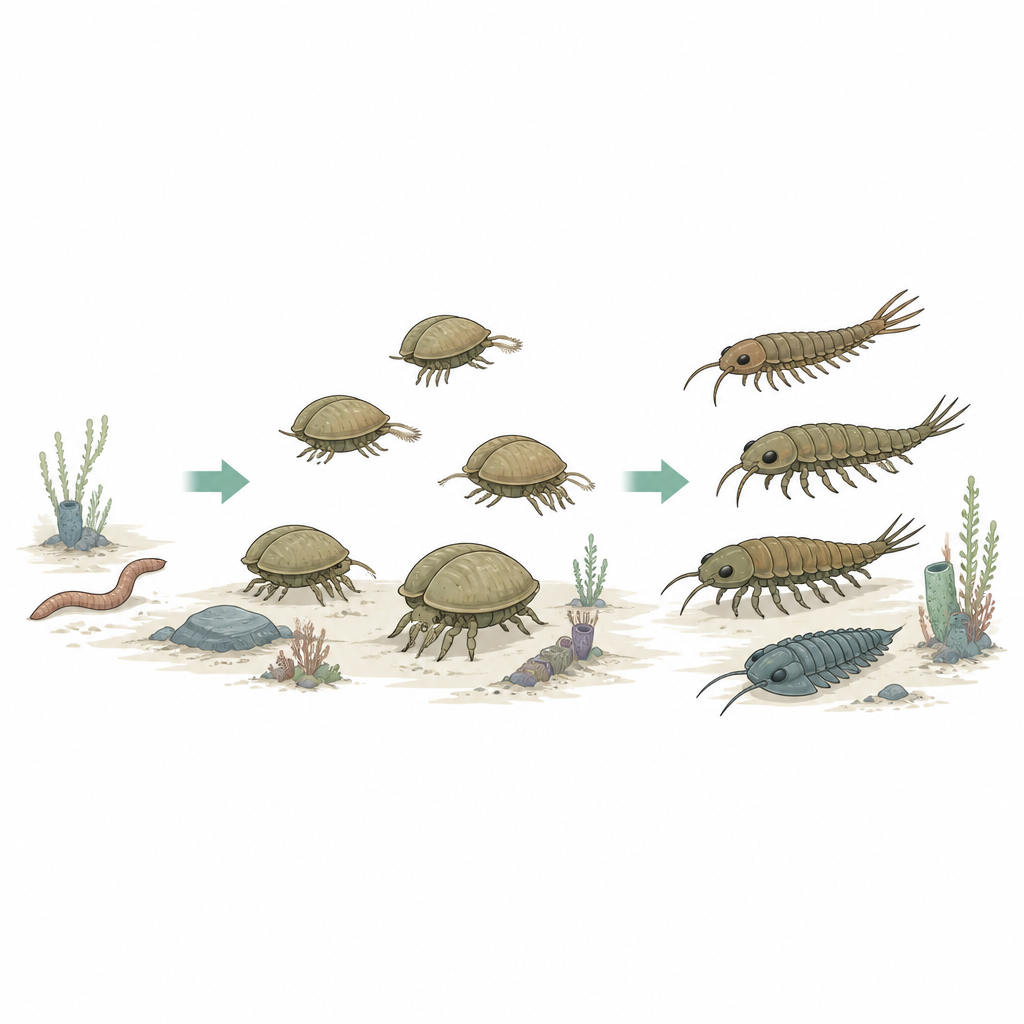
Long before insects, crabs, and spiders appeared, their distant ancestors were exploring the seafloor. This study looks at a small Cambrian creature called Sunella dimorphismus, preserved in exquisite detail in 518‑million‑year‑old rocks from China. By revealing its three‑dimensional anatomy, the researchers use this tiny animal to untangle when key features of the arthropod body first evolved, including jointed legs, a segmented trunk, and a distinct head.
A clam like shell with a secret inside
At first glance, Sunella resembles a little clam, with an oval two part shell that covered most of its body. New fossils and X ray scans show what the shell hid: a body of 14 segments divided into head, middle trunk, and tail regions, plus an elegant paddle shaped tail fan. The head carried a pair of large stalked eyes, a smaller median eye, and a set of curved grasping limbs at the front. The trunk bore repeated pairs of limbs, each built from a leg like inner branch and a broad outer flap that likely helped the animal swim and walk near the seafloor.
Reading fine details from stone
The team studied more than 50 specimens collected from several sites in Yunnan, China. Many are flattened fossils, but micro computed tomography allowed the scientists to digitally “slice” some specimens and reconstruct buried structures in three dimensions. This revealed the full length of the body extending beyond the shell, the boundaries between segments, and the internal layout of the limbs. Careful comparison of shell shapes using outline analysis confirmed that these fossils represent a distinct species from previously named relatives, justifying the new name Sunella dimorphismus.
Placing Sunella on the family tree
To understand why Sunella matters for the big picture, the researchers compared its features with those of many other early arthropods. They built a large evolutionary tree using computer based methods that test different ways of linking species. On this tree, Sunella sits very close to the base of the group known as deuteropods, which includes most familiar arthropods and their extinct stem relatives. Only one genus, Erratus, branches off earlier. This position makes Sunella a crucial reference point for reconstructing what the earliest members of this major group looked like.
Step by step construction of an arthropod body
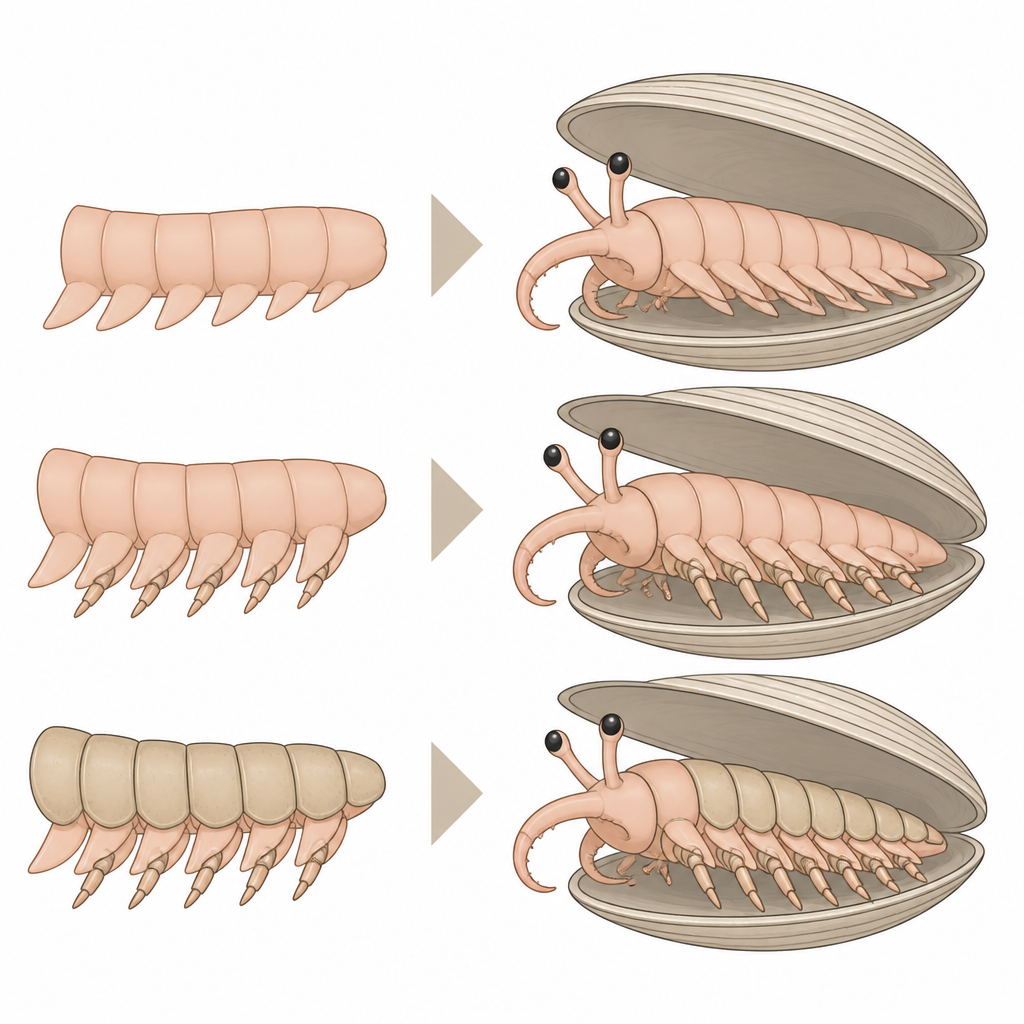
With Sunella placed on the tree, the authors used statistical methods to infer which traits were likely present in common ancestors. The results suggest that jointed limbs along the trunk evolved before the trunk itself became fully divided into hard, movable segments. Both of these changes occurred before the appearance of a “six segment head” seen in some later Cambrian forms. The study also indicates that certain lineages with clam like shells, such as isoxyiids, may have secondarily lost a rigidly segmented trunk, showing that evolution can simplify as well as build complexity.
Predator and prey in a changing world
Functionally, Sunella appears to have been a small, active predator. Its large eyes and raptorial front limbs would have been useful for spotting and seizing tiny animals, while its flaps and leg branches provided both swimming power and control near the seabed. Yet Sunella itself likely served as food for larger hunters of the Cambrian seas. Overall, the work paints a picture of arthropod evolution as a staged process: first jointed limbs, then a fully segmented trunk, and only later a more complex head. For non specialists, this means that the hallmark design of modern insects and crustaceans was assembled piece by piece, and creatures like Sunella capture that construction in action.
Citation: Liu, C., Pates, S., Zhang, M. et al. 3D morphology of the Cambrian bivalved arthropod Sunella informs about head segmentation, arthrodization, and arthropodization. Commun Biol 9, 647 (2026). https://doi.org/10.1038/s42003-026-09909-z
Keywords: Cambrian arthropods, Sunella, fossil evolution, arthropod body plan, jointed limbs