Clear Sky Science · en
NCBP2 drives colorectal cancer growth and metastasis through LIPG-mediated lipid droplet accumulation
Why fat filled cancer cells matter
Colorectal cancer is one of the most common and deadly cancers worldwide. This study uncovers how certain tumor cells stockpile tiny fat droplets and how this hidden fuel reserve helps them grow faster and spread to distant organs. By tracing this process back to a single control protein inside the cell nucleus, the work points to fresh ways to slow or stop aggressive bowel tumors.
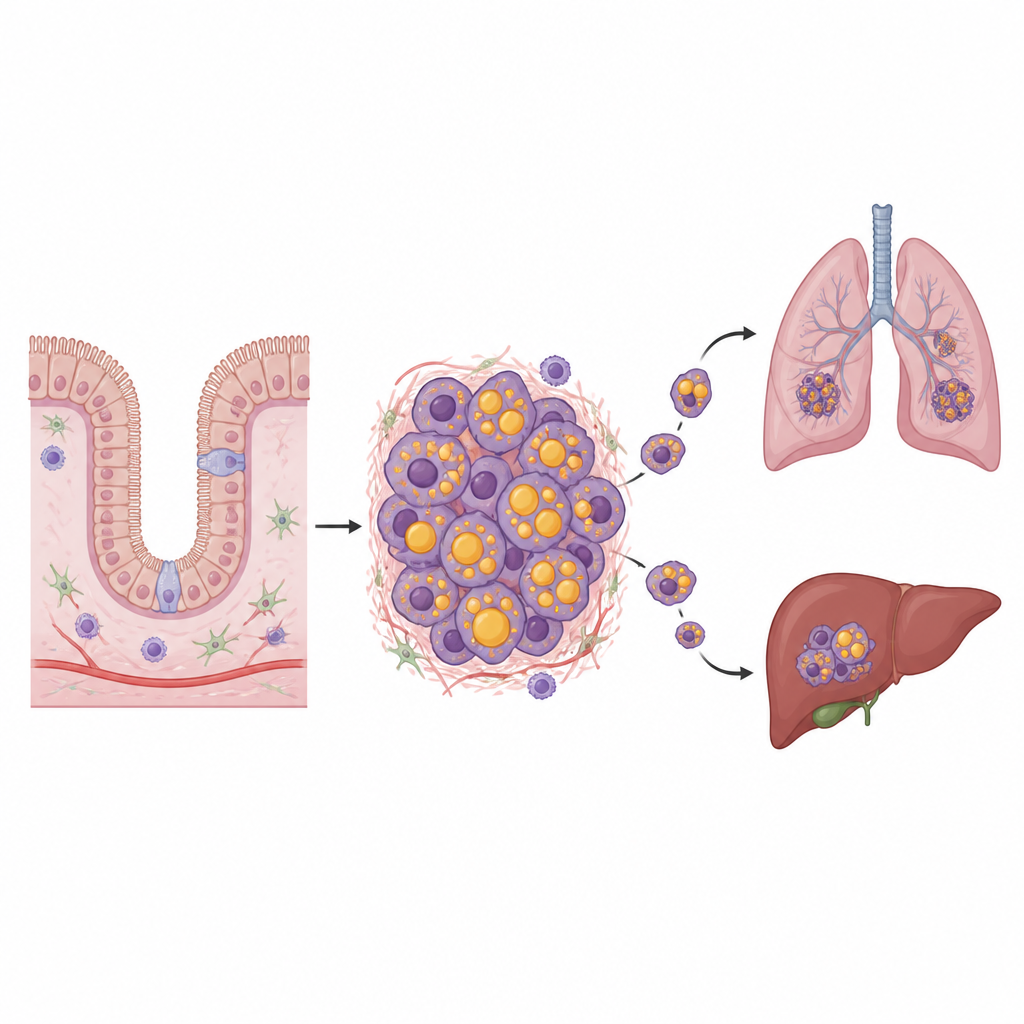
A search for dangerous gene switches
The researchers began by scanning several large public databases of patient tumors to find genes that are consistently more active in colorectal cancer than in healthy colon tissue, and that also track with poor survival. Among hundreds of candidates, one stood out: NCBP2, a protein that normally helps cells process newly made RNA messages. Patients whose tumors had higher NCBP2 levels were more likely to have deeper tumor invasion, distant spread, advanced stage disease and shorter overall survival. Lab tests on patient samples and cancer cell lines confirmed that NCBP2 is strongly elevated in colorectal cancer compared with nearby normal tissue.
How one protein drives growth and spread
To see what NCBP2 actually does in tumor cells, the team forced colorectal cancer cells grown in dishes to make extra NCBP2. These cells divided more quickly, formed more colonies and moved more readily, all signs of aggressive behavior. They also showed features of a shape shifting process that helps cells break away and travel through the body. In mice, cells with extra NCBP2 formed larger tumors under the skin and produced more nodules in the lungs, while turning NCBP2 down had the opposite effect. Together these experiments show that NCBP2 is not just a marker of poor prognosis but an active driver of growth and metastasis.
Linking gene control to fat storage
Digging deeper, the scientists asked which genes were turned up or down when NCBP2 levels changed. One key partner emerged, an enzyme called LIPG that sits at the cell surface and helps break down fats from the bloodstream. NCBP2 was found to bind directly to the capped end of LIPG messenger RNA in the nucleus, protecting this message from decay and boosting LIPG production. As LIPG levels rose, cancer cells accumulated more triglycerides and more lipid droplets, the tiny fat filled spheres that serve as energy stores. When LIPG was blocked or reduced, NCBP2 could no longer drive fast growth, migration or lung spread in mice, showing that LIPG is a crucial middleman in this pathway.
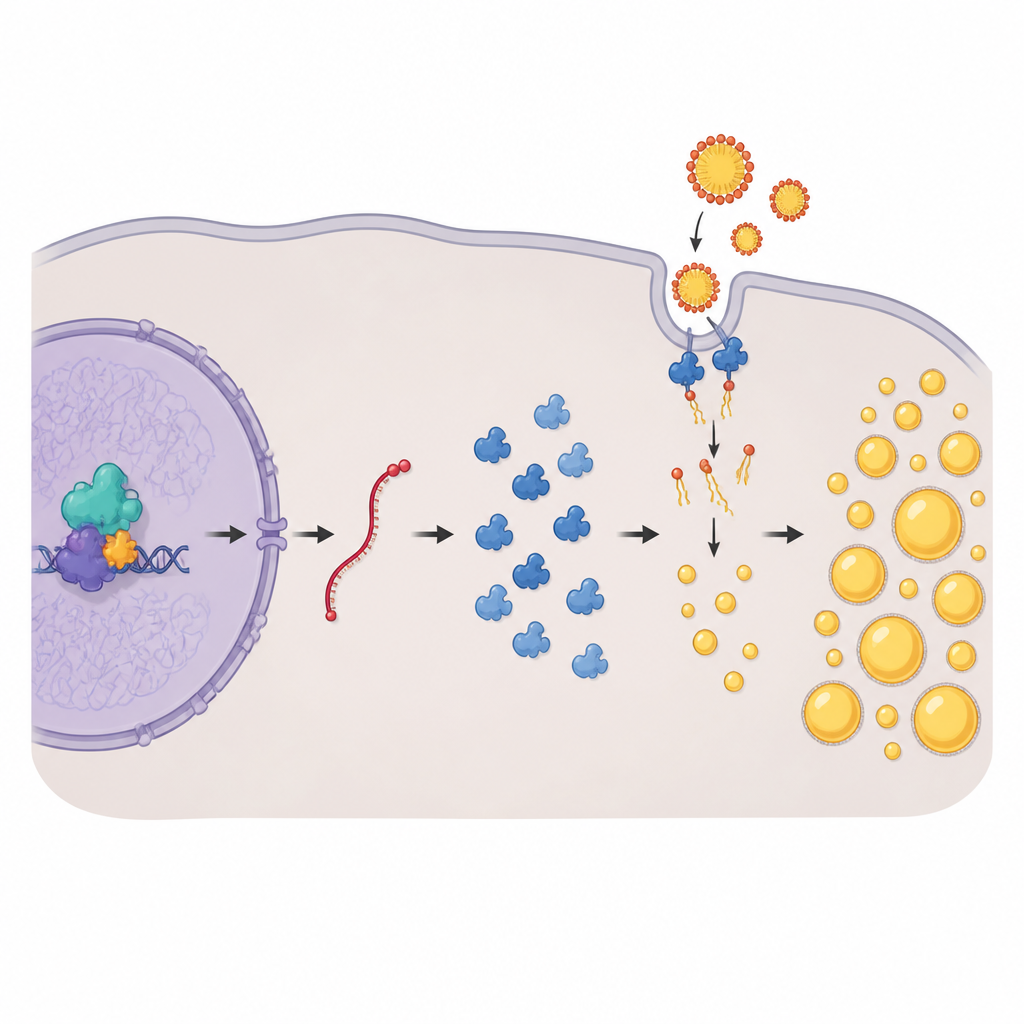
Fat droplets as fuel for cancer
Lipid droplets have recently been recognized as a hallmark of many tumor types. In this study, colorectal cancer cells with high NCBP2 and LIPG built up more lipid droplets and expressed higher levels of proteins that coat and stabilize these droplets. When the researchers treated cells with a drug that blocks DGAT1, an enzyme needed to form new droplets, the boost in growth and movement caused by NCBP2 was largely lost. This suggests that the ability to stockpile fat is central to how NCBP2 and LIPG help tumors thrive, likely by supplying energy and building blocks during rapid division and by helping cells cope with stress.
What this means for future treatment
For people without a science background, the key message is that this work reveals a chain of events that lets bowel cancer cells hoard fat and use it to power growth and spread. A nuclear protein, NCBP2, stabilizes the instructions for making the fat handling enzyme LIPG, which in turn helps load the cell with lipid droplets. Tumors with high levels of these molecules tend to be more advanced and linked to poorer outcomes. By targeting any step in this NCBP2 to LIPG to fat droplet pathway, future therapies may be able to cut off an important energy source for colorectal cancer and slow its progression.
Citation: Liu, L., Lu, W., Miao, S. et al. NCBP2 drives colorectal cancer growth and metastasis through LIPG-mediated lipid droplet accumulation. Commun Biol 9, 655 (2026). https://doi.org/10.1038/s42003-026-09903-5
Keywords: colorectal cancer, lipid droplets, NCBP2, LIPG, cancer metabolism