Clear Sky Science · en
A multidimensional framework for dissociating the neuroplasticity of auditory and early language deprivation
How Missing Sounds and Words Shape the Brain
Deaf children often grow up without full access to sound and, in many cases, without a complete language in their earliest years. This study asks a deceptively simple question with big consequences: do missing sounds and missing early language reshape the brain in the same way, or do they leave different signatures in how the brain is wired and works?
Different Life Paths, Different Experiences
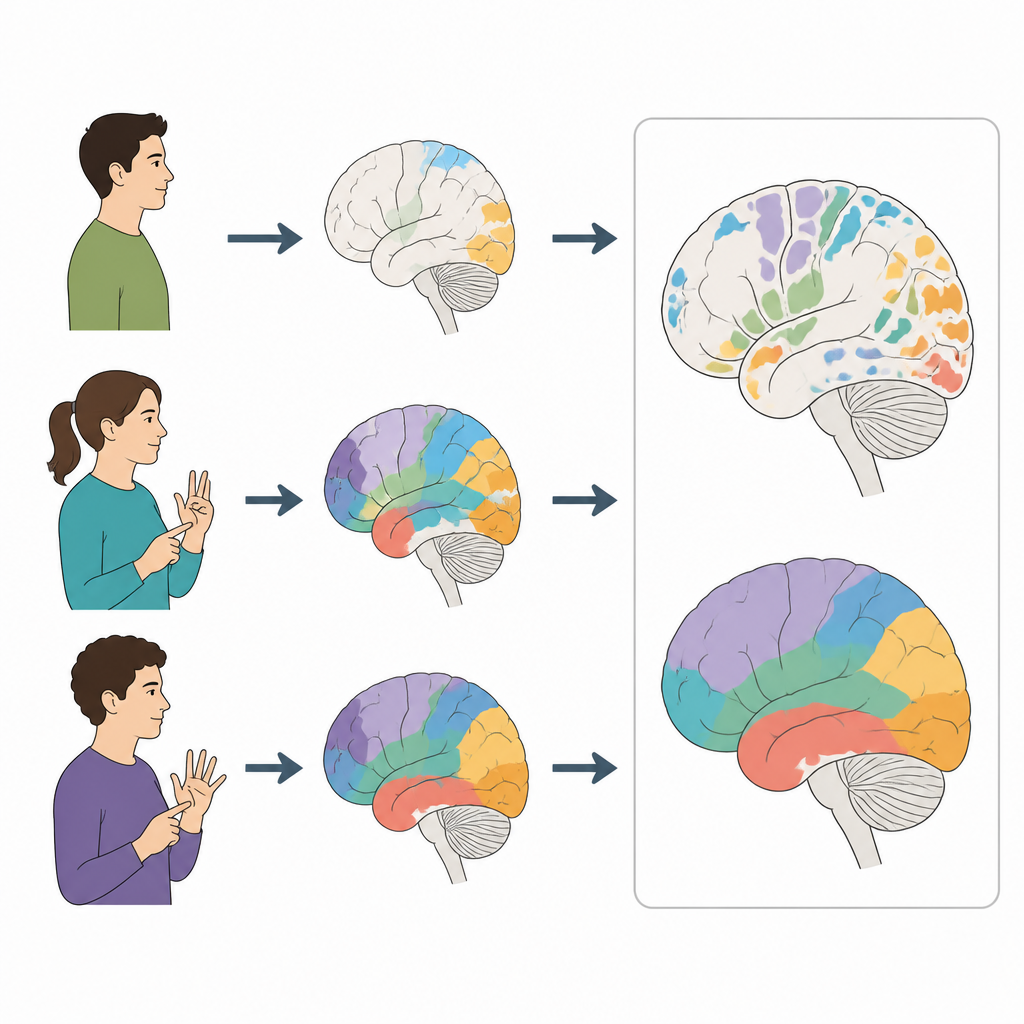
The researchers compared three groups of young adults in China: hearing people who grew up with spoken Mandarin, deaf people who learned sign language from birth, and deaf people who only began to learn sign language around school age. All participants took part in brain scans while resting quietly and while watching sentences in either Chinese Sign Language or spoken Mandarin. This design let the team separate the effects of lacking sound from birth from the effects of lacking a full language in early childhood.
What Happens During Everyday Language Use
When participants processed sentences in the scanner, the hearing group showed strong activity in classic hearing areas, while deaf signers relied more on visual regions and a posterior “multimodal” network that can handle input from several senses. In contrast, the two deaf groups looked surprisingly similar to each other during the task. Standard brain-mapping methods did a good job of capturing how the loss of hearing shifts activity between auditory and visual regions, but they struggled to reveal clear differences linked specifically to delayed exposure to language.
Hidden Dimensions in the Resting Brain
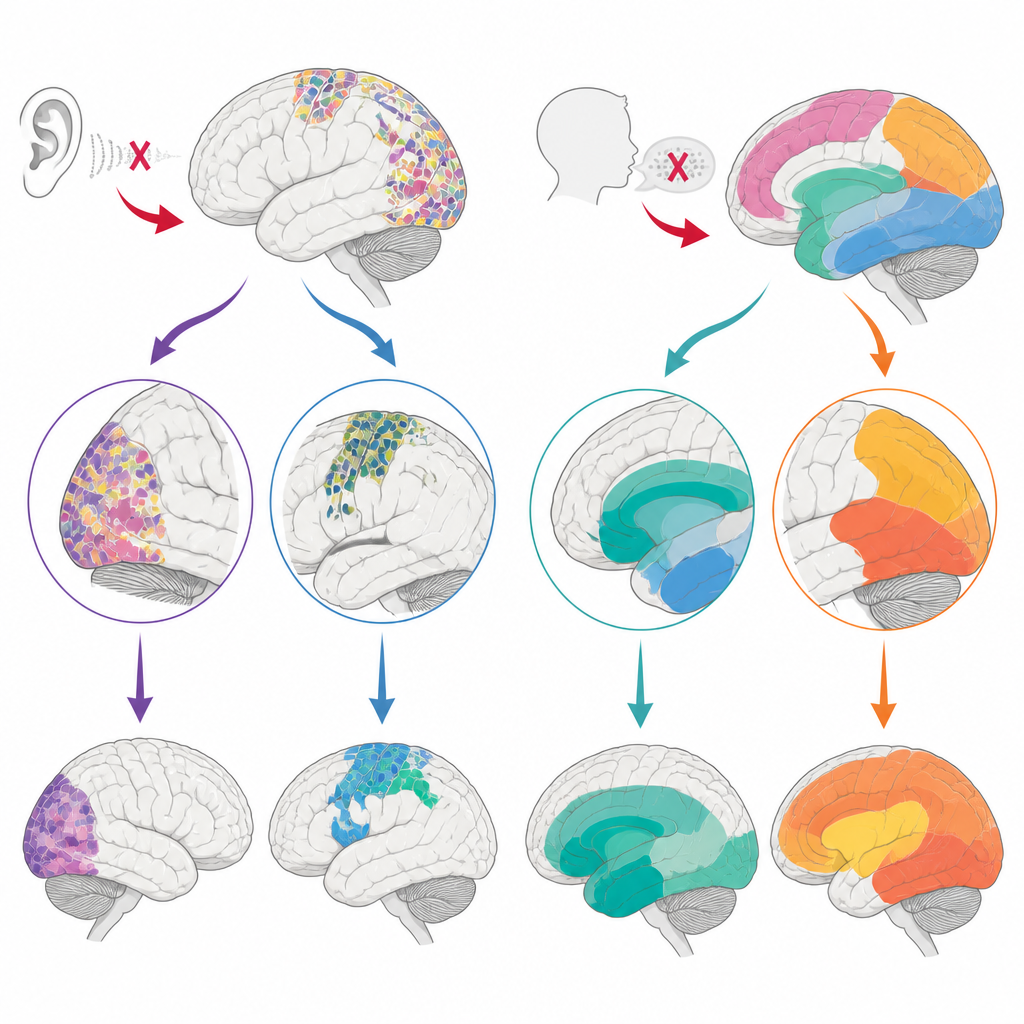
To dig deeper, the team turned to resting-state scans, which track how brain regions naturally rise and fall together when a person is not doing any particular task. Using a mathematical technique, they distilled these complex patterns into ten “gradients” or dimensions that capture how different areas are functionally related. The first three dimensions formed a broad framework, separating basic sensory systems from higher thought networks and distinguishing visual and motor regions. The remaining seven dimensions captured finer details, such as specific sound, movement, or language-related specializations woven inside this larger layout.
Hearing Loss Versus Language Delay in Brain Wiring
Machine-learning models then examined which of these dimensions best distinguished the groups. Lack of hearing mainly altered the more fine-grained dimensions tied to sensory and motor regions, especially in and around the auditory cortex and nearby areas that combine sight and movement. In these individuals, deprived sound regions appeared to retune themselves to support visual and sensorimotor processing, while the overall large-scale layout of the brain remained relatively intact. In contrast, early language deprivation left a different mark. It was linked to changes in the broad, dominant dimensions that organize how the brain separates and coordinates different types of information, particularly within the so-called default mode network and higher visual areas.
How Intrinsic Structure Guides Language Processing
The researchers also asked how these resting dimensions support active language processing. By mathematically reconstructing task-related brain activity from the ten gradients, they found that the dominant, large-scale dimensions contributed most strongly to language processing for everyone. However, deaf participants without sound relied more on subtlest dimensions associated with motor and auditory features, whereas those who had experienced delayed language depended more on the broad modality-separating dimension. This suggests that language tasks draw on a pre-existing functional scaffold, and that missing sound or early language shifts which parts of that scaffold do the heaviest lifting.
Why These Findings Matter
For a layperson, the key message is that the brain responds very differently to a world without sound and to a world without early language. Losing hearing pushes the brain to finely retune specific sensory and motor patches while leaving its overall large-scale map mostly stable. In contrast, missing a complete language early in life seems to reshape that large-scale map itself, affecting how the brain organizes and separates different kinds of information. This multidimensional view helps explain why restoring sound alone may not fully address the challenges faced by people who also lacked early language, and it underscores the importance of giving deaf children rich, accessible language from their earliest years.
Citation: Liu, L., Tang, C., Chen, J. et al. A multidimensional framework for dissociating the neuroplasticity of auditory and early language deprivation. Commun Biol 9, 703 (2026). https://doi.org/10.1038/s42003-026-09900-8
Keywords: deafness, brain plasticity, language development, functional connectivity, resting state fMRI