Clear Sky Science · en
Pollination and dispersal networks in the Amazonian tree flora
Why Forest Life Depends on Invisible Allies
The Amazon rainforest is often described as a world of trees, but this study reveals a surprising twist: those trees are quietly dependent on animals for their very survival. From bees and bats to monkeys and tapirs, animals move pollen and seeds across the forest, allowing new trees to grow. By mapping these hidden relationships for thousands of tree species, the authors show that animals are not just visitors to the forest—they are structural pillars holding it together. 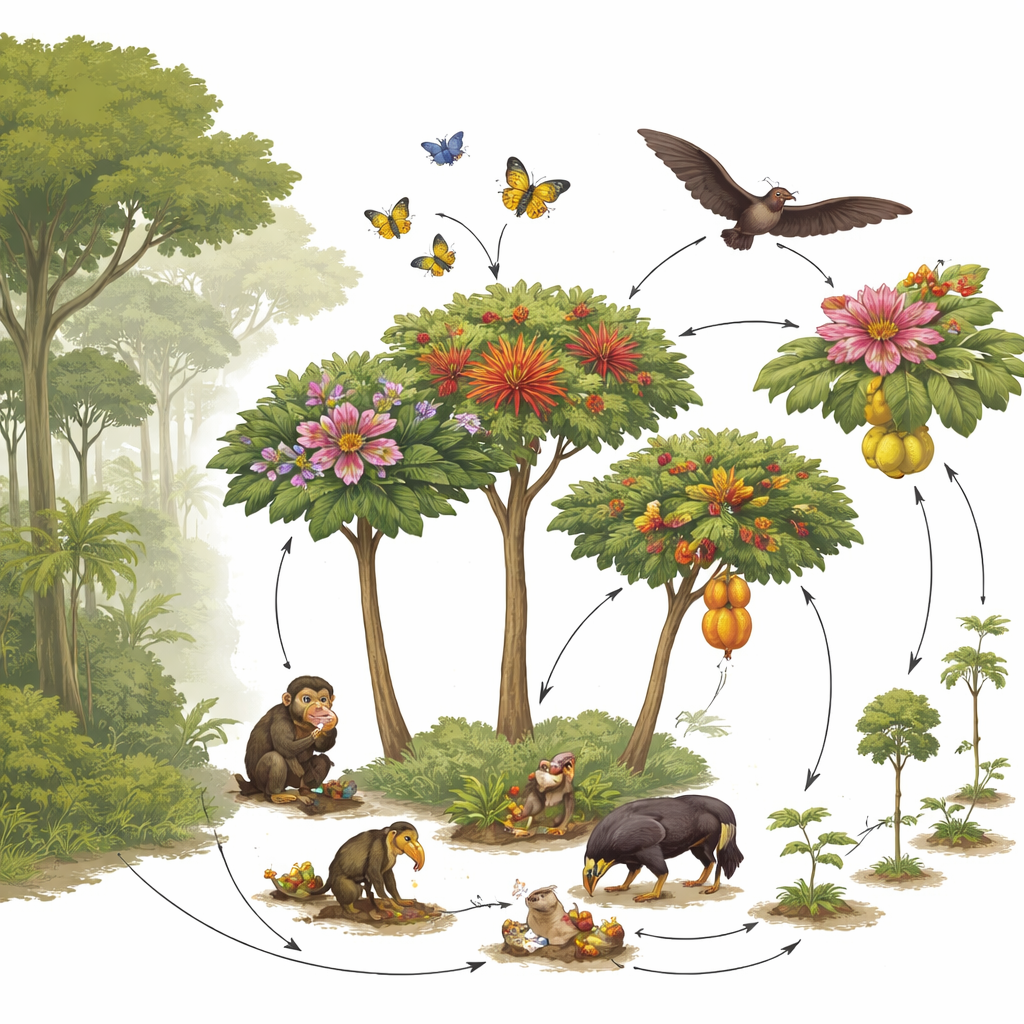
Counting Partners in a Giant Forest
To uncover these links, researchers gathered information on flower visitors and seed dispersers for 5,201 Amazonian tree species—about half of all tree species known from the region and more than 99% of all individual trees. They combined data from hundreds of field studies, floras, and trait databases, then scaled those observations up using an independent estimate of how many individuals of each species occur across the basin. This allowed them to build large “interaction networks” showing which animals typically visit which tree groups, and which kinds of fruits are moved by which kinds of animals.
Bees, Bats, Birds and Beyond
The analysis shows that bees are the dominant visitors of Amazon tree flowers. Nearly 60% of the studied species, about three quarters of the tree genera, and more than 80% of all individual trees are visited by bees. Butterflies, beetles, flies, wasps, hummingbirds and bats also visit many species, often sharing the same flowers. Most flowers are small, pale and radially symmetric, traits that fit a generalist strategy: they can be used by multiple kinds of pollinators rather than just one highly specialized animal. Nectar is the most common reward produced by Amazon tree flowers, followed by pollen, while more unusual rewards such as oils and resins are rarer but important for some specialized insects.
Animals as Seed Couriers
The story continues when flowers turn to fruit. Between roughly four out of five and five out of six Amazonian tree species rely on animals to move their seeds away from the parent tree. Most of these trees bear fleshy fruits with small to medium-sized seeds, suited to being eaten and carried by arboreal vertebrates such as primates, birds and bats. Other dispersal modes—like wind, explosive seed pods or floating on water—are present but much less common overall. By shuttling seeds away from the shadow and pests around parent trees, animals help new seedlings find space, light and safety, shaping which tree species dominate different parts of the forest.
A Few Tree Lineages Do Much of the Work
Although the Amazon hosts an enormous variety of tree species, the study confirms that a small set of “hyperdominant” genera provide a large share of the pollen and fruit used by animals. Groups such as Protium, Eschweilera, Inga, Pouteria, Ocotea, Virola and several palm and fig relatives stand out because they are both abundant and species-rich. Together, just a few dozen such genera supply half of the fruit resources for animal seed dispersers and half of all recorded interactions between trees and flower visitors. These trees function as hubs in the web of relationships, sustaining pollinator and frugivore communities that, in turn, keep the forest regenerating. 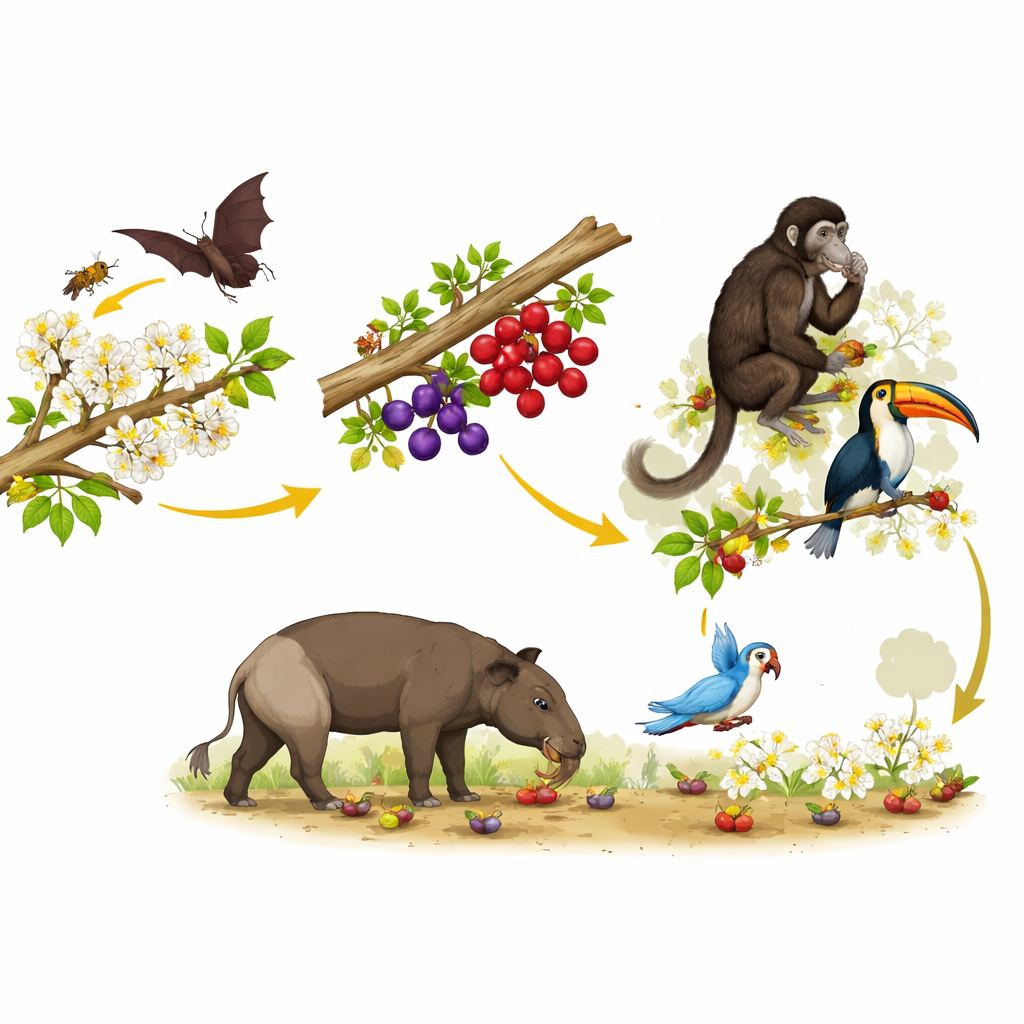
What This Means for the Future of the Forest
When the researchers combined their pollination and dispersal data, they found that in nearly 80% of all tree–individual interactions, animals are involved in both stages; in only about half a percent are animals absent from both. In everyday terms, almost every tree in the Amazon depends on animals to both set seed and spread that seed. This makes the ongoing loss of wildlife through hunting, habitat fragmentation and climate change a serious threat to the forest’s ability to renew itself. Protecting pollinators and seed dispersers, and safeguarding the key tree groups that feed them, is therefore not just about saving individual species. It is about maintaining the living machinery that allows the Amazon rainforest to persist, recover from disturbance and continue storing carbon, supporting biodiversity and sustaining local communities.
Citation: ter Steege, H., Ballarin, C.S., Pinto, C.E. et al. Pollination and dispersal networks in the Amazonian tree flora. Commun Biol 9, 486 (2026). https://doi.org/10.1038/s42003-026-09896-1
Keywords: Amazon rainforest, pollination, seed dispersal, plant–animal interactions, forest biodiversity