Clear Sky Science · en
The redundant protein synthesis gene Aimp1 challenges the canonical inverse relationship between translation and autophagy
Why cell cleanup and protein building matter
Every cell must juggle two vital jobs: building new proteins and cleaning up worn out parts. A long standing idea in biology holds that when cells ramp up protein production, their cleanup crews slow down, and vice versa. This study uncovers an exception to that rule by focusing on a single, surprisingly expendable gene called Aimp1. The work shows how this gene helps fine tune the balance between making proteins and breaking down cellular waste, especially in immune cells that face stressful conditions like infection.
Two core jobs inside every cell
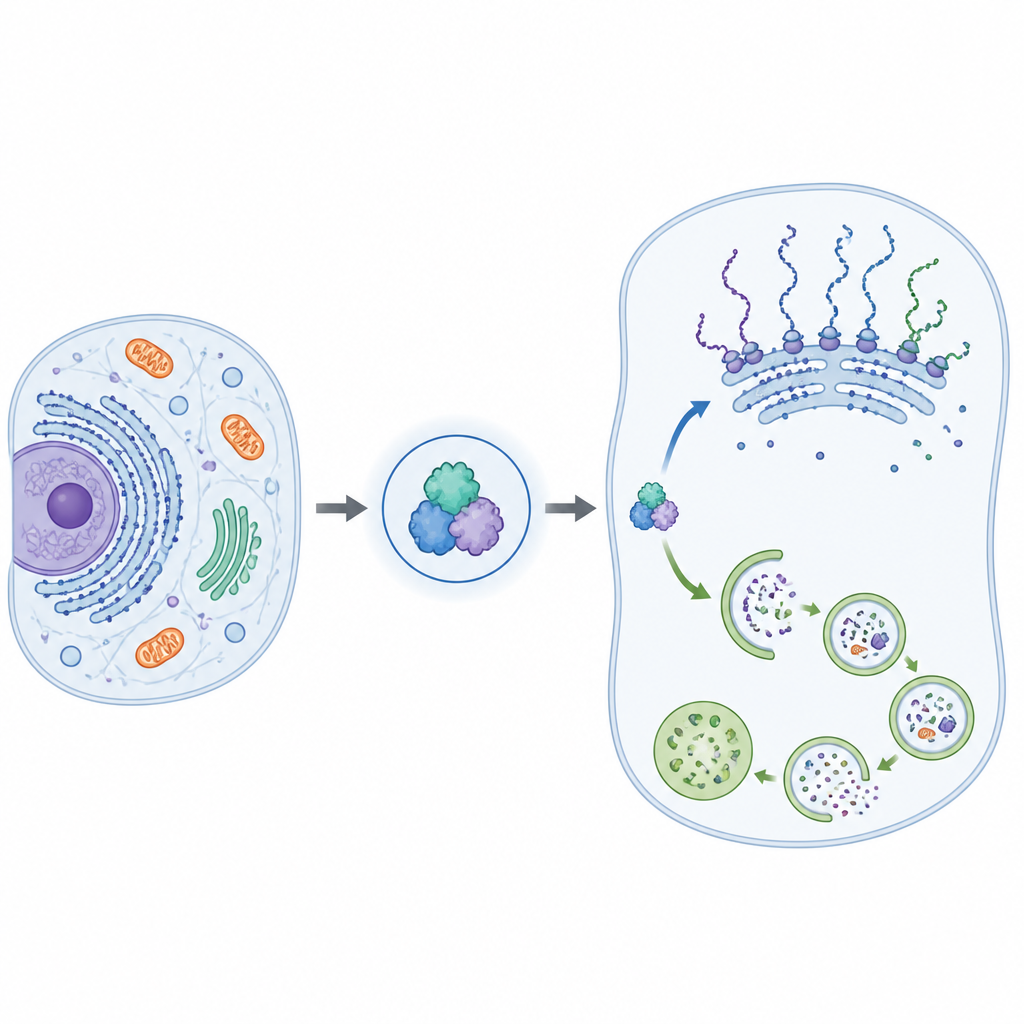
Cells are constantly making proteins, which act as the machinery and structure of life. They also rely on a quality control system called autophagy, in which tiny bubbles inside the cell collect and recycle damaged components. These two activities are often thought to move in opposite directions, controlled by a central nutrient sensor called mTORC1. When mTORC1 is active, protein making tends to rise while cleanup falls. When nutrients are scarce or stress is high, mTORC1 activity drops, allowing autophagy to increase and help cells cope.
Finding an exception to the usual balance
Using large genetic datasets from hundreds of human cell lines, the researchers searched for genes tied to protein production that are highly conserved across species but not strictly required for cell survival. They reasoned that such genes might act more like regulators than core parts of the protein making machinery. One gene, Aimp1, stood out. It belongs to a bigger assembly that helps load building blocks onto transfer RNAs, a key step in making proteins. Yet, by comparing how strongly cells depended on different genes, the team found that Aimp1 behaved differently from the truly essential translation genes and showed strong links to genes involved in autophagy and cellular recycling.
Aimp1 shapes cleanup without halting construction
To test Aimp1 directly, the scientists deleted it in human cells with a simplified genome and in mouse myeloid cells, a family that includes many immune cells. In both cases, overall protein production remained largely unchanged, as measured by the incorporation of a tracking compound into newly made proteins. However, markers of autophagy and lysosome behavior were altered. Loss of Aimp1 changed how a key mTORC1 target protein was modified, and shifted levels of LC3 and other signals tied to the formation and turnover of recycling compartments. These shifts suggested that Aimp1 helps couple mTORC1 activity to the autophagy machinery, allowing cleanup to proceed efficiently without shutting down general protein building.
Stress, infection, and immune cell timing
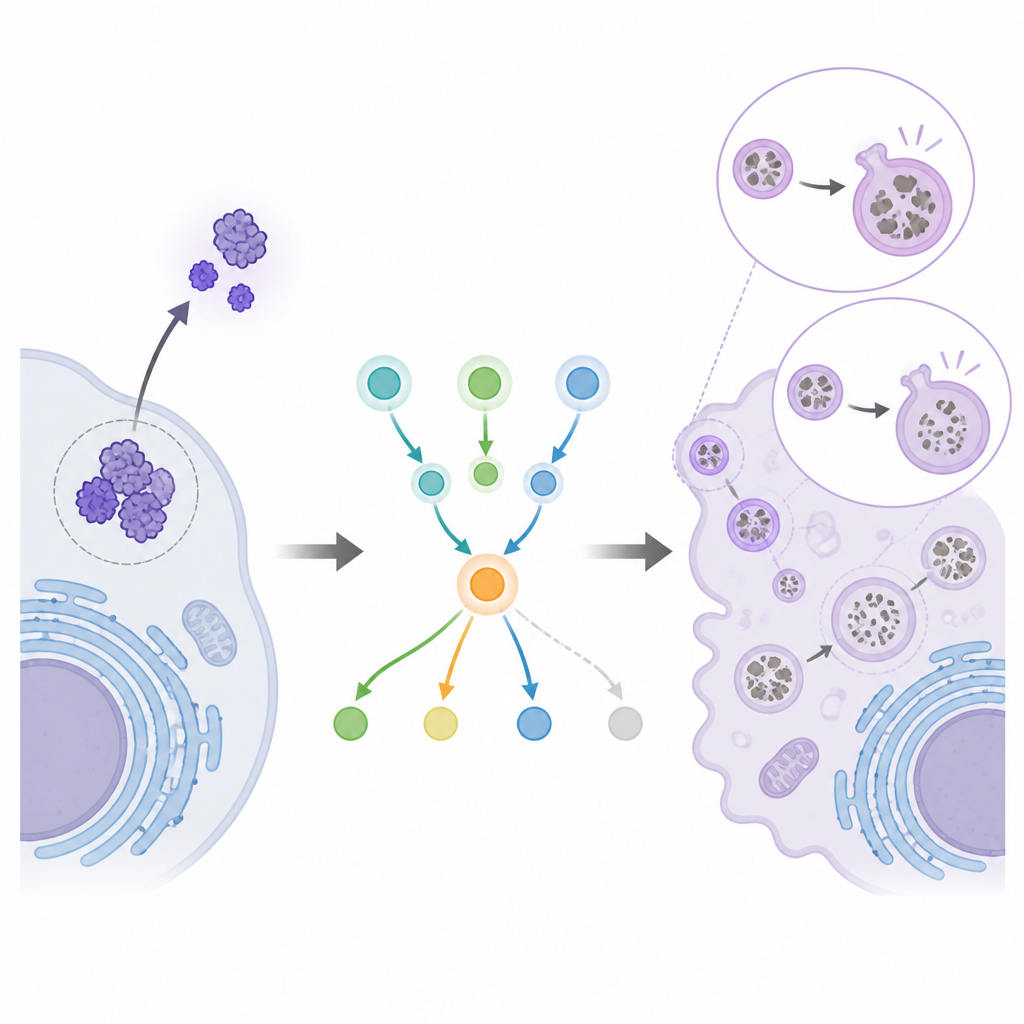
The team then turned to real world stress conditions by mining existing gene activity data from nutrient starved cells and from blood cells during infection and sepsis. Across these situations, they observed an overall pattern in which genes for autophagy rose while many protein making genes fell, supporting the traditional inverse relationship. Strikingly, Aimp1 bucked this trend. In some nutrient conditions its levels stayed steady, while during inflammation its activity dropped along with related genes in its complex. In mice engineered to lack Aimp1 only in myeloid cells, immune cells still made proteins at normal rates but showed altered signaling and autophagy responses. When the animals were challenged with a bacterial component, key inflammatory molecules in the blood rose faster and stayed higher, revealing that Aimp1 influences how long and how strongly the immune response lasts.
What this means for cell health and disease
This work reveals that Aimp1, although classified as a protein making factor, mainly acts as a subtle regulator of the cell’s cleanup system and its link to growth signals. By being dispensable for basic protein production, Aimp1 can instead tune how mTORC1 connects to autophagy and immune signaling. This challenges the simple idea that protein building and cellular recycling must always move in opposite directions, and helps explain why losing Aimp1 in whole animals leads to serious developmental problems despite leaving core translation intact. In the long run, understanding such regulatory exceptions may open new ways to adjust immune responses or protect tissues under stress by carefully rebalancing construction and cleanup inside cells.
Citation: Lee, D.D., Rutkowski, B.N., Wilson, N.C. et al. The redundant protein synthesis gene Aimp1 challenges the canonical inverse relationship between translation and autophagy. Commun Biol 9, 639 (2026). https://doi.org/10.1038/s42003-026-09892-5
Keywords: autophagy, protein synthesis, mTOR, immune cells, cellular homeostasis