Clear Sky Science · en
Evolutionary history of Chinese cavefishes parallels paleogeoclimatic and river capture processes
Life in the Dark Beneath Our Feet
Caves in southwestern China hide a remarkable secret: a rich world of fishes that spend their entire lives in darkness. These pale, often eyeless species are not only oddities of nature but also living records of how mountains rose, rivers shifted, and climates changed over tens of millions of years. By reading their family trees, scientists can reconstruct the history of the landscape and better understand how ongoing climate change may affect fragile underground life.
Hidden Hotspots of Cave Life
Researchers first set out to map where Chinese cavefishes live today. Drawing on decades of fieldwork, museum records, and online databases, they cataloged 199 species, mostly clustered in the karst regions of eastern Yunnan, southern Guizhou, and northwestern Guangxi. These areas are riddled with sinkholes, underground rivers, and caves carved in soft limestone. In some map grid cells, more than eight different cavefish species coexist, making this part of China one of the world’s richest centers for underground biodiversity. The team also included related surface fishes in neighboring parts of the Yangtze River, the Pearl River, and the Red River Basin to place the cave dwellers in a broader regional context. 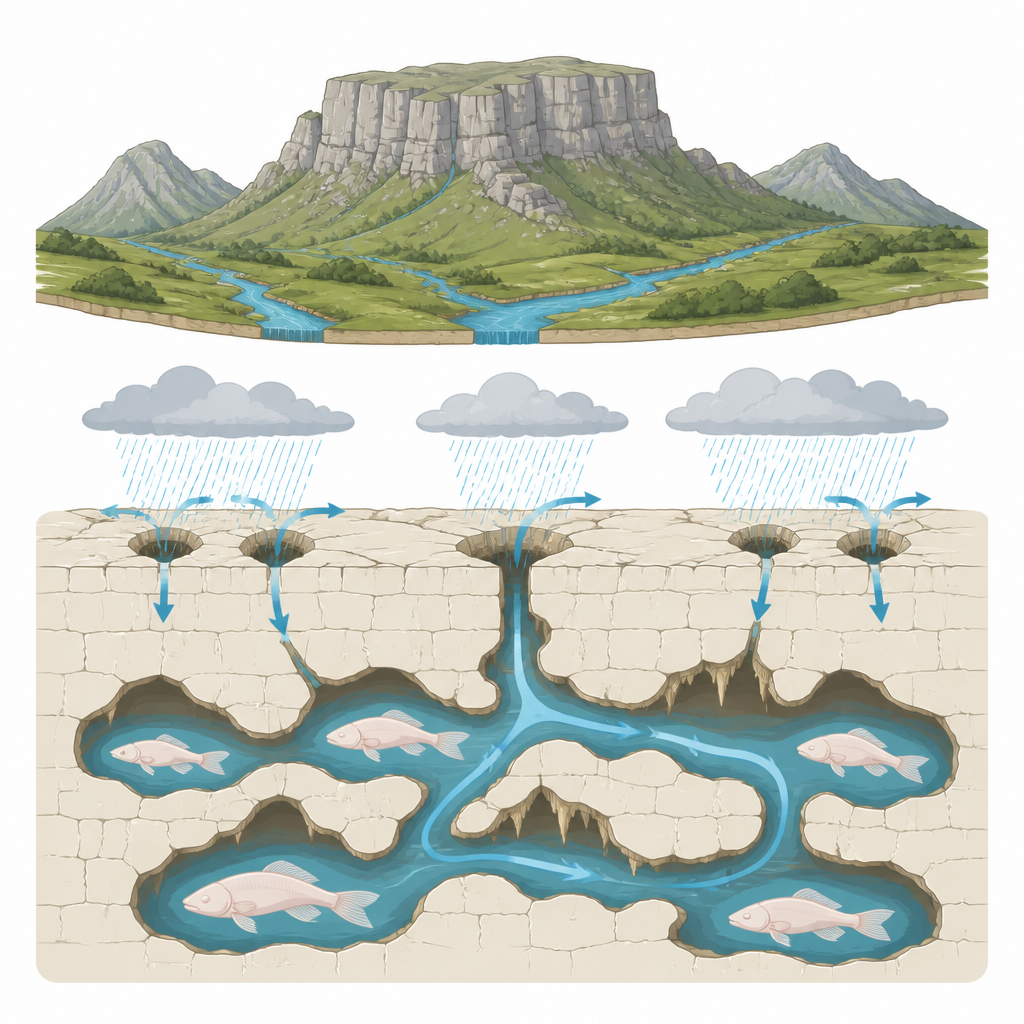
Tracing Family Trees Through Deep Time
To explore how this diversity arose, the authors built the most extensive evolutionary family tree of Chinese cavefishes to date. They analyzed DNA from 183 cave species and close relatives across two major fish orders, six families, and 22 genera. Using fossil and previously dated lineages as time markers, they estimated when lineages split, when fishes first moved into caves, and how often species spread between river systems or evolved in place. Their reconstructions identified 376 key events, including many instances where species diversified within the same river basin and fewer cases where fishes moved between caves or back to surface waters.
From Surface Streams to Dark Caves
The timing of these evolutionary events lines up strikingly with known changes in Asian geology and climate. The study suggests that freshwater fishes first began colonizing caves about 44 million years ago, around the middle of the Eocene, shortly after major collisions between tectonic plates started lifting the Qinghai–Tibet Plateau. As mountains rose and the Asian monsoon strengthened, rainfall and erosion carved new underground channels into the expanding karst landscape. In this changing setting, cave colonization accelerated, and a wave of in situ speciation began roughly 43 million years ago. Rates of new species formation rose sharply around 35 and 18 million years ago and peaked near 8.3, 2.5, and 1.5 million years ago, mirroring pulses of mountain uplift and shifts in monsoon rainfall.
Rivers That Rearranged the Underground World
The story is not the same everywhere. When the team examined ten major river drainages separately, they found that each basin has its own schedule of cavefish diversification. Rivers in the Pearl River system, such as the Hongshui, Nanpanjiang, and Liujiang, show early bursts dating back to the late Eocene and Oligocene. Rivers linked to the upper Yangtze, by contrast, show later peaks in the Miocene and Pliocene. Patterns of genetic exchange reveal that fishes began moving from the ancestral Pearl River system into the developing Yangtze system around 24 million years ago, with later two-way exchanges as river courses shifted and underground connections opened and closed. These findings support a stepwise formation of drainage networks, in which river capture events and changing groundwater paths repeatedly reshaped the map of subterranean habitats. 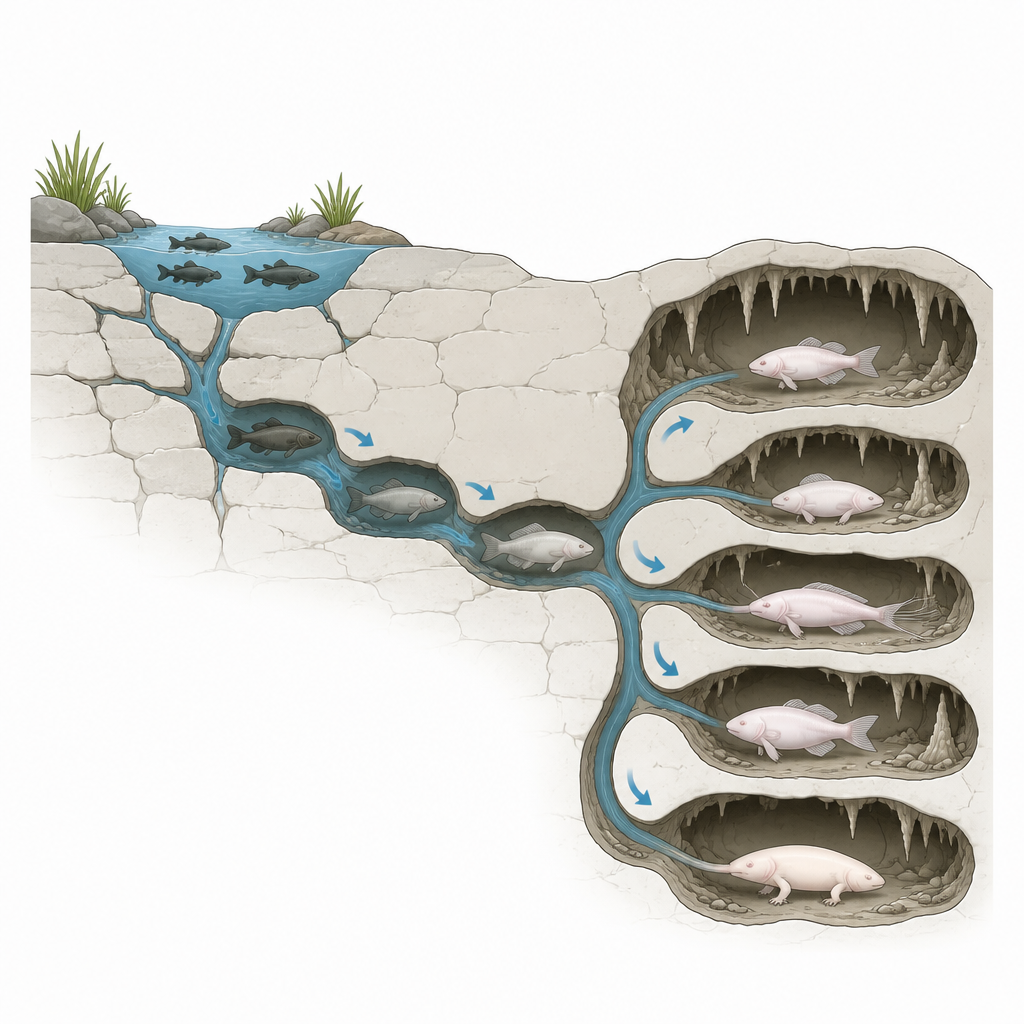
What Cavefishes Tell Us About Change
Viewed together, the results paint cavefishes as sensitive witnesses of Earth’s shifting surface. Their evolutionary history parallels the uplift of the Tibetan region, the strengthening of the Asian monsoon, and the growth and slowing of karst cave formation. Most new species appear to have arisen locally, as isolated cave systems offered fresh ecological opportunities and barriers. Today, however, global warming, drought, and human pressure threaten to dry out or pollute these same underground waters. The study’s detailed timeline of when and where cavefish lineages arose provides a framework for identifying priority regions and periods of past change, helping guide conservation efforts so that these pale, hidden fishes can continue to illuminate the deep history of Asian landscapes.
Citation: Luo, T., Xiao, MY., Liao, M. et al. Evolutionary history of Chinese cavefishes parallels paleogeoclimatic and river capture processes. Commun Biol 9, 618 (2026). https://doi.org/10.1038/s42003-026-09881-8
Keywords: cavefish, karst caves, river evolution, Asian monsoon, biodiversity history