Clear Sky Science · en
Dual regulatory role of IS91-encoded Orf121 in IS91 transposition
Hidden movers in bacterial DNA
Bacteria constantly reshape their DNA, and some of the smallest pieces of this DNA shuffling machinery can help spread antibiotic resistance. This study focuses on a tiny genetic element called IS91 and a partner protein named Orf121, revealing how they work together to balance DNA movement with genome stability. Understanding this balance can shed light on how resistance genes travel between bacteria and how cells keep that process in check.
A tiny DNA hitchhiker with big effects
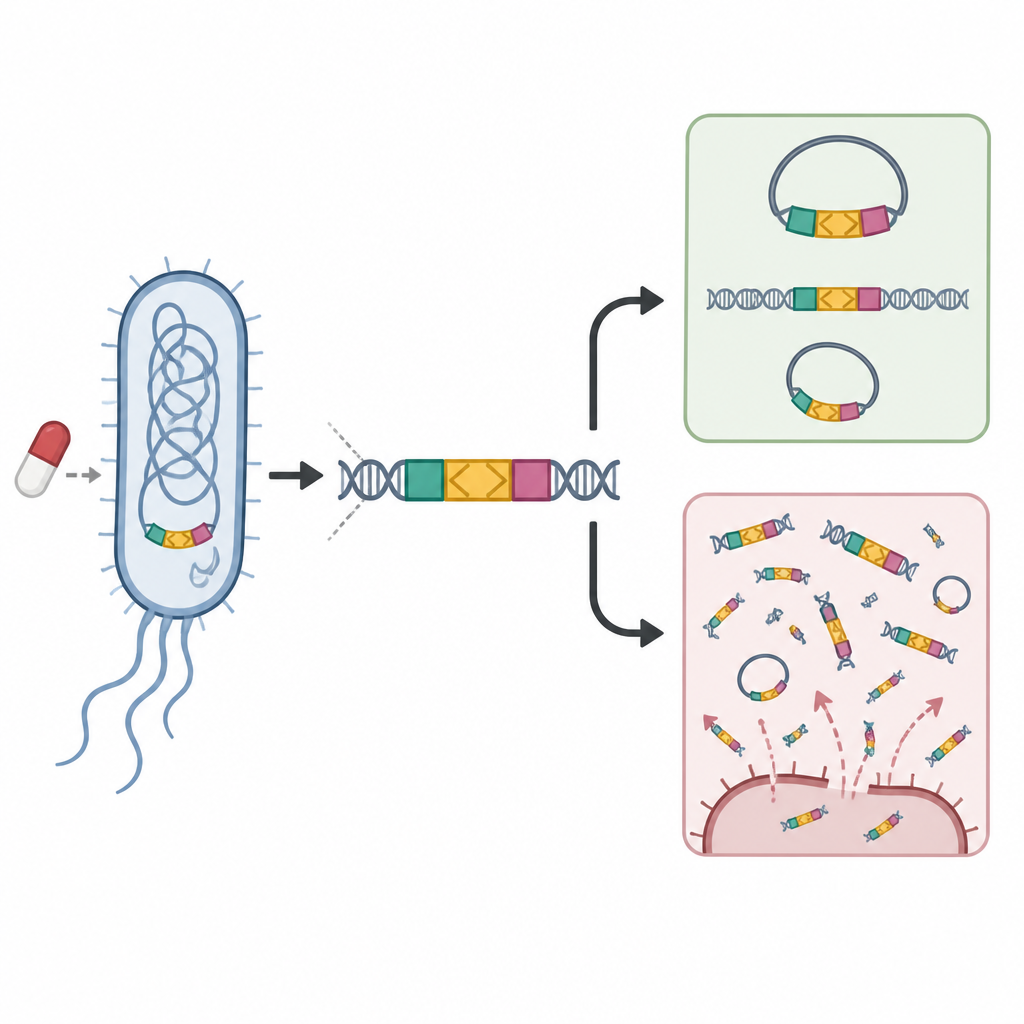
Insertion sequences are short stretches of DNA that can copy or cut themselves out of one place in a genome and insert into another. The IS91 family is unusual because it does not behave like most known jumping elements and is often found next to antibiotic resistance genes. The classic IS91 element carries not only the main enzyme that performs the DNA cutting and joining, called TnpA, but also an extra short gene, orf121, that other family members lack. The stop signal of orf121 overlaps by one letter with the start of tnpA, hinting at intimate control of how both proteins are produced.
Orf121 as a volume knob for DNA jumping
The researchers first explored how common orf121 is in nature. By scanning hundreds of DNA entries from public databases, they found that most IS91 variants carry a complete Orf121 protein and that the one-letter overlap with tnpA is highly conserved. This suggests that the overlap is not an accident but has been preserved by evolution. In laboratory tests, they measured how strongly two nearby DNA on-switches drive production of orf121 and tnpA. They showed that tnpA is mainly produced from the promoter in front of orf121 and that the tiny overlap between the two genes boosts expression of tnpA, likely through tight coupling of their translation on the same message.
Holding back runaway DNA movement
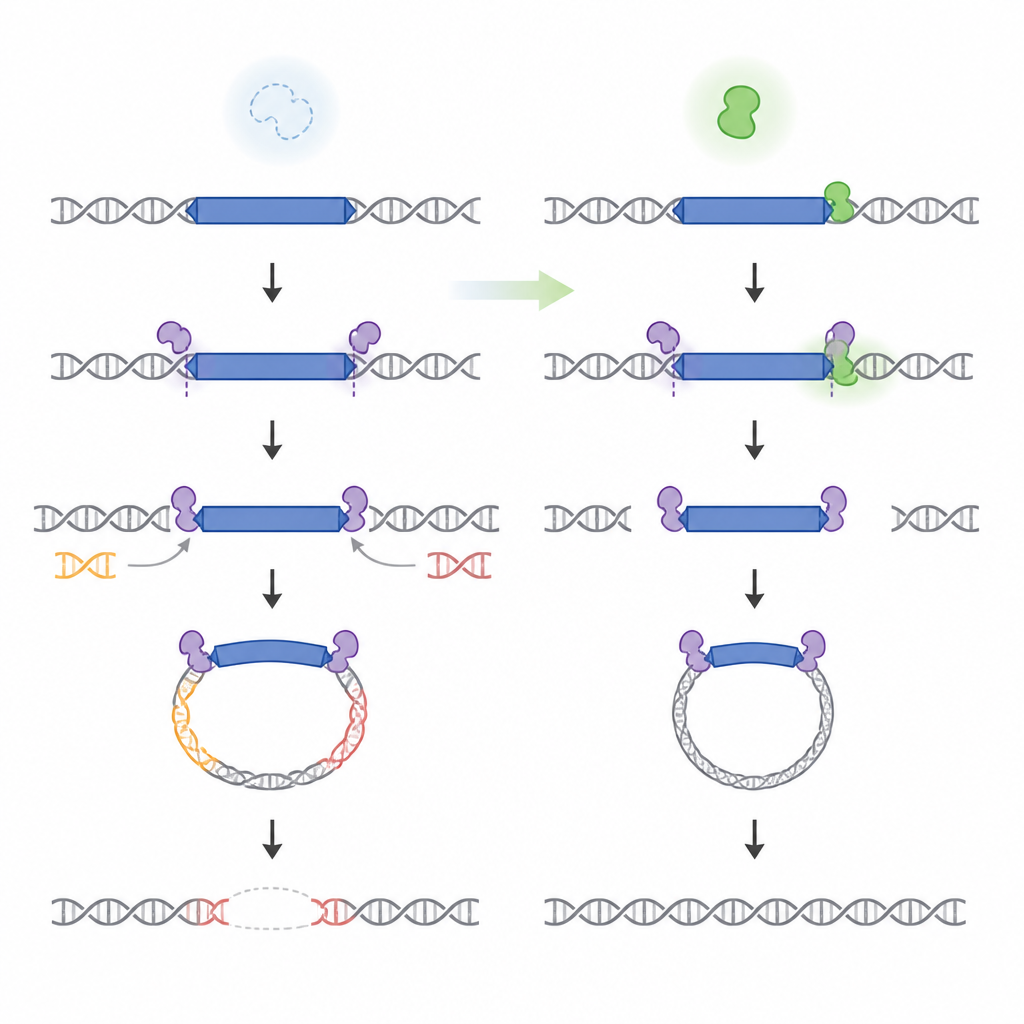
To see what Orf121 actually does during DNA jumping, the team used a system in which IS91-like segments could move onto a target plasmid during a controlled mating experiment in Escherichia coli. When TnpA was produced on its own, IS91 jumped frequently into the target DNA. When Orf121 was produced together with TnpA, either from the same message or from a separate one, jumping dropped sharply, sometimes by several thousand fold. This reduction matched a drop in tnpA message and protein levels, showing that Orf121 can lower the amount of active transposase. Yet Orf121 did not change where IS91 chose to insert: preferred target DNA sequences stayed the same whether Orf121 was present or not.
Cleaning up the cut and limiting cargo
IS91 moves by forming circular DNA intermediates. Earlier work had seen both single-stranded and double-stranded circles, but it was not clear which form is actually used for insertion. Using carefully designed plasmids that carried pre-made IS91 junctions, the authors showed that only the bottom single-stranded circle served as a working intermediate in their assays. Double-stranded circles and the opposite strand did not yield detectable insertion. Orf121 also improved the precision of the cut made at one end of IS91, known as terIS. Without Orf121, that end often failed to be recognized correctly, leading to one-ended transposition events in which extra neighboring DNA was dragged along. With Orf121 present, the fraction of these one-ended events dropped significantly, meaning fewer flanking genes were co-mobilized.
Balancing spread and stability
Together, these findings show that Orf121 plays a dual role. It acts as a brake on IS91 activity by reducing the production and action of the TnpA enzyme, and it acts as a guide that helps TnpA cut precisely at the correct DNA boundary, minimizing how much extra DNA is accidentally moved. For a bacterium, this represents a compromise: IS91 remains mobile enough to help shuffle genes, including resistance genes, but not so active that it threatens the stability of the host genome. For scientists tracking antibiotic resistance, this work highlights how even very small regulatory proteins can strongly influence when and how resistance genes are mobilized.
Citation: Fauconnier, A., Da Re, S., Gaschet, M. et al. Dual regulatory role of IS91-encoded Orf121 in IS91 transposition. Commun Biol 9, 667 (2026). https://doi.org/10.1038/s42003-026-09874-7
Keywords: IS91, insertion sequence, antibiotic resistance, bacterial genome, mobile genetic element