Clear Sky Science · en
Optochemical elucidation of a critical role of the incomplete spindle assembly checkpoint in zebrafish development
When Early Life Juggles Speed and Safety
Every animal starts as a single cell that must divide again and again with astonishing speed. But copying and sharing DNA so quickly comes with risks. If early mistakes slip through, they can ripple across the entire body, sometimes causing birth defects or disease later in life. This study uses light-controlled chemistry in zebrafish to ask a basic question with big implications: how many cell division mistakes can a growing embryo actually tolerate, and when in development are such errors most dangerous? 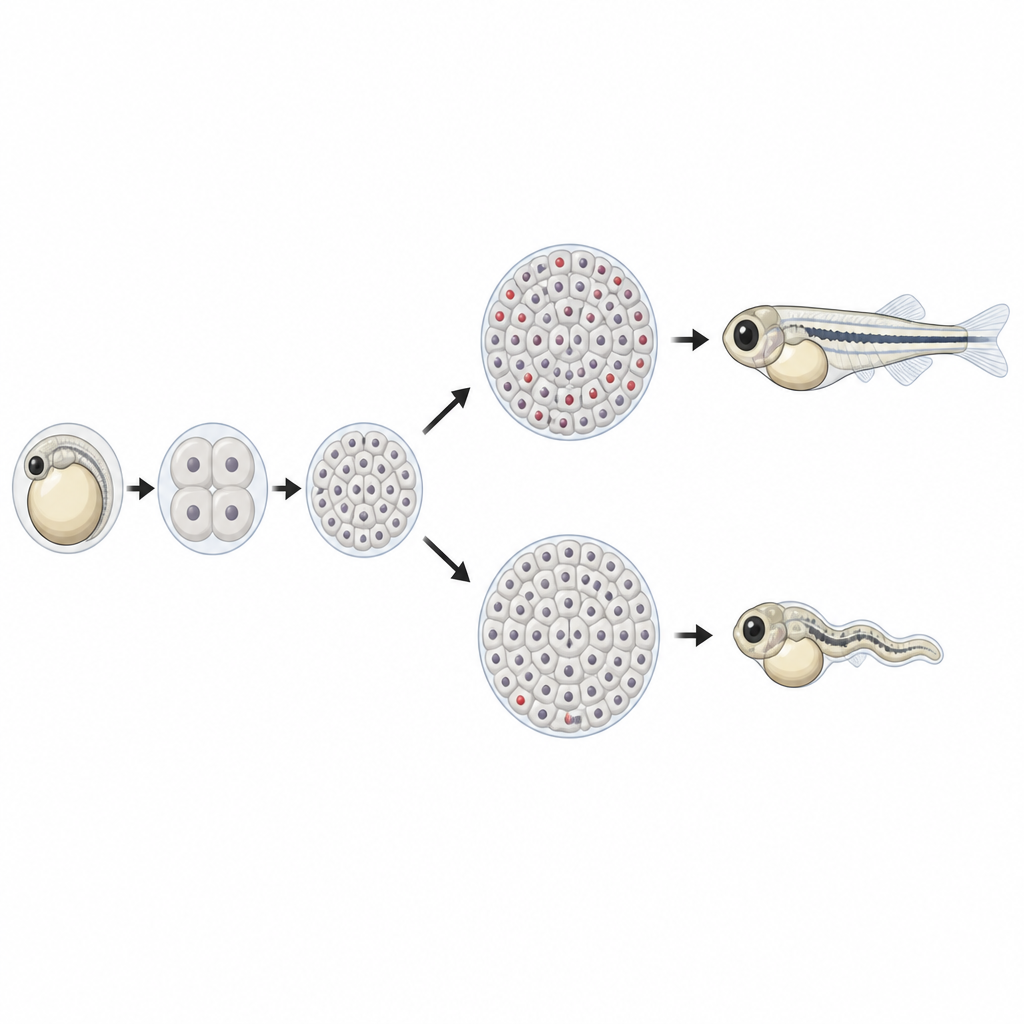
Watching Cells Stumble on Purpose
To probe this balance, the researchers focused on a tiny motor protein that helps chromosomes line up correctly before a cell splits in two. They used a custom molecule that can block this motor when its shape is switched by specific colors of light, and then release it again when the light is changed. Because zebrafish embryos are transparent, the team could bathe whole embryos in this compound and then flip it on and off at precise times simply by shining different wavelengths of light. This let them trigger controlled bursts of cell division errors during distinct windows of early development, something that traditional drugs or genetics cannot easily do.
Fragile Beginnings Before the Body Takes Shape
The team first interfered with chromosome alignment in very young embryos, before the stage when tissues and the overall body plan begin to form. During this early window, cell divisions are extremely rapid and synchronized. Short pulses of disruption caused some widespread misalignment of chromosomes but surprisingly did not always doom the embryos. A few individuals survived even after one or two rounds of severe whole-embryo errors, though they sometimes showed subtle reductions in body length or eye size. However, when the disruption was extended to cover more rounds of rapid divisions, damage added up. More embryos died, and survivors showed marked growth defects. These results suggest that early embryos can survive isolated bursts of trouble but are vulnerable to repeated or long-lasting breakdowns in accurate chromosome sharing.
A More Resilient Phase as Tissues Emerge
The picture changed dramatically once embryos entered the gastrula stage, when cells slow down, divisions become less synchronized, and the first tissues begin to organize. Here, the same light-activated inhibitor caused many cells to misalign chromosomes and to form micronuclei, small extra pockets of DNA that signal past errors. Yet even with several hours of continuous disruption across the whole embryo, most fish grew into apparently normal larvae and even healthy adults. Chromosome spreads taken days later showed that extra or missing chromosomes were more common than in untreated siblings, but still stayed below a level that derailed development. This indicates that embryos at this stage can live with a modest fraction of abnormal cells, as long as errors do not become overwhelming. 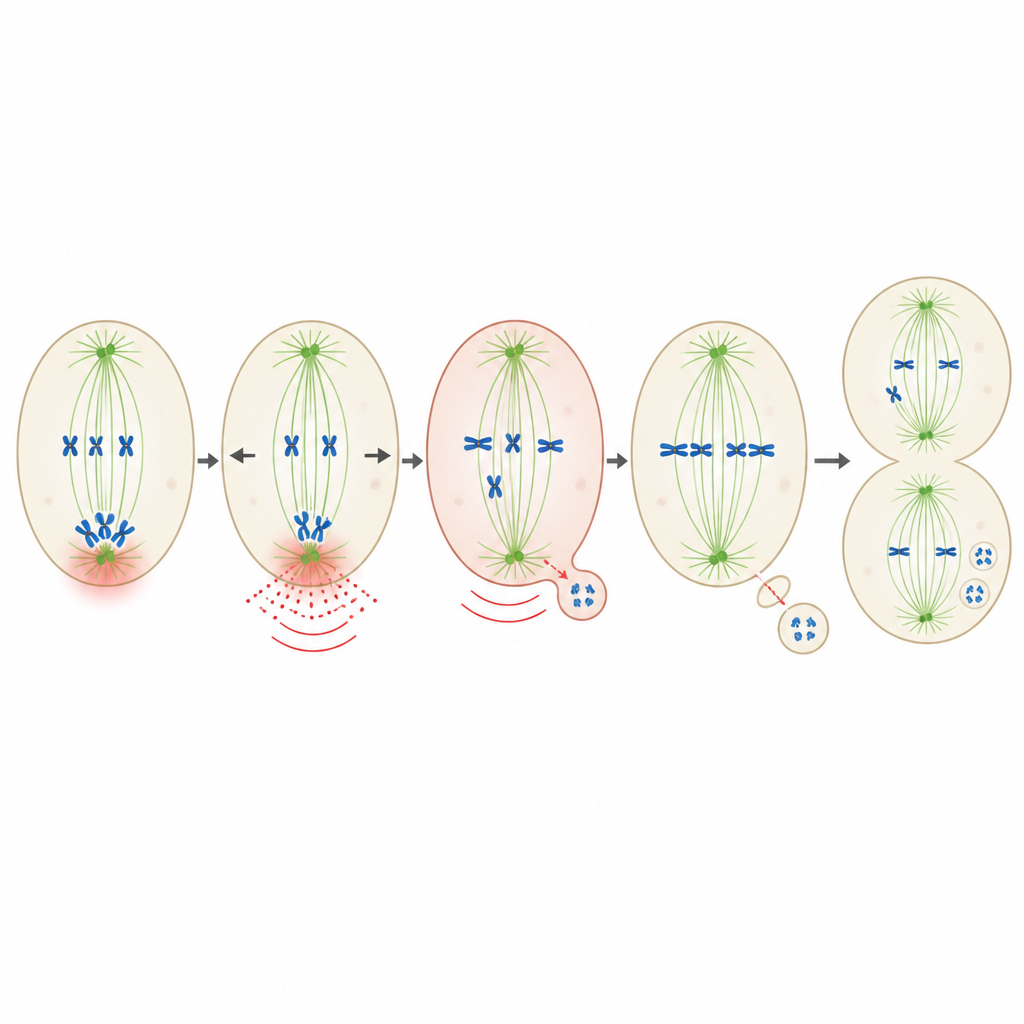
A Leaky Safety Check that Still Matters
Why are gastrula embryos so tolerant? The answer centers on a cellular safety system called a checkpoint, which normally delays cell division if chromosomes are not lined up correctly. Earlier work suggested that this checkpoint is weak or absent in very young embryos. By tracking dividing cells, the authors found that early-stage embryos marched into separation at full speed even when chromosomes were badly misaligned. In contrast, during gastrulation, the same type of error caused a noticeable delay in division. Cells paused long enough to partially improve chromosome alignment, though not to perfection. When the researchers chemically disabled this checkpoint while also disrupting the motor protein, the supposedly tolerant gastrula embryos became highly sensitive and mostly died, with many cells undergoing programmed cell death and fewer cells still dividing. This shows that even an incomplete, “leaky” checkpoint is crucial for blunting the impact of mistakes.
Living with Imperfection
Overall, the study reveals that zebrafish embryos do not require flawless chromosome segregation to build a viable body. Very early on, they endure only a small number of catastrophic missteps before damage accumulates beyond repair. Later, as a partial checkpoint comes online and cell cycles slow, embryos can absorb repeated errors, prune heavily damaged cells, and continue developing even with some chromosome abnormalities in their tissues. The work highlights how early life walks a tightrope between rapid growth and genetic accuracy, and how an imperfect safety system can still be essential for keeping that balance.
Citation: Matsura, A., Hosono, M., Matsuo, K. et al. Optochemical elucidation of a critical role of the incomplete spindle assembly checkpoint in zebrafish development. Commun Biol 9, 648 (2026). https://doi.org/10.1038/s42003-026-09871-w
Keywords: zebrafish development, cell division errors, spindle assembly checkpoint, chromosome misalignment, embryo resilience