Clear Sky Science · en
Tke5 is a Pseudomonas putida toxin that kills plant pathogens by depolarising membranes
Friendly Soil Bacteria as Plant Bodyguards
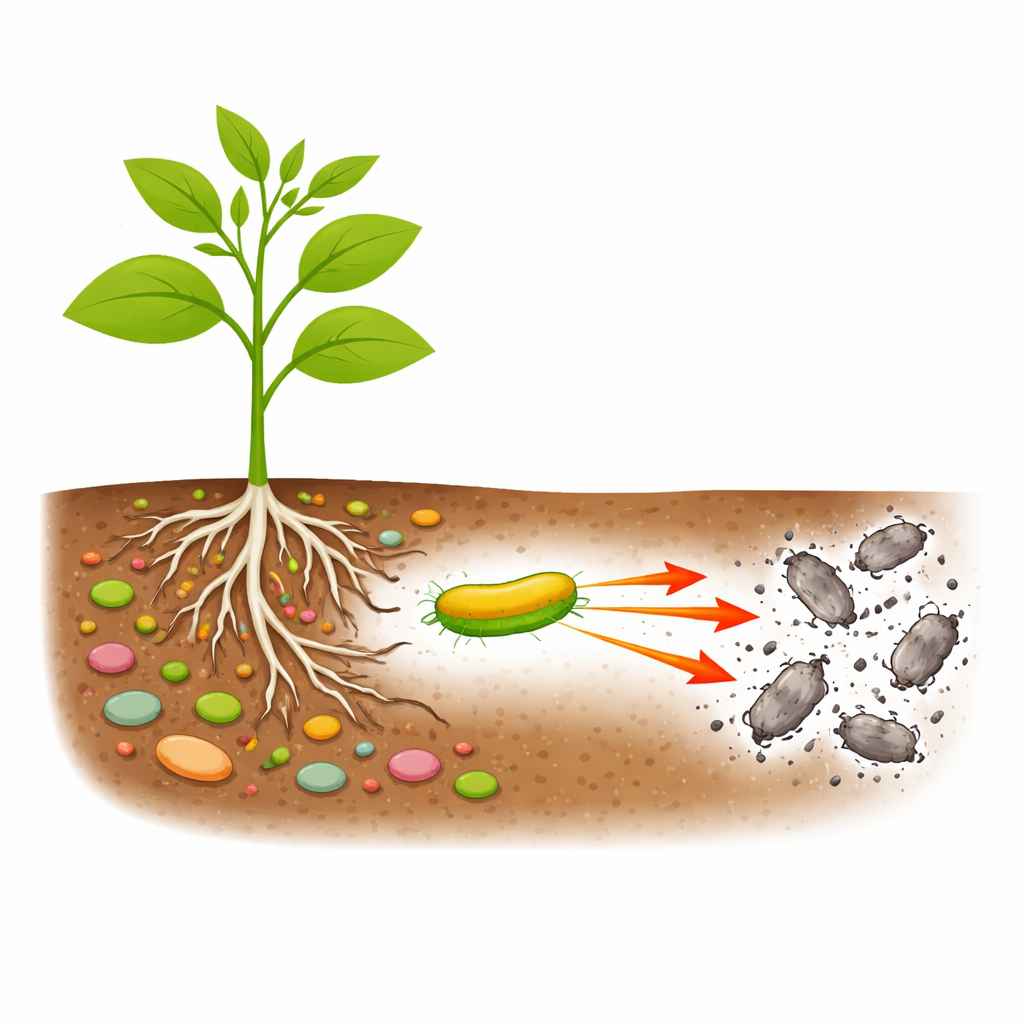
Farmers and gardeners constantly battle bacterial diseases that can wither crops and threaten food supplies. This study uncovers how a helpful soil bacterium, Pseudomonas putida, uses a microscopic weapon—a protein called Tke5—to quietly shut down harmful plant bacteria without tearing them apart. By understanding how this natural "bodyguard" system works at the molecular level, researchers hope to design greener alternatives to chemical pesticides and better protect crops in a warming, crowded world.
A Hidden Weapon in Root-Dwelling Microbes
Plants live in crowded soils teeming with microbes that either help them grow or cause devastating disease. Beneficial species like P. putida compete with plant pathogens for space and nutrients. One of their most powerful tools is the type VI secretion system—a tiny, spring-loaded syringe that can inject toxic proteins directly into neighboring bacteria. Earlier work showed that P. putida carries several such toxins, but many remained mysterious. In this paper, the authors focus on Tke5, a large protein encoded next to genes that build one of these molecular syringes. Computer analyses revealed that Tke5 belongs to a widespread but poorly understood toxin family and likely targets bacterial membranes, hinting that it might act as a pore‑forming toxin—one that punches controlled holes in cell envelopes.
A Precision Toxin and Its Safety Switch
To test whether Tke5 is truly toxic, the researchers forced bacteria to produce it from a controllable genetic switch. When P. putida cells began making Tke5, their growth slowed sharply, especially when Tke5 was guided toward the cell envelope, showing that it is indeed a powerful antimicrobial protein. The team also discovered a neighboring gene, tki5, that makes a partner protein acting as a built‑in antidote. When both toxin (Tke5) and immunity protein (Tki5) were made together, the cells recovered and grew normally. Biochemical purification showed that Tke5 and Tki5 bind each other within the inner membrane, forming a stable complex that protects the producer bacterium from its own weapon while leaving competitors vulnerable.
Cutting Power Without Shattering the Cell
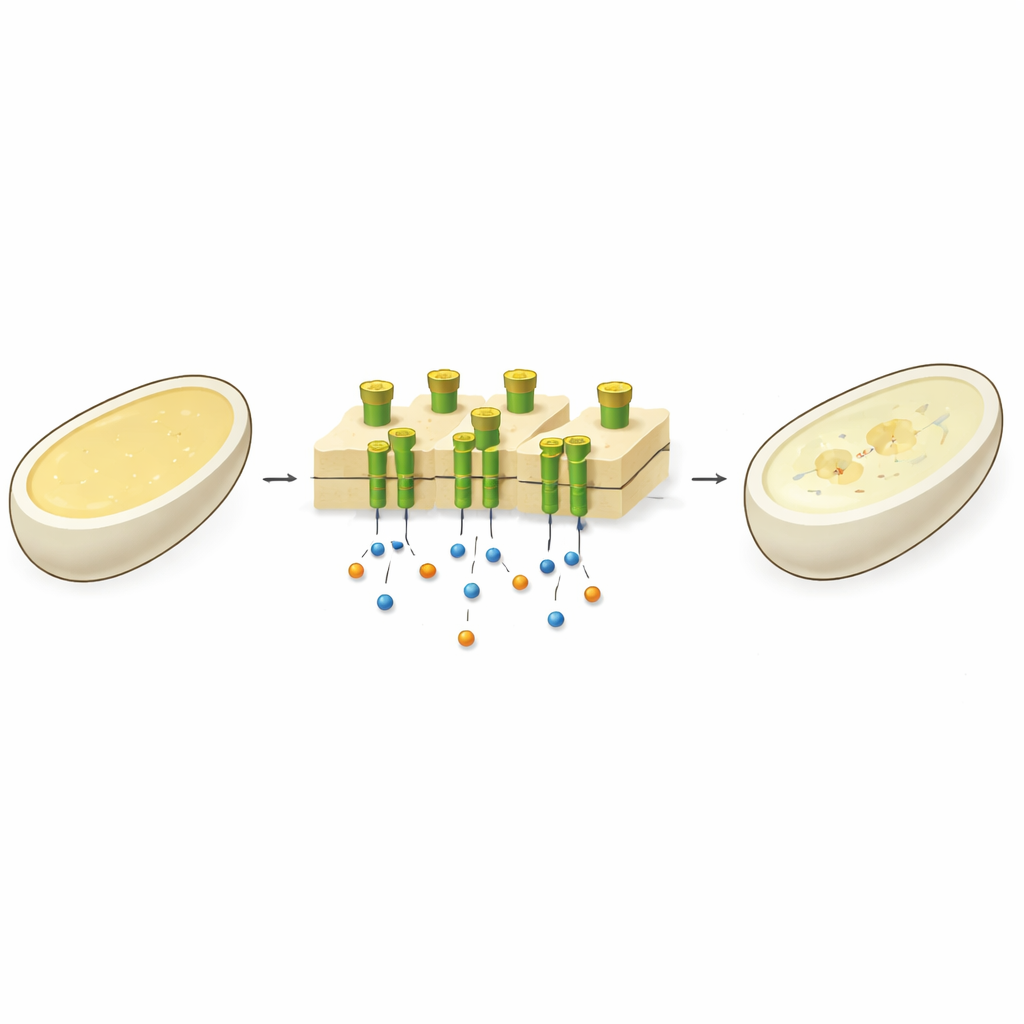
Many toxins work like biochemical sledgehammers, tearing holes in membranes and spilling a cell’s contents. Tke5 behaves more like a lock‑picker. When the authors turned on the tke5 gene in Escherichia coli laboratory bacteria, cell numbers dropped as with a killing antibiotic, confirming that Tke5 is bactericidal rather than merely growth‑inhibiting. Yet flow‑cytometry measurements showed that the membranes did not become leaky to large molecules. Instead, a special dye revealed that exposed cells rapidly lost their electrical membrane potential—the tiny voltage that bacteria use to power nutrient uptake and energy production. Co‑producing the Tki5 immunity protein prevented this loss of membrane potential, demonstrating that the toxin’s main effect is to short‑circuit the cell’s electrical system while leaving the physical barrier mostly intact.
Nanoscopic Pores That Prefer Positive Ions
To see how Tke5 accomplishes this electrical sabotage, the team purified the protein and added it to artificial membranes, then recorded single‑molecule currents. They observed stable, step‑like changes in electrical conductance, direct evidence that Tke5 forms pores across the membrane. These pores are extremely narrow—less than a billionth of a meter in diameter—allowing small charged particles to pass while excluding larger molecules. By imposing salt gradients and measuring the voltage needed to cancel the current, the researchers showed that Tke5 pores strongly favor positively charged ions such as potassium over negatively charged ones. This selective ion flow is enough to drain the cell’s normal voltage difference across its inner membrane, collapsing its energy supply without bursting the cell.
A New Tool for Greener Crop Protection
Finally, the authors tested Tke5 directly against a panel of notorious plant pathogens that attack crops like tomatoes, potatoes, brassicas, fruit trees, and olives. When these disease‑causing bacteria were engineered to produce Tke5, their growth was dramatically curtailed, whereas control cells and those making a harmless fluorescent protein grew well. Together, the findings show that Tke5 is a potent, precision membrane‑depolarizing toxin coupled to its own membrane‑bound immunity shield. Because it can disable a wide range of plant pathogens while being naturally produced by a beneficial root bacterium, Tke5 and related toxins offer a promising blueprint for biological crop protection that could reduce reliance on broad‑spectrum chemical pesticides.
Citation: Velázquez, C., Arce-Rodríguez, A., Altuna-Alvarez, J. et al. Tke5 is a Pseudomonas putida toxin that kills plant pathogens by depolarising membranes. Commun Biol 9, 598 (2026). https://doi.org/10.1038/s42003-026-09863-w
Keywords: biocontrol, plant pathogens, bacterial toxins, membrane pores, sustainable agriculture