Clear Sky Science · en
Ocean acidification disrupts the biomineralization process in the oyster Crassostrea virginica via intracellular calcium signaling dysregulation
Why oyster shells matter in a changing ocean
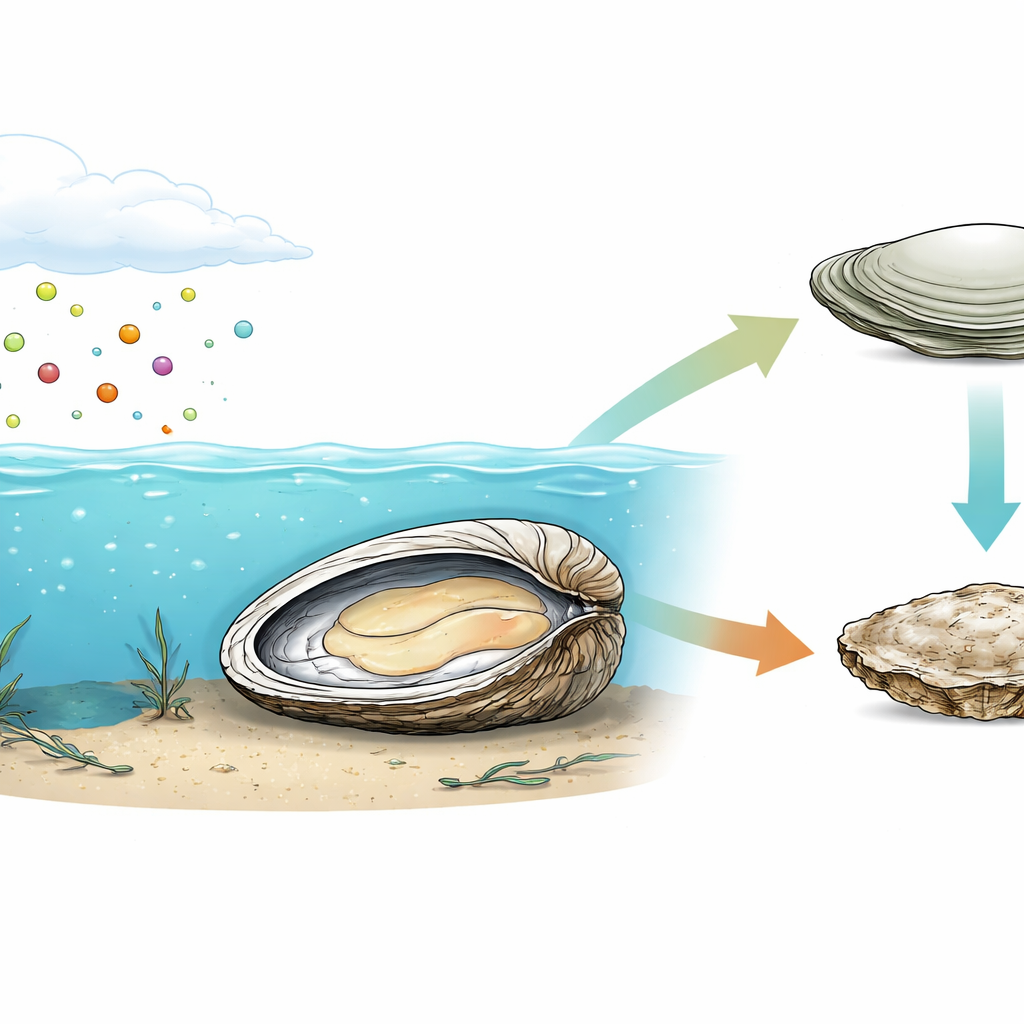
Oysters are more than just seafood—they build reefs that protect shorelines, filter water, and support coastal economies. But as the ocean absorbs more carbon dioxide from the atmosphere, it becomes more acidic, threatening the very process by which oysters build their shells. This study uncovers how acidifying seawater interferes with the oyster’s internal machinery for making shells, revealing that the problem is not only chemical dissolution from the outside, but also a breakdown in a key cell signaling system inside the animal.
How oysters build their armor
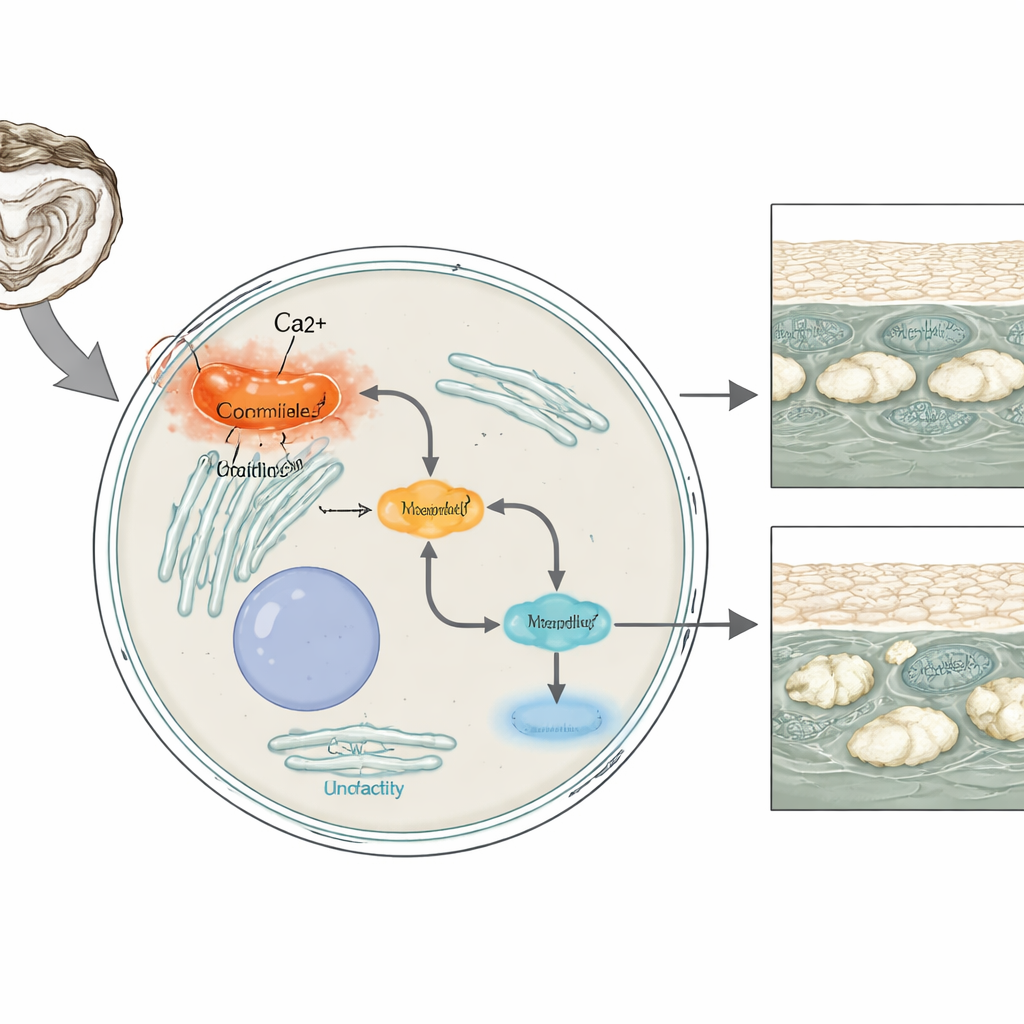
An oyster’s shell is mostly calcium carbonate mineral, reinforced by a thin but intricate organic framework of proteins and sugars. This structure is built by a sheet of tissue called the mantle, whose epithelial cells secrete both the mineral and the organic shell matrix. Inside these cells, calcium is not only a raw material for shells—it also acts as a messenger that helps control when and how shell-building proteins are produced and arranged. Two core players in this signaling system are calmodulin, which senses calcium inside the cell, and calcineurin, an enzyme that responds to calmodulin and helps regulate genes needed for proper shell formation.
When extra carbon dioxide reaches the sea
Human activities are driving atmospheric carbon dioxide toward levels that will markedly increase ocean acidity. In more acidic seawater, shell minerals dissolve more easily and fewer building blocks are available to form new calcium carbonate. The authors asked whether oysters simply suffer from this chemistry, or whether their own cells also respond—and perhaps overreact—in ways that damage shell construction. Using cell cultures made from the mantle tissue of the eastern oyster, they exposed cells to high carbon dioxide conditions that mimic the chemistry of oyster shell fluid in an acidified ocean, then monitored how calcium inside the cells and key signaling proteins responded.
Calcium signals go into overdrive
Under elevated carbon dioxide, mantle epithelial cells showed a clear influx of calcium from the outside environment into their interiors. This surge in calcium strongly boosted levels of calmodulin, the calcium sensor, while paradoxically suppressing calcineurin, its usual downstream partner. At the same time, genes encoding several core shell matrix proteins—responsible for controlling crystal type, guiding mineral deposition, and building the organic scaffold—became overactive in the cultured cells. Larval oysters raised in acidified seawater showed misshapen shells and disorganized shell matrices, along with stage-dependent shifts in these same signaling and shell-building genes, indicating that the disruption begins early in development and changes as larvae grow.
Chemical blocking and rescue experiments
To test whether this disturbed signaling pathway actually drives the shell defects, the researchers chemically blocked calmodulin’s ability to bind calcium using a compound called W-7. Even without extra carbon dioxide, this treatment mimicked many of the molecular and structural changes seen under acidified conditions: calmodulin levels rose, calcineurin activity fell, shell matrix genes were misregulated, and larval shells developed abnormal organic layers and altered mineral patterns. In a complementary experiment, adding extra calcineurin to mantle cells exposed to high carbon dioxide largely restored shell-matrix gene activity to normal levels. Together, these manipulations show that it is the imbalance in the calcium–calmodulin–calcineurin pathway, not just external seawater chemistry, that leads to faulty shell construction.
What this means for oysters and oceans
This work reveals that ocean acidification harms oysters not only by dissolving their shells from the outside, but also by scrambling an internal signaling circuit that coordinates shell building. Excess calcium entering mantle cells under acidified conditions drives calmodulin into overdrive, which in turn weakens calcineurin and throws the production and arrangement of shell matrix proteins out of balance. The result is a shell that is malformed and potentially weaker, even if it still appears to grow. Understanding this cellular vulnerability offers new clues for breeding or managing more resilient oyster stocks and highlights that the biological impacts of rising carbon dioxide extend deep into the inner workings of marine organisms, not just the waters they live in.
Citation: Huang, C., Matt, J., Hollenbeck, C. et al. Ocean acidification disrupts the biomineralization process in the oyster Crassostrea virginica via intracellular calcium signaling dysregulation. Commun Biol 9, 607 (2026). https://doi.org/10.1038/s42003-026-09861-y
Keywords: ocean acidification, oyster shells, calcium signaling, biomineralization, marine climate change