Clear Sky Science · en
Distinct adaptation and ancestral retention signals in African and European indigenous cattle genomes
Cows on the front line of a changing world
As the planet warms and diseases spread, the humble cow sits at the center of a global challenge: how to keep producing milk and meat when heat, parasites, and scarce feed all intensify. This study looks inside the DNA of traditional African and European cattle to reveal how their mixed family histories help them cope with harsh conditions, and how those same genetic treasures could support future farming.
Many breeds with deep and tangled roots
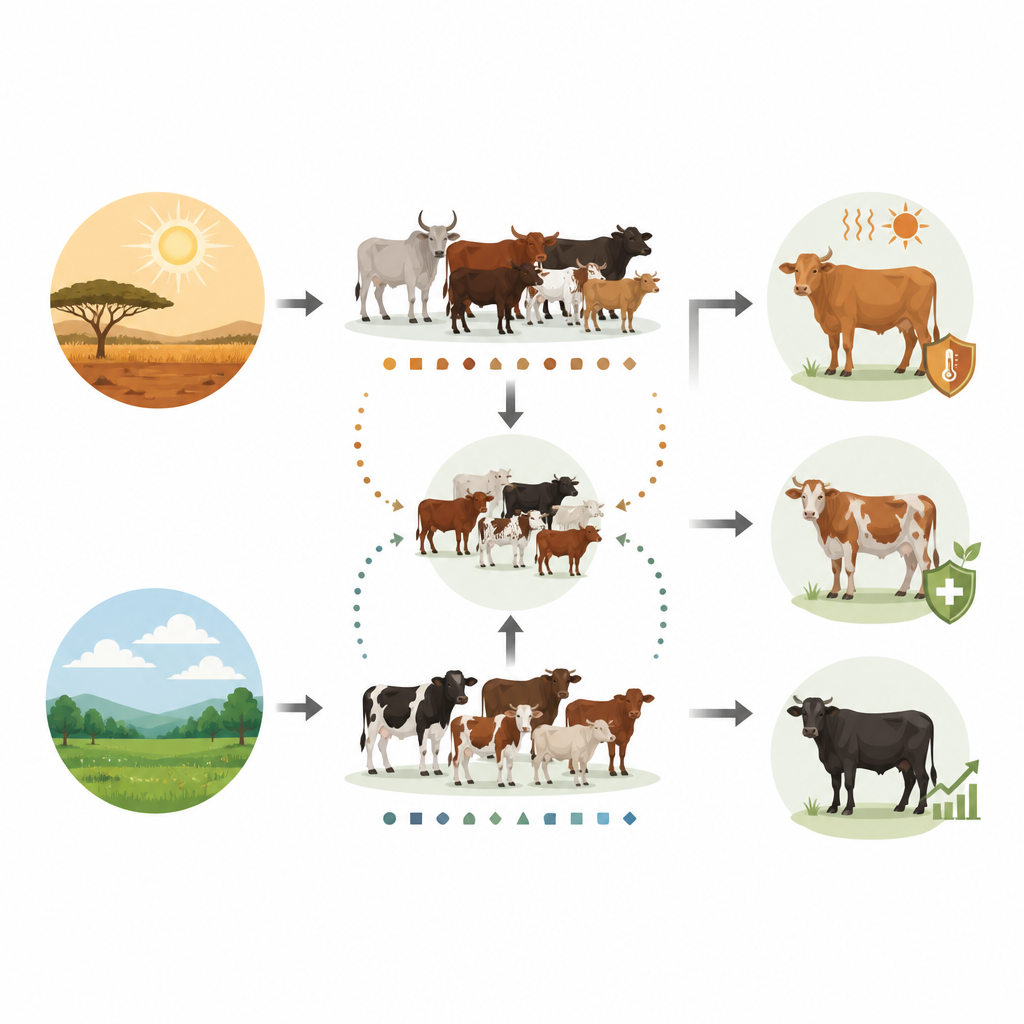
Across Africa and Europe, local cattle breeds have been shaped by thousands of years of movement, trade, and selective breeding. Some descend mainly from humpless taurine cattle, others from humped indicine cattle, and many are blends of both. The researchers sequenced the whole genomes of 519 animals from 24 indigenous breeds, then compared them with 117 reference genomes from around the world. By plotting genetic similarities and building family trees, they showed that African and European breeds form distinct clusters, but with clear signs of past mixing, especially in African herds and in Portuguese cattle from the Iberian Peninsula.
Tracing ancient mixtures in cattle DNA
To understand when and how these mixtures occurred, the team used statistical tools that detect traces of past gene flow in patterns of shared genetic variants and in how those variants are arranged along chromosomes. They found strong evidence that many African breeds carry both taurine and indicine ancestry, reflecting several waves of crossbreeding over the last few hundred to roughly a thousand years. In southern Europe, one Portuguese breed, Mertolenga, showed clear signals of older African taurine input, likely linked to historical contacts across the Mediterranean during the Moorish presence in Iberia. These timelines match what archaeologists and historians know about cattle movement and trade.
Genetic mosaics that help cattle survive
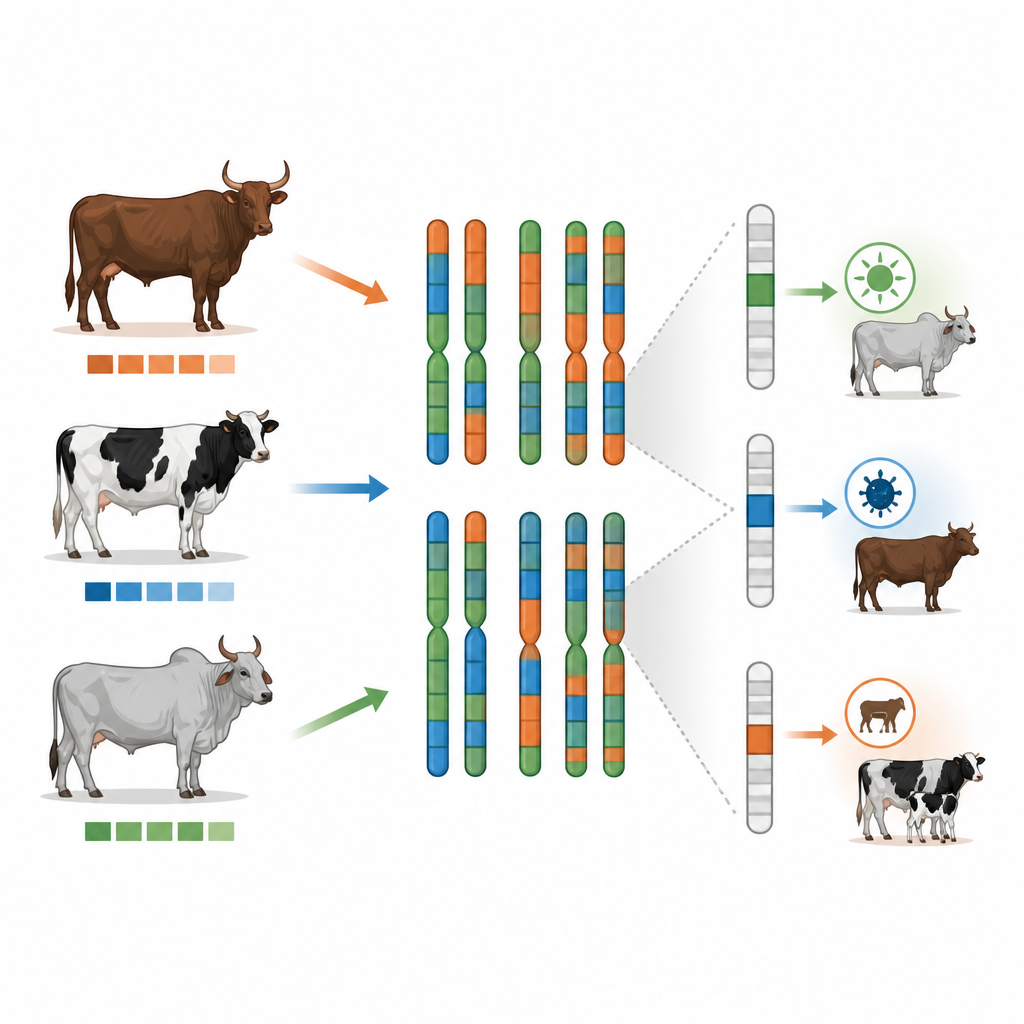
The study then zoomed in to see which stretches of DNA from each ancestral source were most likely to be kept by natural or human-driven selection. Using a method that paints each segment of the genome as African taurine, European taurine, or indicine in origin, the authors searched for patches that were unusually common across animals living in similar environments. In African herds, segments of African taurine origin were especially rich in genes tied to immune defenses, energy use, and basic cell balance, fitting with long exposure to tropical infections and nutritional stress. Segments of indicine origin often carried genes related to coping with heat, managing cellular stress, and regulating inflammation, echoing the reputation of humped cattle for thriving in hot, parasite-rich regions.
Key genes for heat, health, and productivity
Among the many highlighted genes, several stood out as repeat players. One gene of indicine origin, DDIT3, helps cells respond to heat and nutrient shortage and showed strong and consistent retention in African breeds, suggesting that indicine versions of this gene give cattle an edge under thermal and feed stress. Another, IRAK3, is involved in fine-tuning immune responses and may help animals avoid damaging inflammation while fighting infections. In African breeds that recently received European taurine input, the retained European segments tended to contain genes affecting growth, reproduction, and body composition, such as those involved in lipid metabolism, fertility, and milk traits. In Portuguese Mertolenga cattle, African taurine–derived regions included a cluster of genes related to heat shock protection, energy balance, and fertility, which may support the breed’s ability to keep stable body temperature in hot weather.
Why these findings matter for future herds
Together, these results reveal that today’s African and European indigenous cattle are genetic mosaics whose mixed ancestry has been sculpted by climate, disease, and farming practices. Instead of one lineage being “best,” different ancestral pieces contribute different strengths: disease tolerance from African taurine cattle, heat and stress resilience from indicine cattle, and productivity from European taurine cattle. Understanding where these useful segments sit in the genome provides a roadmap for breeding programs that aim to balance robustness and output without losing precious local diversity. For farmers and breeders, conserving indigenous cattle and their unique genetic combinations may be one of the most practical tools for keeping livestock healthy and productive in an increasingly unpredictable world.
Citation: Gao, J., Ginja, C., Liu, Y. et al. Distinct adaptation and ancestral retention signals in African and European indigenous cattle genomes. Commun Biol 9, 619 (2026). https://doi.org/10.1038/s42003-026-09856-9
Keywords: cattle genetics, livestock adaptation, heat tolerance, disease resistance, indigenous breeds