Clear Sky Science · en
Early life chronic stress-disrupted activity of the dorsal raphe nucleus selectively drives behavioral impairments
Why early stress in tiny fish matters to us
Stressful experiences in childhood are known to raise the risk of anxiety and mood problems later in life, but the brain changes linking early stress to later behavior are hard to see. This study uses transparent zebrafish larvae and advanced brain imaging to watch how a key mood‑related brain region responds to repeated stress, revealing how early life stress can subtly rewire stress circuits and change how animals cope with challenges.
Watching stress circuits in real time
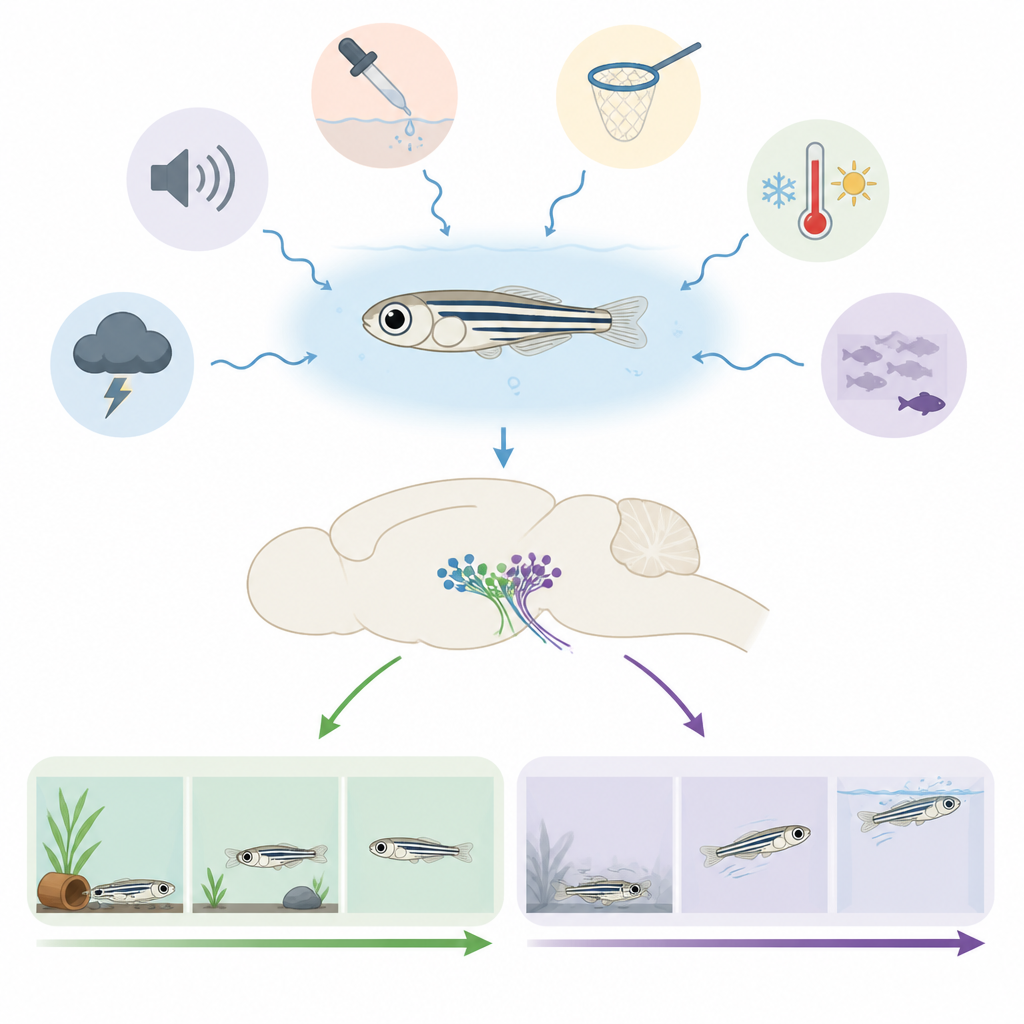
The researchers focused on the dorsal raphe nucleus, a small brainstem region rich in serotonin‑producing cells that communicate with many emotion and stress centers across the brain. Because larval zebrafish are tiny and see‑through, the team could label these cells with a fluorescent calcium sensor and record their activity with two‑photon microscopy while the animals were awake. They exposed some young fish to a week of mild, unpredictable stressors such as brief salt spikes, chasing and sudden light changes, while other fish grew up in calmer conditions. Later, they compared how these two groups of fish responded in the brain and in behavior when faced with new stressful events.
How healthy brains learn to dial down a repeated threat
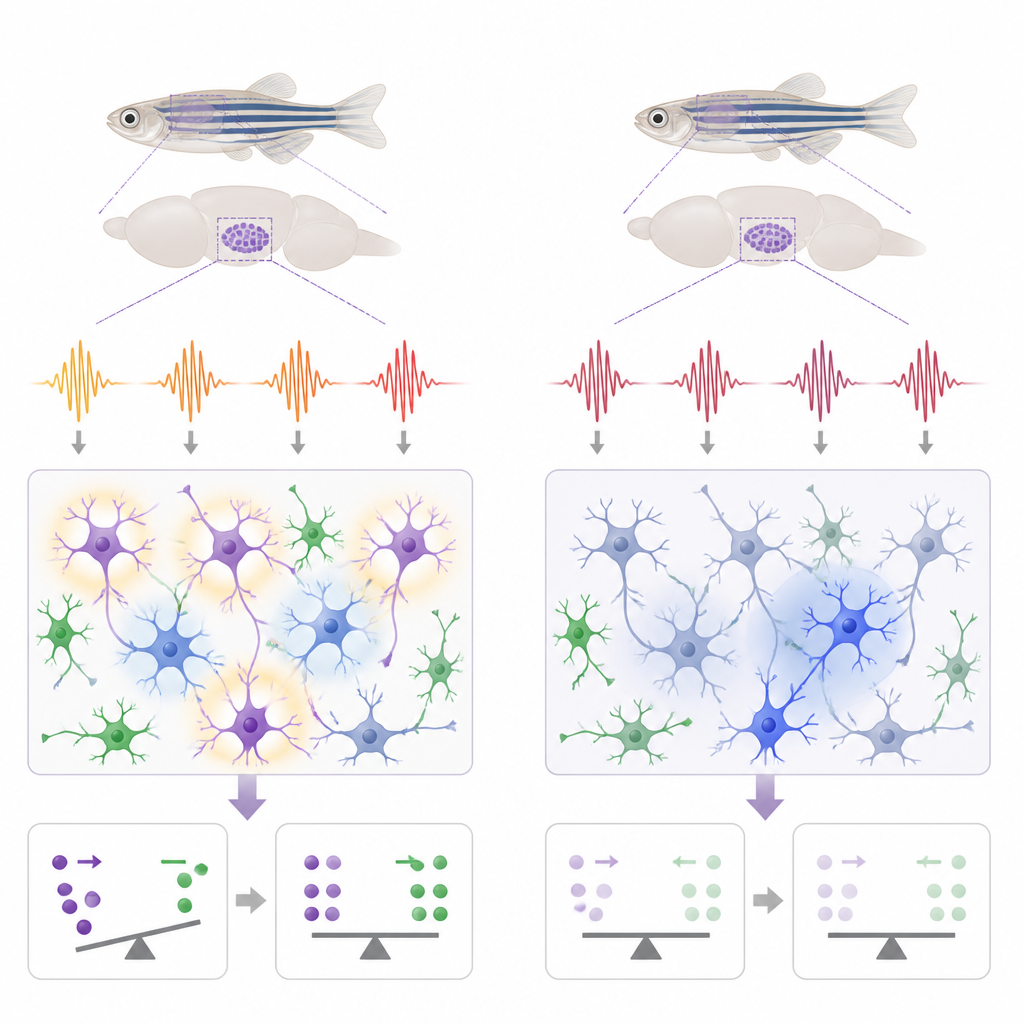
In normally raised fish, a strong salt stimulus that mimics a harsh environment reliably activated serotonin cells in the dorsal raphe. However, when this salty challenge was repeated several times, the overall response of these cells gradually faded. This process, called habituation, is the brain’s way of learning that a repeating challenge is not getting worse, so it can conserve energy and reduce unnecessary alarm signals. Interestingly, the same brain cells did not show this pattern when the fish saw simple flashes of red light, suggesting that the dorsal raphe was especially tuned to true stress rather than just any sensory change.
Early stress locks some cells into rigid patterns
Fish that had experienced chronic early life stress showed a very different picture. Their dorsal raphe serotonin cells still responded strongly to the first salt exposure, but their activity did not quiet down with repetition. By examining individual cells, the team found that normally there is a flexible mix of cells that ramp up and quiet down, shifting the balance from excitation toward inhibition over time. In stressed fish, especially within a subset of serotonin cells that also carried a marker of the calming messenger GABA, this flexibility was lost. More of these cells became stuck in a stably inhibited state and failed to switch between active and quiet modes across repeated stress events, suggesting that early adversity had reduced the plasticity of this micro‑circuit.
From altered brain signals to altered behavior
The scientists then asked whether this rigid brain response translated into changes in how the fish behaved. They presented dark flashes that usually startle zebrafish and cause a brief burst of swimming. In fish with an intact dorsal raphe, those raised without early stress quickly toned down their startle responses over trials, while previously stressed fish kept reacting strongly for longer, a sign of poor habituation and a more persistent alarm state. Remarkably, when the researchers selectively removed the serotonin cells in the dorsal raphe after the stress period, the stressed fish regained normal habituation to the dark flashes. In contrast, early stress also made fish more anxious in a plus‑shaped swimming maze and slowed their general movement, but these anxiety‑like changes were not corrected by removing the dorsal raphe cells, pointing to other brain regions or circuits as the drivers.
What this means for coping with life’s challenges
Together, these results suggest that early life stress can leave a lasting imprint on a key serotonin circuit that helps the brain decide when to calm down in the face of repeated challenges. In zebrafish, this imprint shows up as a loss of flexibility in a specific group of cells, leading to stubbornly high stress responses and slower behavioral habituation, even though overall brain structure looks normal. While fish and humans are very different, the basic organization of serotonin systems is conserved, so this work offers a window into how early adversity might tune stress pathways toward maladaptive coping, and why some stress‑related behaviors, like startle sensitivity, may be controlled by different circuits than ongoing anxiety.
Citation: Varga, Z.K., Golla, A. & Kermen, F. Early life chronic stress-disrupted activity of the dorsal raphe nucleus selectively drives behavioral impairments. Commun Biol 9, 642 (2026). https://doi.org/10.1038/s42003-026-09855-w
Keywords: early life stress, serotonin, dorsal raphe nucleus, zebrafish, stress habituation