Clear Sky Science · en
Temporal synchrony and spatial similarity of interbrain subnetworks predict dyadic social interaction
How Our Brains Quietly Sync During Everyday Choices
When we haggle over a price, split a restaurant bill, or decide what is “fair,” our brains do more than think alone. They subtly coordinate with the brains of the people we are dealing with. This study asks a deceptively simple question: when two strangers repeatedly bargain over money, can patterns of shared brain activity reveal—and even predict—how fairly they will treat each other?
A Two-Person Money Game
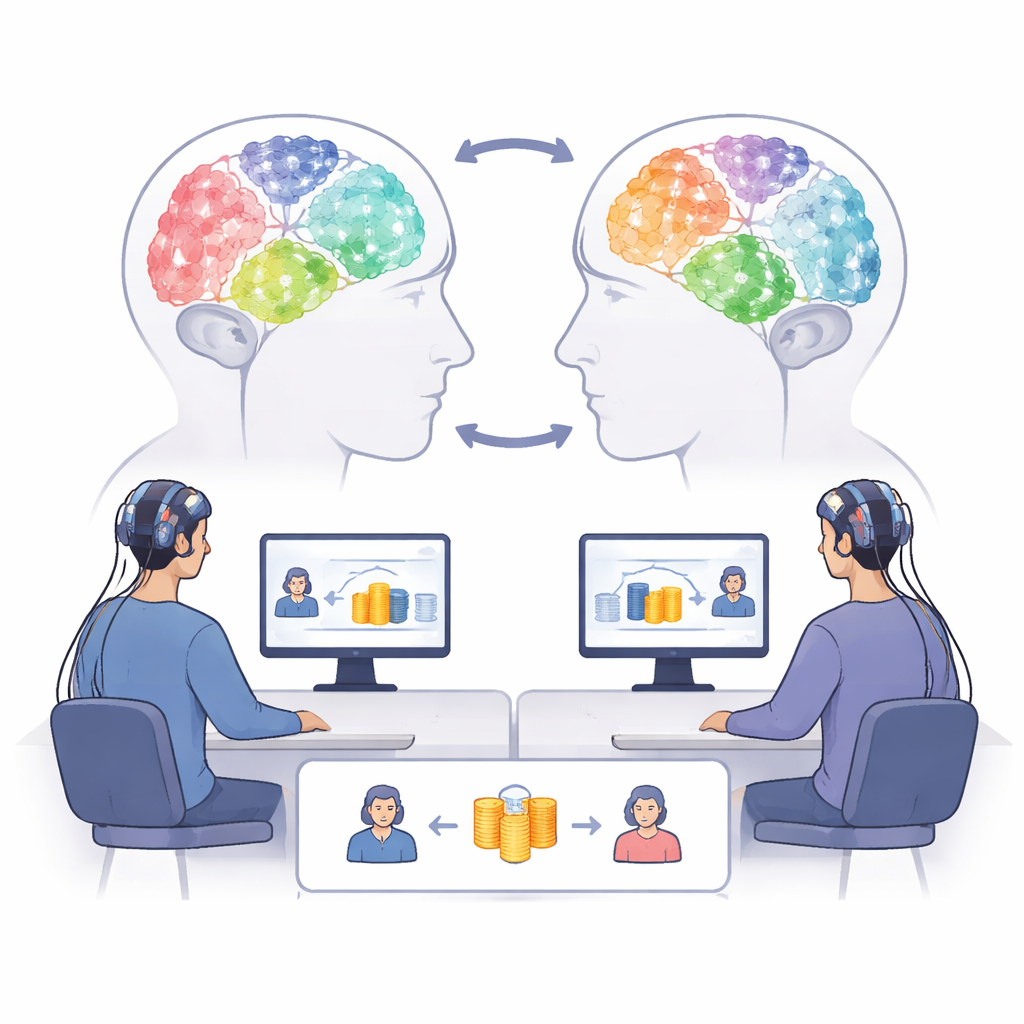
To explore this, the researchers invited 74 pairs of university students to play a classic bargaining task called the ultimatum game. In each round, one person proposed how to split a pot of money, and the other could accept or reject the offer. If the offer was rejected, both got nothing. The pairs played many rounds, encouraging them to adjust their behavior based on what their partner had done before. While they played, both people wore caps that recorded their brain activity using electroencephalography (EEG), allowing the scientists to track rapid neural changes in both brains at once.
Looking at Networks, Not Just Spots
Instead of examining one brain region at a time, the team treated each brain as a set of interacting networks. Using a mathematical method called Bayesian non-negative matrix factorization, combined with EEG source imaging, they uncovered eight large-scale subnetworks that consistently lit up during the game. These included networks linked to internal thoughts and social reflection (often called default mode and self-related systems), movement and sensation, and visual processing. Some matched well-known brain networks, while others showed task-specific twists, hinting that the social give-and-take of bargaining reshapes how these networks work together.
Time Matters: When Brains Fire Together
One focus was temporal synchrony—how closely the timing of brain activity in one person matched that in their partner. The researchers measured this “interbrain synchrony” between corresponding subnetworks in the two brains. As the game progressed, pairs showed stronger synchrony at the network level, especially between systems involved in thinking about oneself and others, planning, sensing the body, and processing visual information. Pairs whose subnetworks were more tightly synchronized tended to make fairer offers, accept more offers, and earn more money overall. In other words, when the timing of their brain activity aligned, their behavior became more cooperative and mutually beneficial.
Space Matters Too: Similar Brain Maps
Timing was only half the story. The team also examined spatial similarity—how alike the physical activation patterns of the same network looked in the two brains. This “inter-subject similarity” increased over blocks of the game in systems related to self-reflection and movement, but decreased in some visual networks. Higher similarity in self-related networks was linked to more fairness and greater total earnings, suggesting that partners whose brains represent the social situation in a more similar way tend to interact more constructively. In contrast, greater similarity in certain visual areas was associated with less cooperative behavior, perhaps reflecting a stronger focus on external details rather than on the shared relationship.
When Time and Space Align
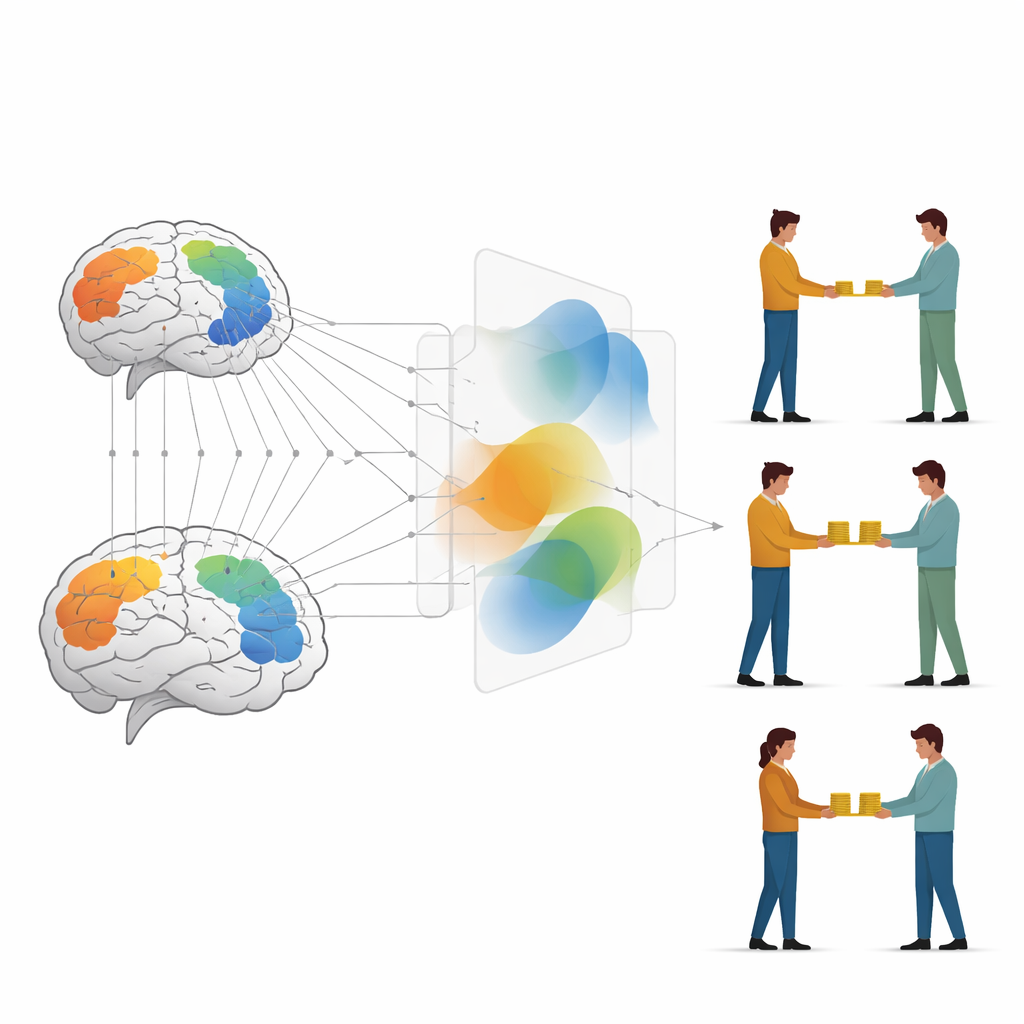
The most striking finding came from combining both perspectives. Within several key subnetworks—especially those tied to internal thoughts, movement, and vision—the degree of temporal synchrony between partners was strongly related to how similar their spatial activation patterns were. This combined “spatiotemporal coupling” turned out to be a powerful marker of interaction quality. Using machine learning, the researchers showed that a fusion of timing-based synchrony and spatial similarity could reliably predict how fair, accepting, and profitable a pair’s decisions would be. Features involving internal thought networks and movement-related systems were among the most informative.
What This Means for Everyday Social Life
For non-specialists, the takeaway is that good social interaction is not just “in your head”—it is also “between heads.” When two people reach fair deals and coordinate smoothly, their brains do not simply work harder; they work together, aligning both in how and where activity unfolds. This study provides evidence that large-scale brain networks, and the way they synchronize across two people in both time and space, are central to successful cooperation. In the future, such interbrain signatures could help us better understand social difficulties in psychiatric conditions, and perhaps even guide new ways to support healthier, more harmonious interactions.
Citation: Li, Y., Li, S., Li, Y. et al. Temporal synchrony and spatial similarity of interbrain subnetworks predict dyadic social interaction. Commun Biol 9, 589 (2026). https://doi.org/10.1038/s42003-026-09854-x
Keywords: interbrain synchrony, social decision making, brain networks, EEG hyperscanning, cooperation