Clear Sky Science · en
Comparative genomics of different haplotypes in Ditylenchus destructor provides insights into their host preferences
Why a tiny worm matters to our food
Hidden in the soil, a microscopic worm called Ditylenchus destructor quietly damages potatoes, sweet potatoes and other root crops, leading to yield losses in the field and rotting during storage. Farmers and inspectors already treat it as a quarantine pest, but not all populations of this nematode behave the same way: some attack mainly sweet potatoes, others thrive on potatoes, and some manage both. This study asks a simple but crucial question: what is different in their DNA that makes one group favor one crop over another?
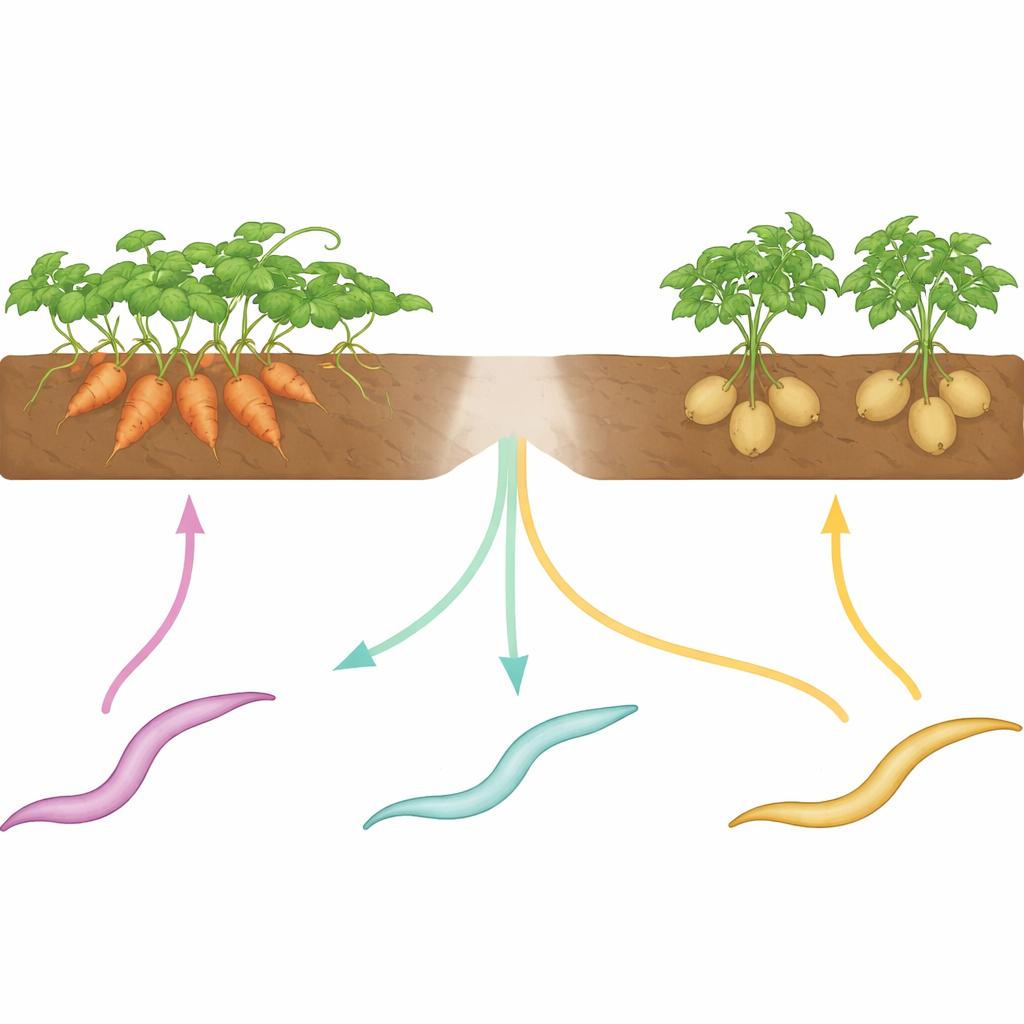
Different strains, different favorite foods
The researchers focused on three genetic variants, or haplotypes, of D. destructor found in China. Haplotype A was collected from sweet potato, while Haplotypes B and C were collected from potato. Earlier work using a commonly studied stretch of ribosomal DNA had hinted that these groups form two main branches: one containing A, and another containing B and C. By growing the nematodes on sweet potato and potato plants, the team confirmed that A reproduces best on sweet potato, C is most successful on potato, and B does reasonably well on both. These simple growth tests, combined with DNA-based family trees, showed that host preference has a clear genetic backdrop.
Building complete genetic blueprints
To uncover the details, the scientists produced high-quality genome sequences for one isolate from each haplotype, combining long-read technologies (PacBio or Nanopore) with accurate short reads from Illumina. This hybrid strategy let them stitch together most of each genome into long stretches, while keeping individual letters highly accurate. They then compared these three new genomes with two previously published genomes from Haplotype A. The resulting genetic blueprints, each containing around 120–160 million DNA letters and more than 20,000 predicted genes, formed a solid foundation for side-by-side comparisons across haplotypes.
Genomes that reshape and specialize
Whole-genome comparisons revealed that the three Haplotype A genomes are tightly similar to one another, but differ more dramatically from Haplotypes B and C. In contrast, the B and C genomes share large, well-aligned regions and cluster together on evolutionary trees, confirming that they are more closely related to each other than to A. At the same time, all three haplotypes show gains and losses of hundreds to thousands of gene families, reflecting an ongoing genetic reshaping that likely supports different lifestyles and host ranges. This broad view suggests that host preference is not caused by a single gene switch, but by suites of genes that have expanded or contracted over time.
Special toolkits for sensing, breaking in, and detoxifying
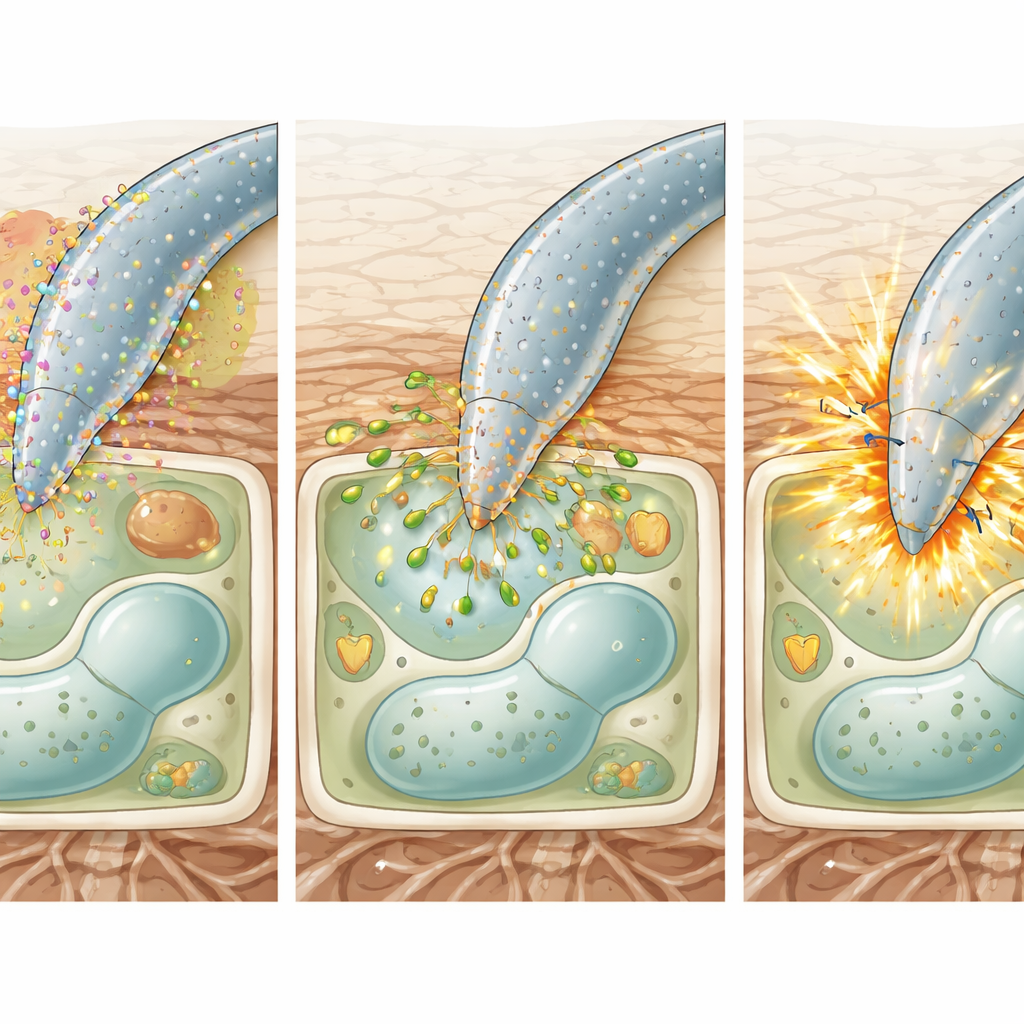
Digging deeper, the team looked for gene families that differed consistently between haplotypes. Haplotype A stood out for carrying many more genes encoding chemosensory receptors known as GPCRs, thought to help nematodes sense chemical cues from their environment and locate suitable hosts. It also had extra copies of GH31 enzymes, which can trim sugar chains and may be especially useful in sweet potato storage roots rich in complex starches. Haplotype B, by contrast, was enriched in genes for pectate lyases, enzymes that cut through pectin in plant cell walls, and in detoxification proteins of the cytochrome P450 family—traits well suited to penetrating and coping with the chemical defenses of both sweet potato and potato. Haplotype C carried higher numbers of genes involved in dealing with reactive oxygen molecules and toxic compounds, including NADPH reductases, oxidoreductases, ABC transporters, animal haem peroxidases, C-type lectins, and a class of proteases called Astacins. Many of these proteins are secreted out of the nematode, forming a specialized “secretome” that interacts directly with plant tissues and defenses.
What this means for protecting crops
Together, these findings paint a picture of three closely related worm lineages that have tuned their genetic toolkits for different hosts: one with enhanced “noses” and sugar-processing enzymes for sweet potato, one with extra wall-cutting enzymes suited to both crops, and one armed with robust detox and defense systems for potato. For plant breeders and plant-health authorities, the work offers a genomic roadmap for understanding how D. destructor chooses and exploits its hosts, and highlights specific genes that could be targeted to create resistant crop varieties or new control strategies. In essence, the study turns a once-mysterious pattern of host preference into a set of testable molecular explanations.
Citation: Zhao, Z., Zhang, H., Wang, J. et al. Comparative genomics of different haplotypes in Ditylenchus destructor provides insights into their host preferences. Commun Biol 9, 600 (2026). https://doi.org/10.1038/s42003-026-09851-0
Keywords: plant-parasitic nematodes, potato rot nematode, host adaptation, comparative genomics, crop disease resistance