Clear Sky Science · en
Population genomics of Quercus gilva provides insights into the conservation of fengshui forests
Ancient village forests under pressure
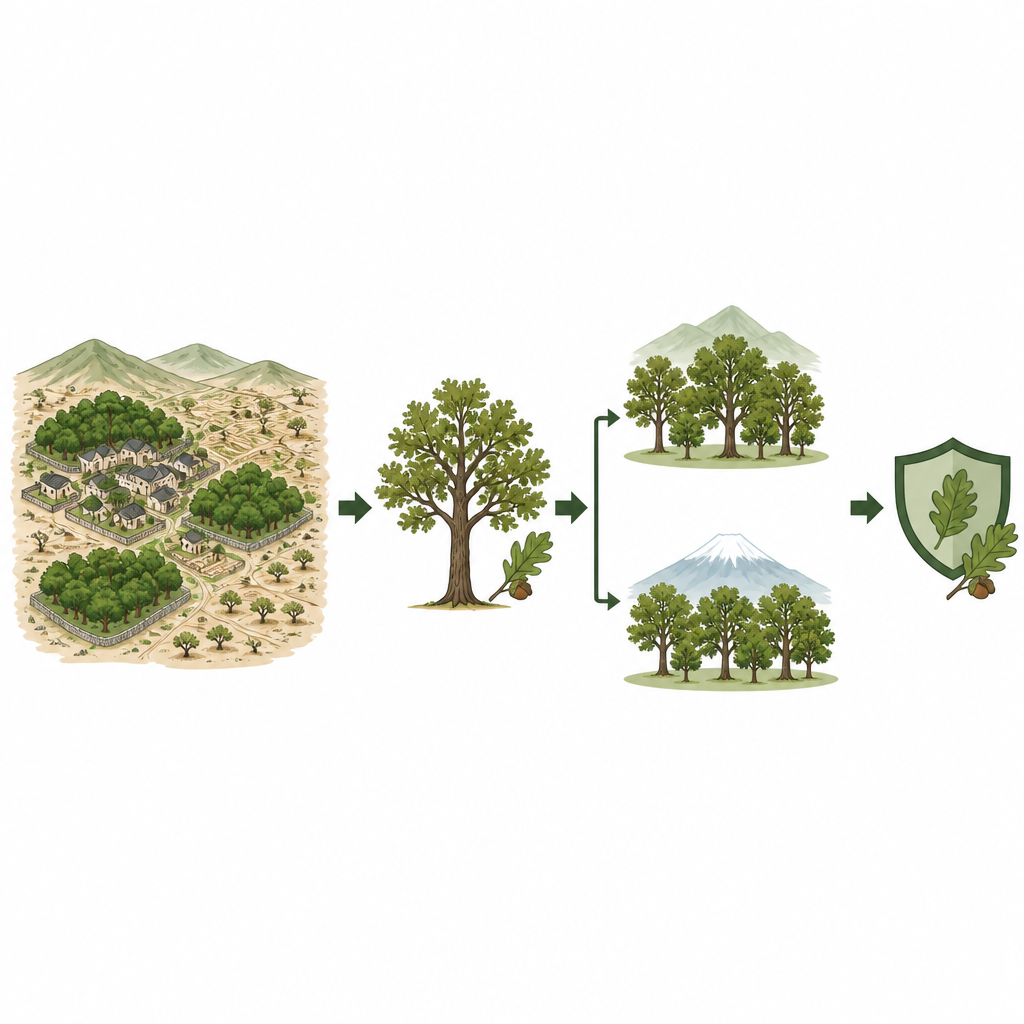
Across parts of East Asia, many villages are ringed by small patches of old forest that people have guarded for centuries for spiritual and cultural reasons. These “fengshui forests” are more than scenic backdrops: they shelter rare wildlife, protect soils and water, and hold venerable trees that tie communities to their past. But as the climate warms and human activities reshape the land, scientists and local people alike are asking whether these ancient groves, and the key tree species within them, can survive the changes ahead.
A key oak of East Asian evergreen forests
The study focuses on Quercus gilva, an evergreen oak that dominates many broadleaf forests in southern China, Japan, and Korea. This tree provides food and habitat for numerous species and is also a cornerstone of fengshui forests near villages and temples. Yet its numbers have fallen sharply as land has been cleared for farms, roads, and valuable timber. In mainland China, the researchers found that most remaining stands now survive only as small fragments in village groves, while in Japan and Korea the species persists in scattered pockets and is considered endangered in Korea. Because replanting such a keystone tree across its full range would be extremely difficult, understanding its natural capacity to adapt is crucial for conservation.
Reading the oak’s DNA story
To uncover how resilient Q. gilva might be, the team used population genomics, which samples DNA across the whole genome of many individuals. They first built a new high-quality reference genome from a wild tree in western Hunan, China, using a mix of short and long DNA reads and chromosome-linking data. They then resequenced 55 trees from 19 populations across China and Japan, identifying more than three million reliable genetic variants. These data allowed them to compare patterns of diversity, reconstruct past population sizes, and search the genome for regions tied to environmental adaptation and potential genetic weakness.
Two lineages shaped by shifting seas
The DNA comparisons revealed two main lineages of Q. gilva: one in China and one in Japan, with subtle east–west differences inside China. Using models of how gene variants spread and change over time, the researchers estimate that the Chinese and Japanese lineages split about four million years ago, during climate shifts in the Pliocene that altered seas and land bridges around Japan. Both lineages went through bottlenecks and later expansions, with population sizes shrinking through much of the Pleistocene and then growing again after the last ice age. Occasional gene exchange between the regions likely occurred when land connections reappeared during glacial periods, but today the lineages remain clearly distinct.
Hidden strengths and weaknesses in the genes
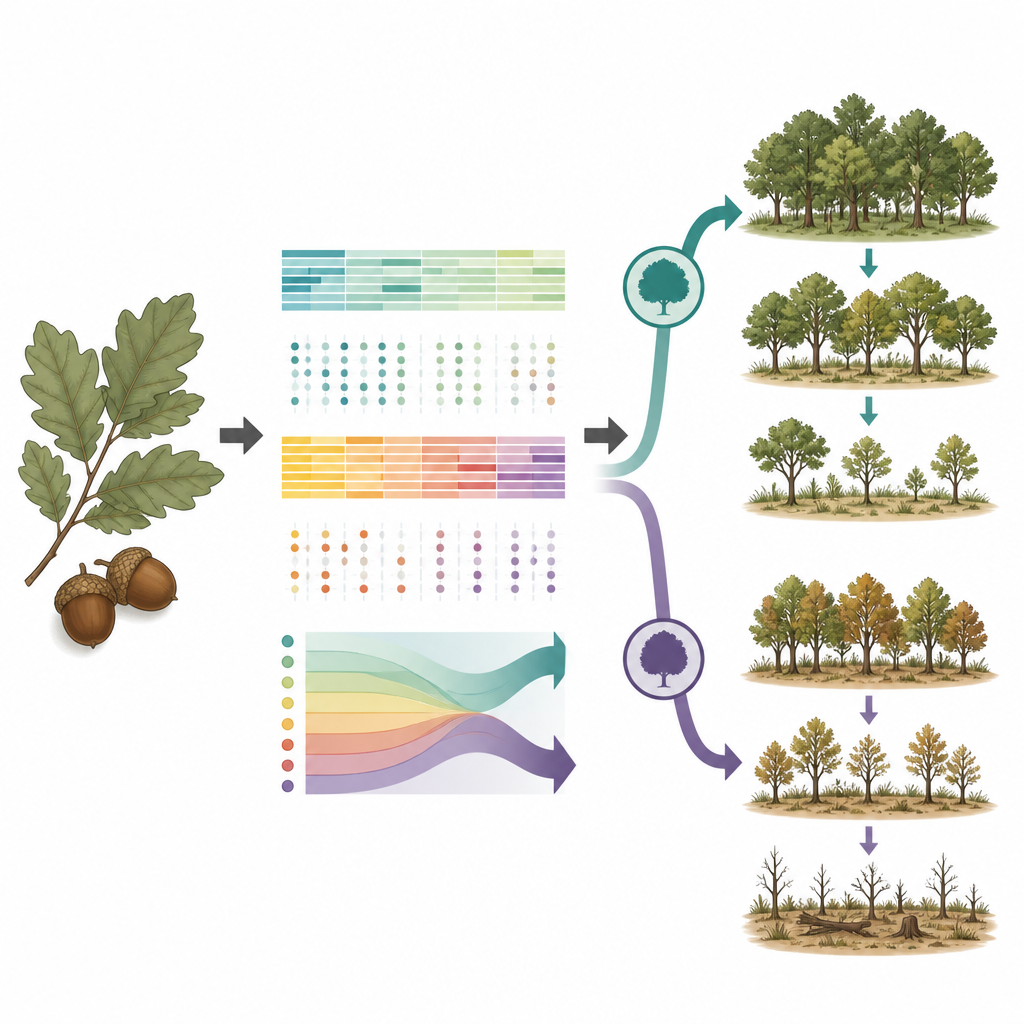
Beyond broad history, the team probed how Q. gilva has responded to its local environments. They identified sections of the genome that show signs of strong natural selection, as well as specific DNA variants linked to temperature and rainfall. Many of these genes relate to how trees manage water, cope with oxidative stress, and repair or package their DNA, hinting at molecular tools that help them weather drought, cold, and other challenges. At the same time, the scientists measured “genetic load” – the build-up of harmful mutations that can reduce fitness or increase the risk of inbreeding problems. They found that Chinese populations, despite having slightly higher overall genetic diversity, carry more potentially damaging mutations than Japanese populations, including changes in genes associated with histone deacetylases, which help control when other genes turn on or off.
Guiding future care for fengshui forests
By combining these genomic insights, the authors suggest that some populations should be viewed as conservation priorities because they pair relatively rich genetic diversity with lower harmful mutation loads. These include Changning and Lianyuan in China and Kiyosumi and Tama in Japan. In contrast, the Jianou population in Fujian, even though it hosts at least 240 impressive old trees, shows low diversity and a high burden of risky variants, raising concern about inbreeding depression and poor regeneration. The study concludes that while fengshui forests still harbor valuable genetic resources for Q. gilva, safeguarding them under future climate change will require careful, population-specific strategies, and more field and genetic work before any active measures such as moving seed or seedlings between sites are attempted.
Citation: Jiang, XL., WU, MX., SAITO, Y. et al. Population genomics of Quercus gilva provides insights into the conservation of fengshui forests. Commun Biol 9, 657 (2026). https://doi.org/10.1038/s42003-026-09846-x
Keywords: population genomics, oak forests, fengshui forests, genetic diversity, conservation genetics