Clear Sky Science · en
Resolvin D1 requires TLR2-FPR2 crosstalk for inflammation resolution and protection during ocular bacterial infection
Why eye infections matter
Bacterial infections inside the eye can steal vision in a matter of hours or days, and current treatments mainly rely on antibiotics. While these drugs help kill germs, they do not fully control the intense inflammation that can permanently damage delicate retinal tissue. This study explores how the eye’s own “stop signals” for inflammation, in particular a fat-derived molecule called resolvin D1, help clear infection while protecting sight, and why a specific pair of immune sensors must work together for this protection to succeed. 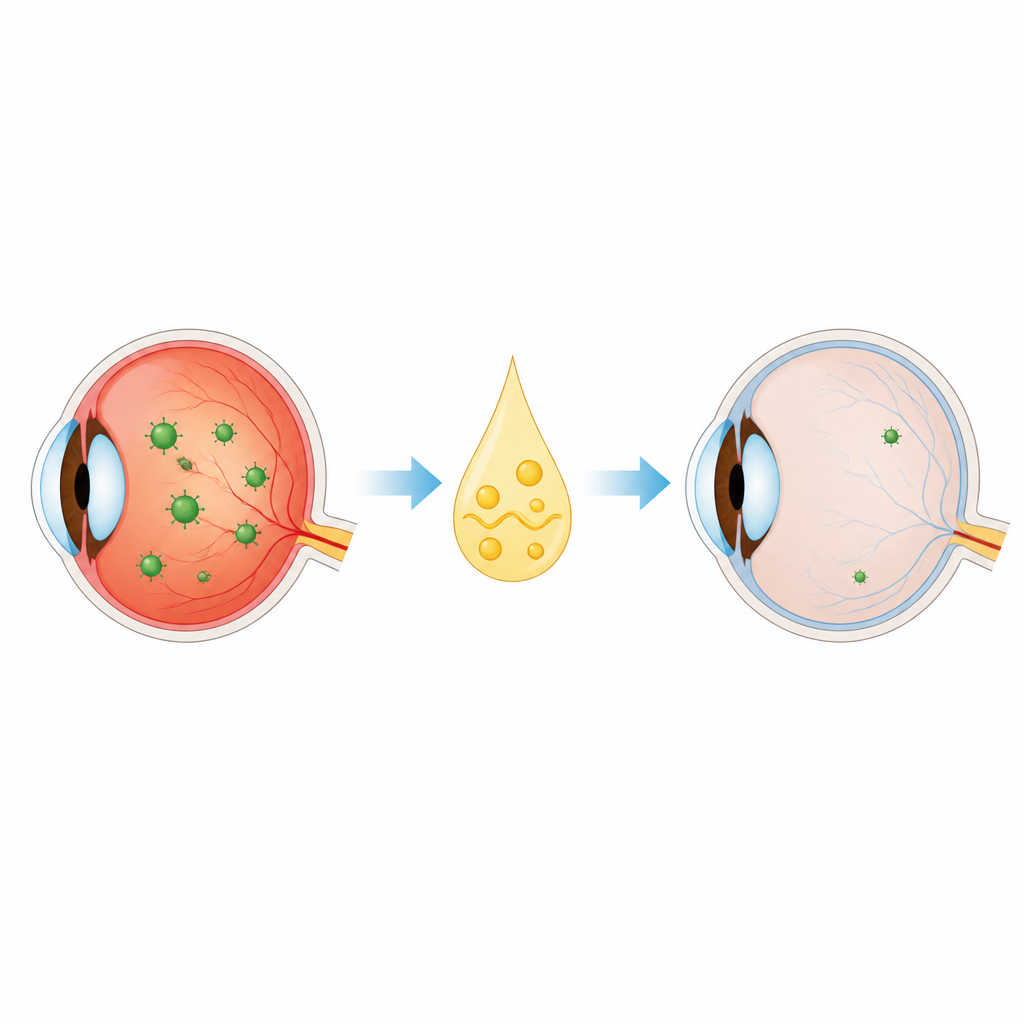
The eye’s built in peacekeepers
Inflammation is not simply turned on and then left to fade away on its own. The body actively switches from early “alarm” molecules to later “peacekeeping” molecules that help shut down inflammation and repair tissue. The authors focused on a family of peacekeeping substances made from omega 3 fats, called specialized pro resolving mediators. Using mice with severe inner eye infection caused by Staphylococcus aureus, they mapped hundreds of lipid molecules in the retina over time. They found that infection strongly reshaped fat metabolism and boosted production of several pro resolving mediators, including resolvin D1, especially when the eye was supplied with extra omega 3 building blocks.
A protective signal that saves sight
Next, the team tested whether giving extra pro resolving mediators directly into infected mouse eyes could improve outcomes. Several of these molecules reduced levels of a key inflammatory signal, but resolvin D1 stood out. When delivered either before or soon after infection, resolvin D1 reduced the cloudy corneal haze characteristic of endophthalmitis, preserved the layered structure of the retina, and lowered clinical disease scores. Importantly, treated eyes held far fewer bacteria and retained about 80 percent of normal electrical responses, showing that vision related function was largely maintained. Rather than acting like a classic antibiotic, resolvin D1 appeared to boost the eye’s own defenses while turning down harmful inflammation.
Tuning the immune response, not shutting it off
To understand how resolvin D1 reshapes the immune response, the researchers measured inflammatory molecules and immune cells inside the eye. Infection alone caused a surge of inflammatory cytokines and chemokines and drew in large numbers of neutrophils, white blood cells that can damage tissue if they linger too long. Resolvin D1 treatment sharply reduced these signals and limited neutrophil buildup. At the same time, it increased anti inflammatory factors and shifted resident immune cells and microglia from a destructive, “attack mode” state toward a calmer, cleanup oriented state. In cell culture, resolvin D1 also helped retinal support cells swallow and kill bacteria more effectively, showing that it can enhance host defense while easing collateral damage. 
Two key receptors must work together
Resolvin D1 sends its message by binding to a cell surface receptor called FPR2. The team showed that this receptor is present on retinal microglia and Muller glia, and that resolvin D1 increases its levels in normal mice. However, when they blocked FPR2 with small molecule inhibitors, the benefits of resolvin D1 vanished: inflammation rose, bacteria persisted, and more neutrophils flooded the eye. An unexpected twist emerged when they repeated the experiments in mice lacking another immune sensor, Toll like receptor 2, which normally detects bacterial components. In these mice, resolvin D1 no longer protected the eye, did not lower inflammation, and did not improve bacterial clearance. Moreover, resolvin D1 failed to boost FPR2 levels without Toll like receptor 2, revealing that these receptors regulate each other and even form physical complexes during infection.
What this means for future eye care
For non specialists, the key message is that the eye relies on a carefully choreographed conversation between danger sensing and resolution signals to survive infection with its structure and function intact. Resolvin D1 acts as a natural peacekeeper that helps the eye clear bacteria while preventing runaway inflammation, but it can only do so when both the FPR2 receptor and Toll like receptor 2 are present and able to cooperate. These findings suggest that future treatments for blinding eye infections may combine antibiotics with drugs that mimic or enhance these natural resolution signals, fine tuning the immune response so that it protects against microbes without sacrificing vision.
Citation: Singh, P.K., Singh, S., Kumar, A. et al. Resolvin D1 requires TLR2-FPR2 crosstalk for inflammation resolution and protection during ocular bacterial infection. Commun Biol 9, 674 (2026). https://doi.org/10.1038/s42003-026-09840-3
Keywords: eye infection, inflammation resolution, resolvin D1, endophthalmitis, retinal immunity