Clear Sky Science · en
The fungistatic mechanism of benzaldehyde against the nematophagous fungus Arthrobotrys oligospora suggests a method for manipulating soil fungistasis
Why stopping soil helpers matters
Farmers increasingly rely on friendly microbes to protect crops from pests instead of using large amounts of chemical pesticides. But in real farm soils, these helpful fungi often fail to wake up, grow, and do their job. This study looks at one common soil chemical, benzaldehyde, and uncovers how it quietly puts a useful nematode-hunting fungus to sleep—and, importantly, how we might help the fungus resist this hidden stress.
A quiet brake on good fungi in the dirt
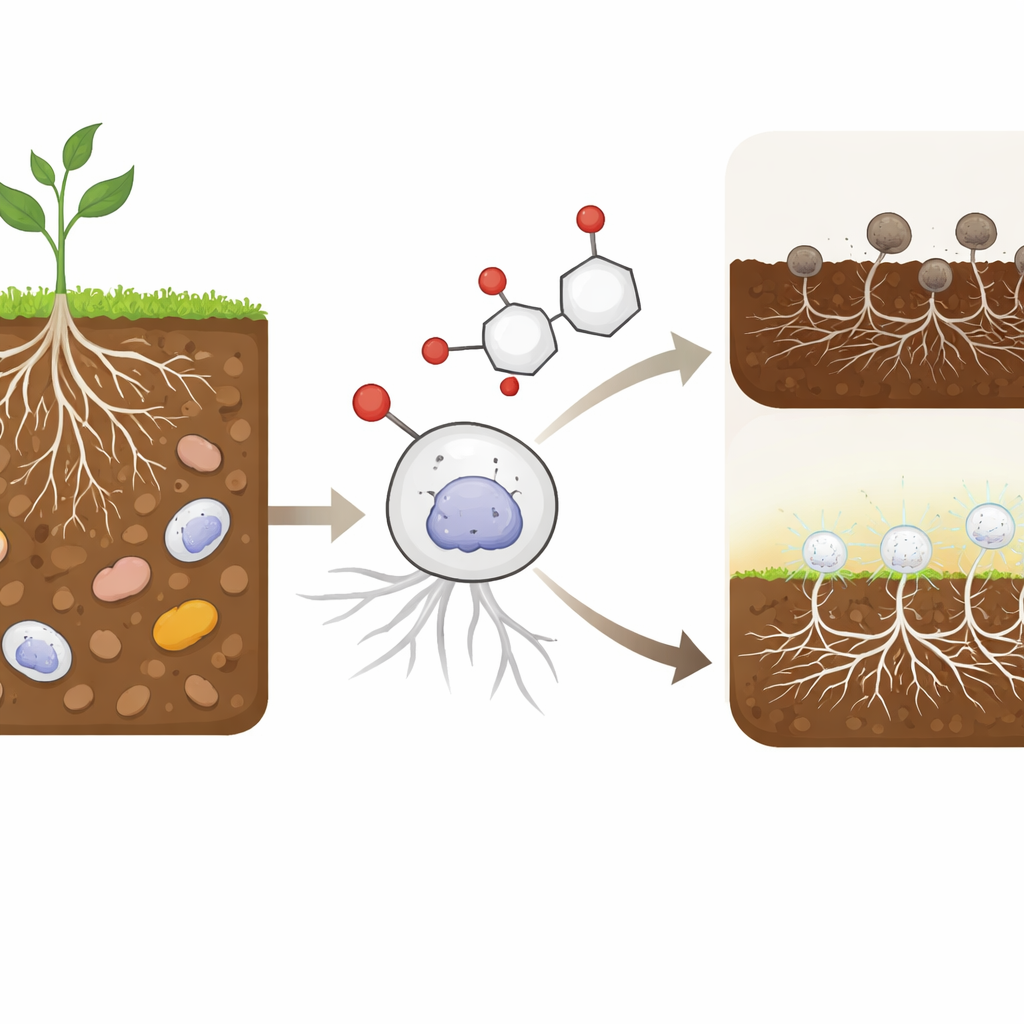
Soils around the world naturally contain a phenomenon called soil fungistasis, where fungal spores land in the ground but barely germinate. That can be good when it slows disease-causing fungi, but it also holds back beneficial species that farmers intentionally add as biocontrol agents. The fungus studied here, Arthrobotrys oligospora, hunts plant-parasitic nematodes and is an important ally for crop protection. Yet in most farm soils, its spores hardly sprout. Earlier work showed that gases and volatile compounds given off by soil microbes are a major cause. Benzaldehyde, a simple fragrance-like molecule produced from plant materials and from widely used benzoic acid preservatives, is one of these widespread soil volatiles.
How a simple molecule drains fungal energy
The researchers exposed fungal spores to benzaldehyde in a sealed two-compartment dish so the spores experienced only its vapor. As benzaldehyde levels rose, spore germination sharply dropped, confirming a strong growth-blocking effect. To see what was happening inside the cells, the team compared gene activity in fresh spores, normally germinating spores, and benzaldehyde-stalled spores. They found signs of strain on both mitochondria, the cell’s power stations, and the endoplasmic reticulum, where many proteins are folded. Genes linked to cleaning up misfolded proteins and recycling damaged cell parts switched on, while genes for efficient energy production were dialed down. Together, this pointed to a core problem: benzaldehyde exposure leads to energy shortage and stress inside the fungus.
When oxygen sparks become harmful
A key part of the story turned out to be reactive oxygen species—tiny, short-lived “sparks” that cells normally keep under tight control. Under stronger benzaldehyde exposure, the spores lit up with fluorescent signals of these reactive molecules. The fungus tried to fight back by boosting genes that make antioxidants such as glutathione. When the team added an antioxidant compound, N-acetyl cysteine, at a modest dose, spores made fewer harmful oxygen species and germinated better. In contrast, a vitamin A–related compound that promotes these sparks, retinol, made the benzaldehyde block even stronger. At very high doses, even the antioxidant backfired, again increasing stress. This shows that the balance of these oxygen-based chemicals is crucial: keeping them in check helps the spores push through the benzaldehyde fog, while excess tips cells into deeper trouble.

Turning on an internal energy switch
The team then focused on AMPK, a master “fuel gauge” found in many organisms that turns on when cells are low on energy. Their gene data hinted that benzaldehyde-triggered energy shortage should activate this pathway, which in turn encourages recycling worn-out components and slows down nonessential protein building. Using chemicals that nudge AMPK up or down, they tested this idea. An AMPK activator, acadesine, reduced oxygen stress inside spores and allowed more of them to germinate despite benzaldehyde. An inhibitor had the opposite effect, making spores more vulnerable. A fungus strain missing a key AMPK subunit was especially sensitive to benzaldehyde, and no longer benefited from acadesine, confirming that this energy sensor is central to resistance.
From lab dish to real farm soils
Because benzaldehyde is only one of several natural soil inhibitors, the researchers next asked whether the same protective switch helps in real soil. They placed fungal spores inside porous bags immersed in soil suspensions and measured how many germinated. An AMPK activator greatly boosted spore germination under this more realistic soil fungistasis, and the common drug metformin, which also nudges AMPK, worked as a cheaper alternative. Low levels of glucose, which help cells make the antioxidant power source NADPH through a key enzyme, also improved resistance, whereas high glucose or excess nutrients could actually worsen stress by fueling more damaging oxygen chemistry.
What this means for greener crop protection
This work reveals that a simple fragrance-like molecule, benzaldehyde, hinders a beneficial nematode-hunting fungus mainly by stoking oxidative stress and draining its energy, which then triggers a protective energy-sensing pathway. By gently boosting that pathway or supplying the right kind of fuel, it may be possible to help biocontrol fungi survive the chemically complex reality of soils and perform more reliably in the field. In practical terms, carefully chosen additives such as AMPK activators or tuned nutrient blends could one day be paired with fungal products to make biological crop protection more dependable and reduce reliance on conventional pesticides.
Citation: Tan, LX., Zhang, YY., Liu, ZJ. et al. The fungistatic mechanism of benzaldehyde against the nematophagous fungus Arthrobotrys oligospora suggests a method for manipulating soil fungistasis. Commun Biol 9, 566 (2026). https://doi.org/10.1038/s42003-026-09836-z
Keywords: soil fungistasis, biological control, benzaldehyde, reactive oxygen species, AMPK pathway