Clear Sky Science · en
A trimeric architecture reveals the glucitol PTS transporter as a distinct superfamily
How Bacteria Move Sugar With Built-In Chemistry
Gut bacteria and lab workhorses like Escherichia coli live in crowded, competitive environments where grabbing food quickly can mean the difference between thriving and dying. This study reveals, in atomic detail, how E. coli uses a specialized molecular machine to pull in a sugar called glucitol while chemically tagging it at the same time. The work uncovers a surprising three-part design that forces scientists to rethink a major class of bacterial transport systems and may one day guide antibiotics that target microbes without harming human cells.
A Molecular Turnstile Just for Bacteria
Bacteria often import sugars through a pathway called the phosphotransferase system, or PTS. Unlike human transporters, PTS machines don’t just move sugar across the cell membrane—they also attach a small phosphate group as part of the same process. This dual role lets the transporter act as both a gate and a first step in sugar metabolism, and helps the cell coordinate how it uses carbon and nitrogen. Because this system is found in bacteria but not in our own cells, it is a tempting target for drugs that could block bacterial growth with fewer side effects.
A Puzzling Sugar Gate With Split Parts
One PTS transporter, which handles the sugar glucitol (also known as sorbitol), has long puzzled researchers. Genetic studies showed that its membrane-embedded part is split into two separate proteins, called GutE and GutA, and coupled to a third protein, GutB, that works on the inside of the cell. Earlier work grouped this glucitol machine with a large family of similar sugar transporters that usually form pairs in the membrane. But that classification never sat comfortably with the unusual gene layout and hinted that something more distinct might be going on.
A Three-Legged Transporter Revealed
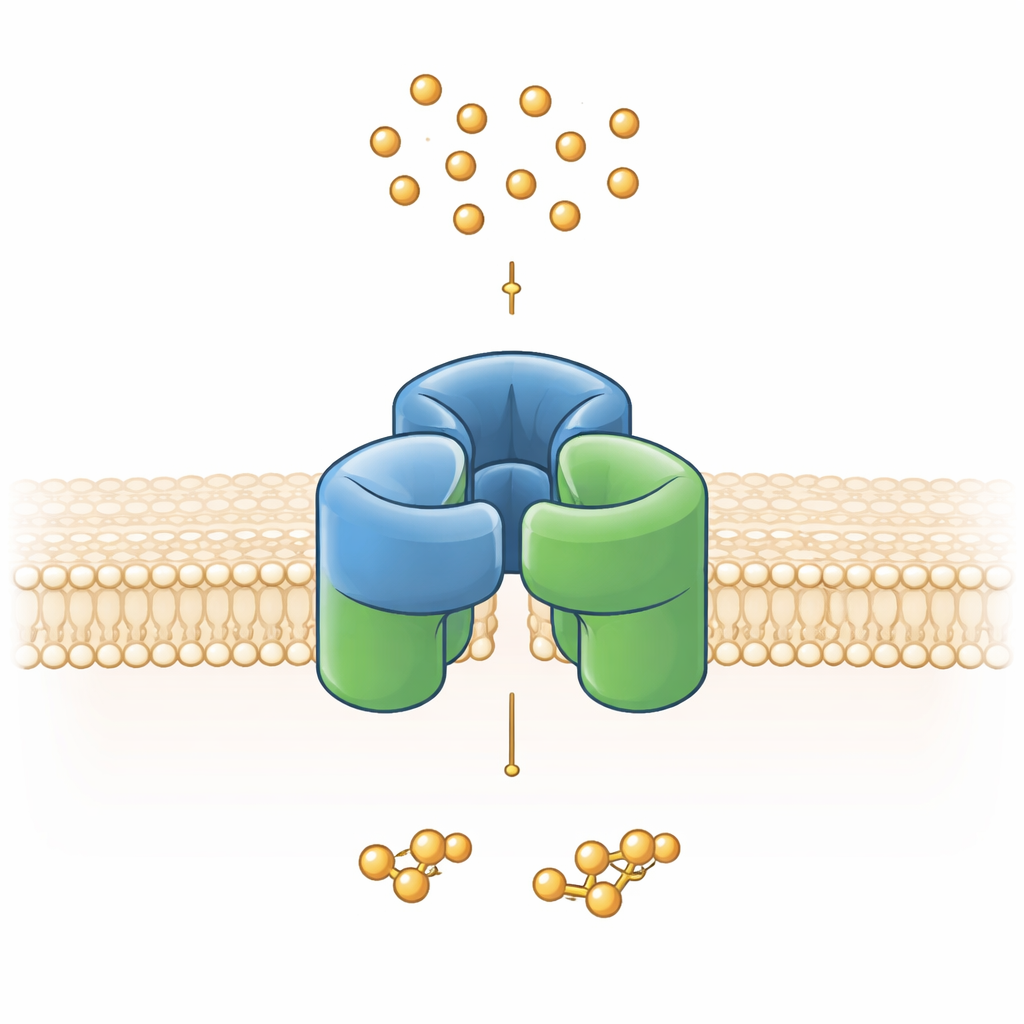
Using high-resolution cryo–electron microscopy, the authors visualized the complete membrane portion of the glucitol transporter from E. coli. Instead of the expected two-unit assembly, they found a three-part, tripod-like structure: a homotrimer. Each “leg” of the tripod is built from one GutE and one GutA chain interwoven in the membrane. Together, the three legs surround a central region where the glucitol molecule sits. The team saw that two of the legs hold the sugar in a sealed-off state, while the third presents an open path toward the cell interior. This arrangement is unlike that of previously known sugar PTS transporters, supporting the idea that the glucitol family forms its own structural superfamily.
An Elevator Motion Inside the Membrane
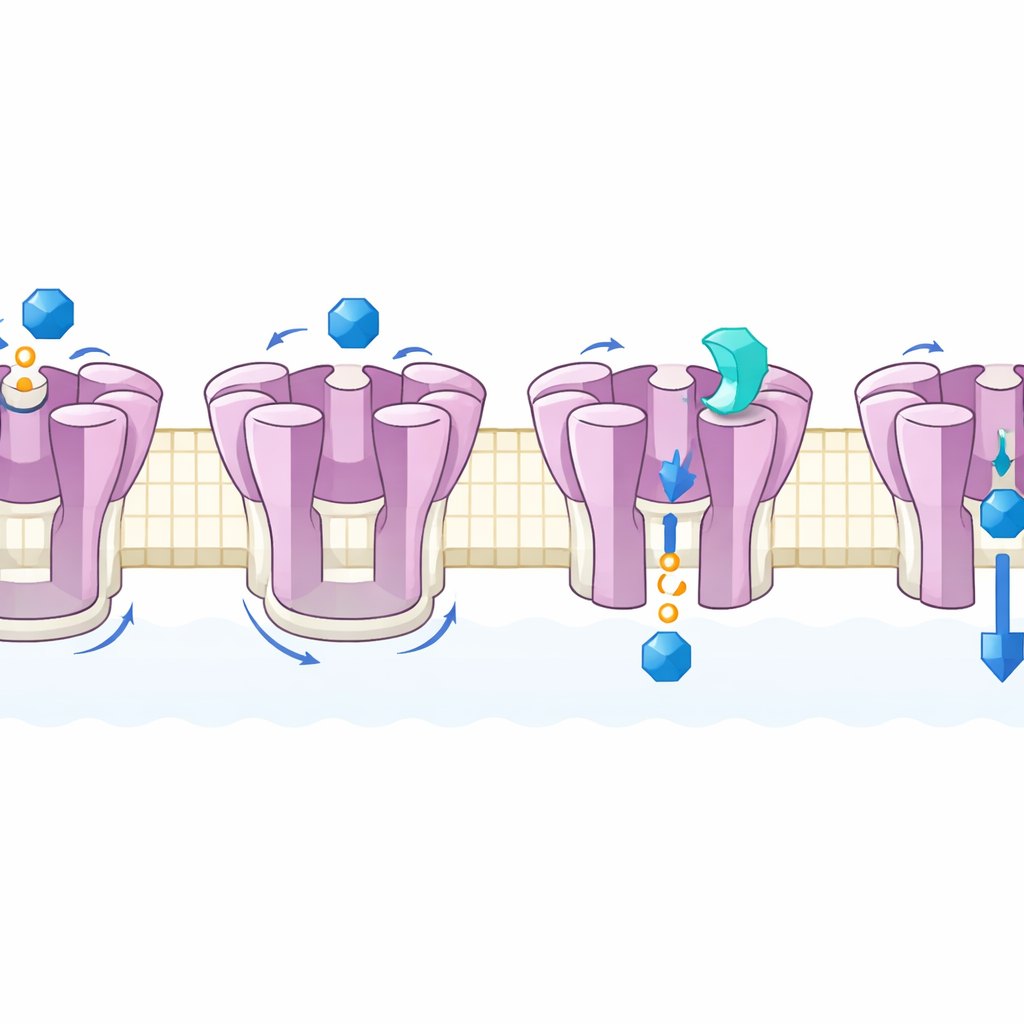
Closer inspection showed that each leg can be divided into a stable scaffold and a more mobile transport region. The scaffold, formed mainly by one key membrane helix from each protein, locks the three legs together into a rigid ring. The transport region, which contains the sugar-binding pocket, appears to move as a solid block relative to this ring. By comparing the open and closed legs, the researchers inferred an “elevator” motion: the transport region slides by several angstroms within the membrane, carrying the bound glucitol from a position facing the outer environment to one facing the cell interior. Throughout this motion, the core shapes of the scaffold and transport parts remain almost unchanged, suggesting a precise, repeatable mechanical cycle.
Sharing Chemistry Between Neighbors
The PTS does more than move sugar—it also transfers a phosphate group through a relay of proteins in the cytoplasm to a reactive cysteine amino acid in the GutE protein. To see how this chemistry might connect to transport, the authors combined their structure with an artificial-intelligence model of the flexible, unresolved cytoplasmic domain. Docking this domain onto the trimer suggested that the reactive cysteine of one leg can sit very close to the sugar-binding pocket of a neighboring leg. This layout hints at an “in-trans” reaction, where one subunit phosphorylates sugar bound in another, rather than acting only on its own cargo. When the team mutated that cysteine to a non-reactive amino acid, bacteria could barely grow on glucitol, confirming that this residue is essential for transport-linked chemistry.
Why This Three-Part Design Matters
Taken together, the structural and functional data show that the glucitol transporter is a founding member of a distinct class of PTS machines. It uses a three-legged scaffold to coordinate elevator-like motions that shuttle sugar across the membrane, while potentially allowing neighboring legs to share the task of adding phosphate groups. This cooperative, trimeric design broadens our view of how bacteria can couple transport and chemistry in compact molecular devices. Because such systems are central to bacterial nutrient uptake yet absent from human cells, understanding their architecture and mechanics could inform future strategies to disrupt harmful microbes without touching our own tissues.
Citation: Deng, T., Liu, X., Zeng, J. et al. A trimeric architecture reveals the glucitol PTS transporter as a distinct superfamily. Commun Biol 9, 570 (2026). https://doi.org/10.1038/s42003-026-09835-0
Keywords: bacterial sugar transport, phosphotransferase system, glucitol transporter, cryo-EM structure, membrane protein mechanism