Clear Sky Science · en
Comprehensive large-scale analyses reveal association between brain structure and cognitive ability during adolescence
Why Teen Brains Matter
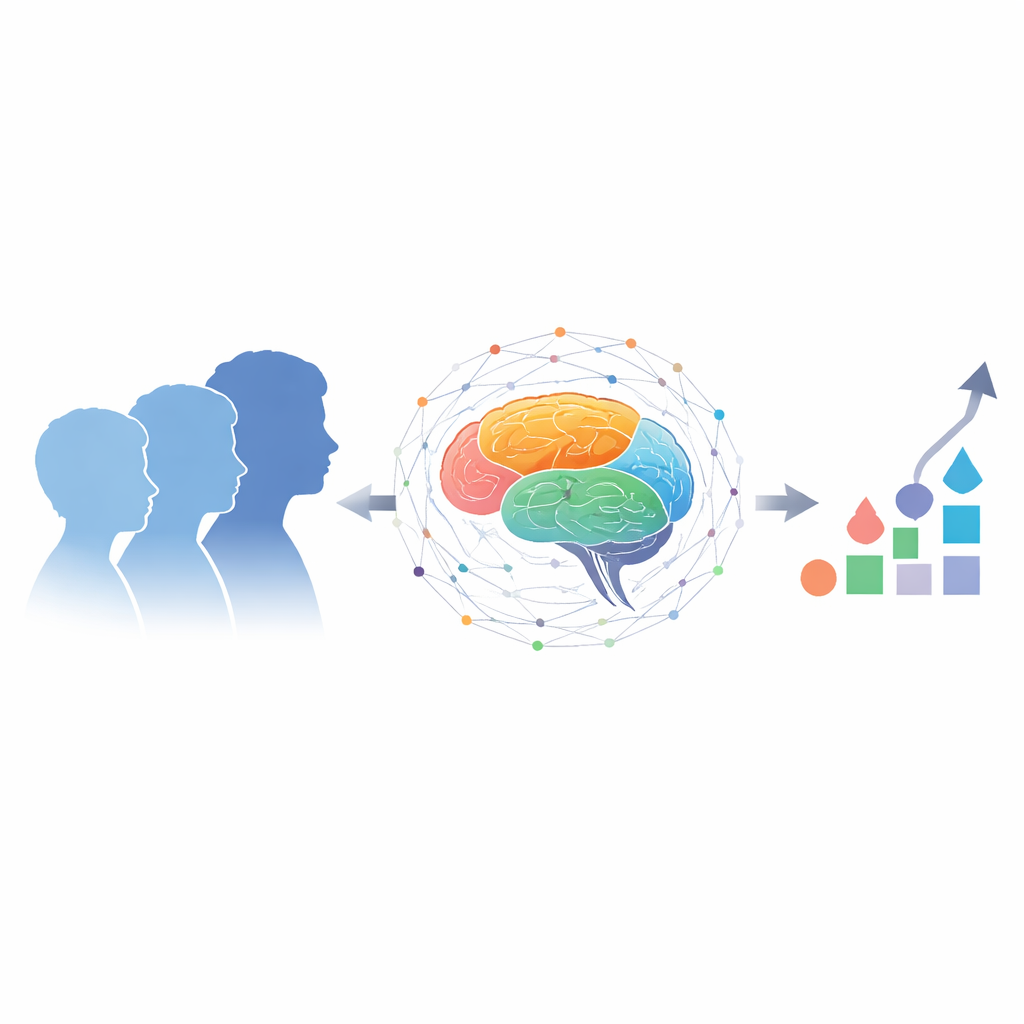
Adolescence is a turning point for both the brain and the mind. During these years, young people’s thinking skills—such as reasoning, memory, and attention—can change dramatically, as does the physical structure of their brains. This study asks a simple but far-reaching question: how tightly are these brain changes linked to how well teenagers think, and does that link itself change as they grow from about age nine to fifteen?
Looking Inside Thousands of Young Minds
To tackle this question, the researchers drew on brain scans and cognitive tests from more than 8,500 children and adolescents in the Adolescent Brain Cognitive Development (ABCD) study, one of the largest brain projects ever conducted. Each participant completed MRI scans that reveal brain anatomy and tissue properties, as well as diffusion scans that capture how water moves through brain tissue, giving clues about the wiring of nerve fibers. The team measured 16 different features in many regions across the cortex and deeper brain structures, then used these measurements to build a map of how similar different regions are to one another—essentially a structural network of the brain.
Mapping Brain Regions, Connections, and Hubs
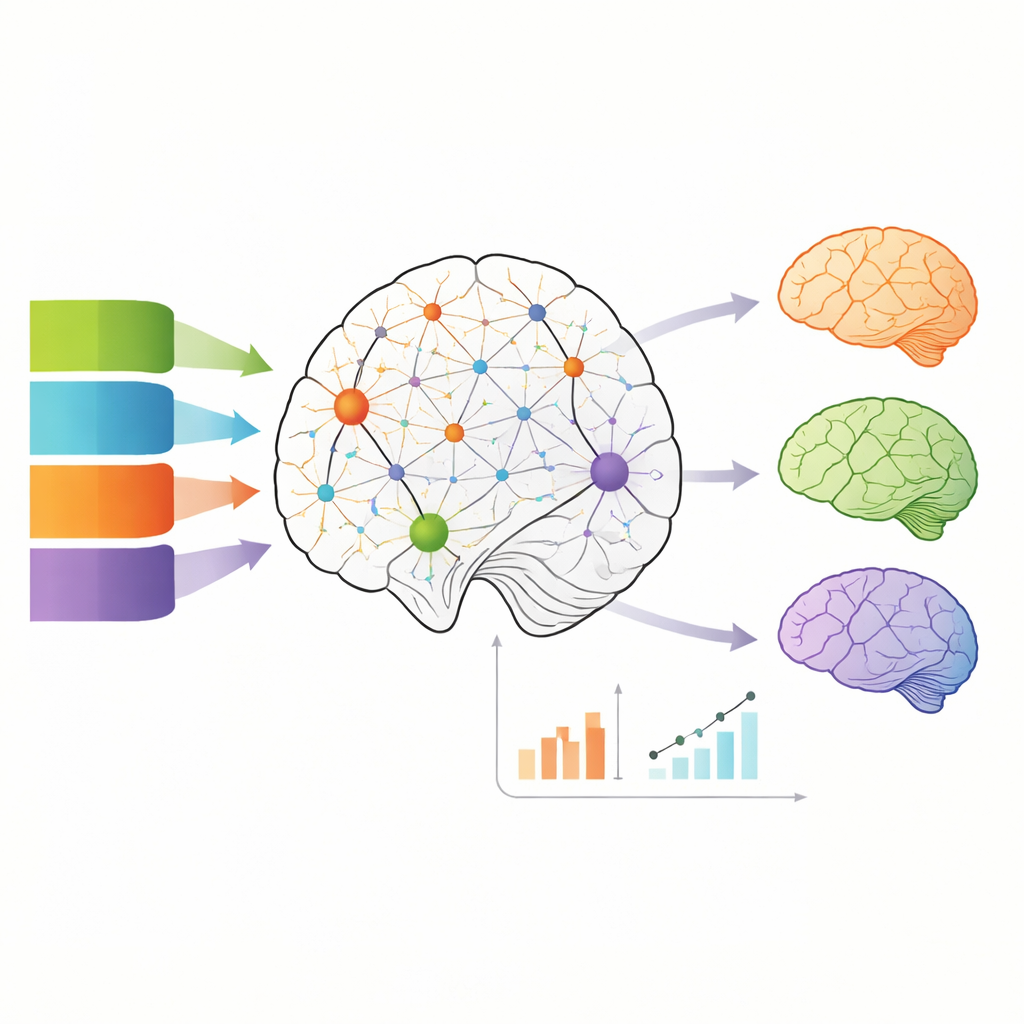
Rather than looking at one brain measure at a time, the authors created a rich description of each person’s brain, including regional properties, the strength of structural links between pairs of regions, and “hub” characteristics that capture how central a region is within the overall network. They then related these 16,563 brain features to performance on seven cognitive tests and to an overall “general intelligence” score that summarizes shared ability across tasks. Their analysis, powered by advanced statistical modeling and thousands of resamplings for robustness, allowed different brain features to compete with one another, highlighting which regions and network properties were most consistently tied to thinking skills.
Key Brain Areas and Measures Linked to Thinking
The strongest structural links to general intelligence clustered mainly in the frontal, temporal, and occipital lobes of the brain. These areas support planning and decision making, language and meaning, and visual processing, respectively. In contrast, some deeper structures and the insular cortex showed weaker ties, at least when considered as network hubs. When the researchers summed associations across the whole brain, traditional structural MRI measures—such as cortical thickness, the depth of folds in the cortex, and signals related to tissue composition—stood out more than diffusion-based measures. Network hubs that were globally well connected across the brain were more related to cognitive ability than hubs that were only locally well connected, reinforcing the idea that broad communication across brain systems underpins smarter thinking.
How These Links Shift With Age
A distinctive aspect of this work is its focus on age-dependence: not just whether brain structure is tied to cognition, but whether that tie grows stronger or weaker between ages nine and fifteen. The same brain regions that were most strongly linked to thinking—the frontal, temporal, and especially occipital lobes—also showed the greatest age-related change in those links. In other words, in these areas, the relationship between structure and performance was not fixed; it evolved across adolescence. Whole-brain measures that were most predictive of ability, largely based on structural MRI, also tended to show the strongest age-dependence. At the network level, local properties became more age-sensitive, suggesting that the fine-tuning of local circuitry may be particularly dynamic during these years.
What This Means for Growing Minds
Taken together, the findings paint adolescence as a period when the anatomy of key brain regions and their position within large-scale networks are closely intertwined with how well teenagers think—and when that brain–mind link itself is still maturing. The study shows that large, carefully analyzed datasets can reveal where in the brain structure is most informative about cognitive ability, and how those relationships change as young people grow. While the work does not prove cause and effect, it provides a detailed roadmap of how brain structure and thinking ability travel together during a crucial window of development, offering a foundation for future research on typical and atypical cognitive growth.
Citation: Yan, J., Iturria-Medina, Y., Bezgin, G. et al. Comprehensive large-scale analyses reveal association between brain structure and cognitive ability during adolescence. Commun Biol 9, 584 (2026). https://doi.org/10.1038/s42003-026-09831-4
Keywords: adolescent brain development, cognitive ability, brain structure, brain networks, MRI