Clear Sky Science · en
Degron models: a toolbox for rapid in vivo depletion of essential proteins regulating mRNA metabolism
Turning Proteins Off Like Light Switches
Many of the most important proteins in our cells are so vital that completely removing them kills the organism. That makes them very hard to study, even though they control processes at the heart of modern medicine, such as how therapeutic mRNA vaccines are handled by the body. This paper describes a new set of genetically engineered mice in which key RNA‑regulating proteins can be switched off rapidly and reversibly in living animals, letting researchers watch what happens in real time rather than guessing from simpler lab systems. 
Why Controlling Protein Lifetimes Matters
Traditional genetic tools usually work by deleting or silencing a gene, which prevents a protein from ever being made. For essential genes, this often causes early death or severe developmental problems, so scientists never see how those proteins work in adult tissues or during disease. The authors instead use “degron” tags—tiny molecular handles attached to a chosen protein. When a matching drug is added, the cell’s own waste‑disposal machinery recognizes the tag and quickly destroys the tagged protein. Because the gene itself remains intact, researchers can decide exactly when, and for how long, to deplete the protein, then watch it reappear after the drug is removed.
Building a Toolbox of Designer Mice
Using a high‑efficiency CRISPR editing protocol directly in fertilized mouse eggs, the team tagged seven proteins that shape the life and death of mRNAs: factors that trim or extend the protective poly(A) tail, remove the 5′ cap, or degrade viral RNA, as well as a protein involved in uptake of RNA therapeutics. Most tags were added to one end of the protein together with a small epitope to help detect it. This streamlined method, using short double‑stranded DNA repair templates, produced correctly edited founders for each line in a single round of injections—simpler and quicker than older embryonic stem cell techniques. In most cases, mice carrying two tagged copies of a gene grew and reproduced normally, showing that the tags can be tolerated even on essential factors, though a few lines did show fertility or blood‑related problems.
Fast Protein Removal in Cells and Tissues
The main workhorse system, called dTAG/FKBP, performed robustly in primary cells taken from the engineered mice. After adding the dTAG drug, levels of the tagged proteins dropped to nearly zero within minutes to a few hours and stayed low for days as long as the drug remained in the culture medium. When the drug was washed away, proteins gradually returned over several days. The speed of removal depended somewhat on where the protein sat inside the cell: proteins clustered in tiny RNA‑processing droplets known as P‑bodies were cleared more slowly than those floating freely in the cytoplasm. In living mice, a single injection of dTAG could strongly deplete several tagged proteins in organs such as liver, kidney, lung, and spleen, with intraperitoneal delivery generally outperforming intravenous injection. One unexpected twist was that an alternative degron system, BromoTag, which worked well in cell culture, failed to produce meaningful protein loss in vivo even with optimized drugs and routes, highlighting how hard it is to translate such chemistries from dish to animal. 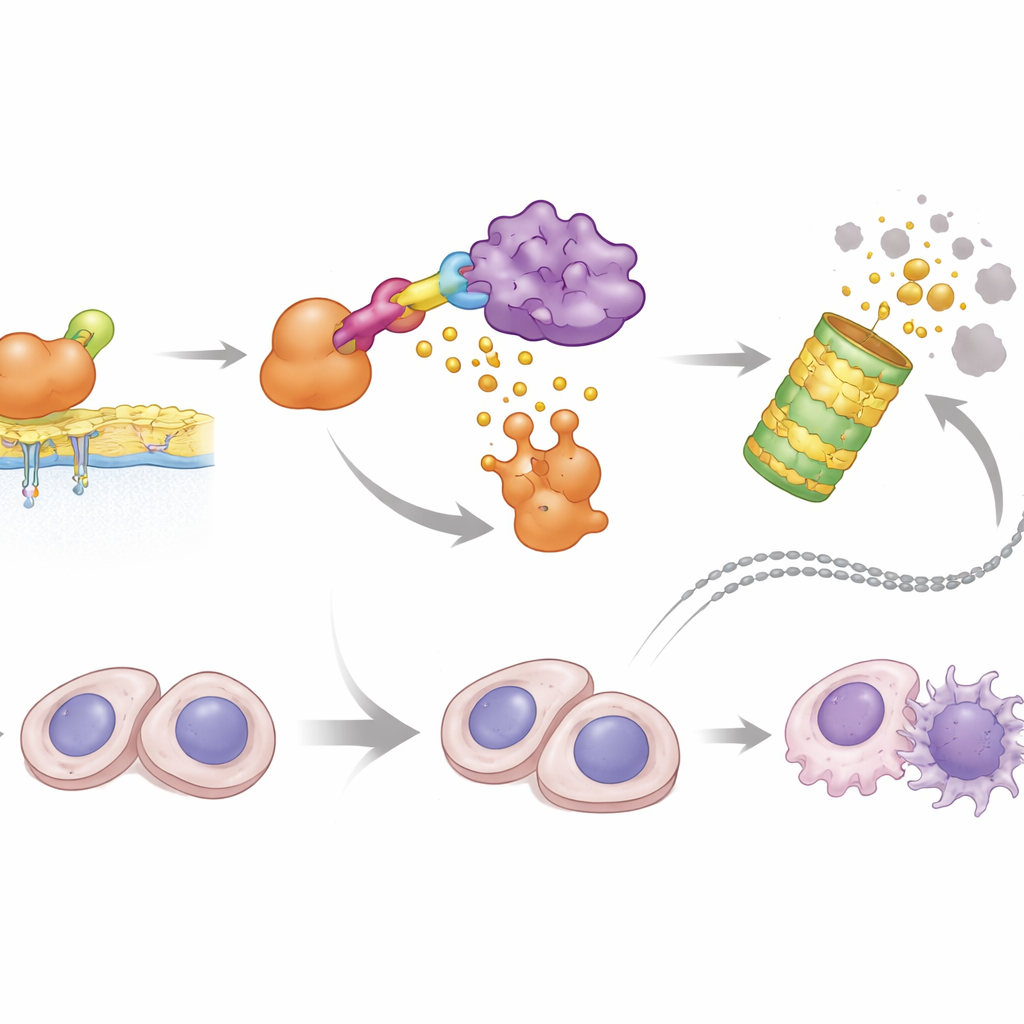
What Happens When a Master Regulator Is Removed
To demonstrate what this toolbox can reveal, the researchers focused on CNOT1, a scaffold protein at the core of a major mRNA‑degrading machine called the CCR4‑NOT complex. Removing CNOT1 in cell cultures caused rapid loss of cell division and survival, especially in immune‑related cells such as macrophages and splenocytes. In mice, depleting CNOT1 in the liver for just 24 hours led to striking biochemical changes: poly(A) tails on many mRNAs became longer, and proteins associated with an acute inflammatory response surged, while everyday metabolic proteins declined. Even without the drug, simply carrying the tag on CNOT1 subtly lengthened mRNA tails and shifted levels of a small set of important proteins, likely explaining chronic issues such as reduced body weight, altered blood parameters, and infertility observed in homozygous tagged animals.
Implications for mRNA Medicines and Beyond
This work delivers a practical catalogue of mouse models in which crucial mRNA‑handling proteins can be dialed down on demand, revealing their roles in immunity, fertility, blood formation, and organ health. For developers of mRNA vaccines and therapies, these models offer a way to test how specific enzymes shape the stability and clearance of therapeutic mRNAs in real tissues, rather than relying on over‑simplified cell lines. More broadly, the study provides a benchmark comparison of two degron strategies in vivo and cautions that tag placement and tag type can themselves influence biology. Together, these mice form a versatile toolkit for dissecting essential cellular pathways that were previously out of experimental reach.
Citation: Antczak, W., Szpila, M., Sałas, K. et al. Degron models: a toolbox for rapid in vivo depletion of essential proteins regulating mRNA metabolism. Commun Biol 9, 615 (2026). https://doi.org/10.1038/s42003-026-09828-z
Keywords: protein degradation, mRNA metabolism, CRISPR mouse models, degron tags, CNOT1