Clear Sky Science · en
Cilia-driven surface currents characterize specific cnidarian groups and lifecycle stages
Hidden rivers on quiet sea creatures
Many ocean animals such as corals and sea anemones cannot swim away from trouble or toward food. Yet, they still manage to feed, breathe, and keep clean while stuck in one place. This study reveals that some of these “living statues” secretly reshape the water right next to their skin, using countless tiny hairs to drive invisible surface currents. These findings help explain how different coral and jellyfish relatives survive in very different ways, and how evolution has repeatedly traded between staying still and stirring the water with muscles.
Tiny hair paddles on animal skin
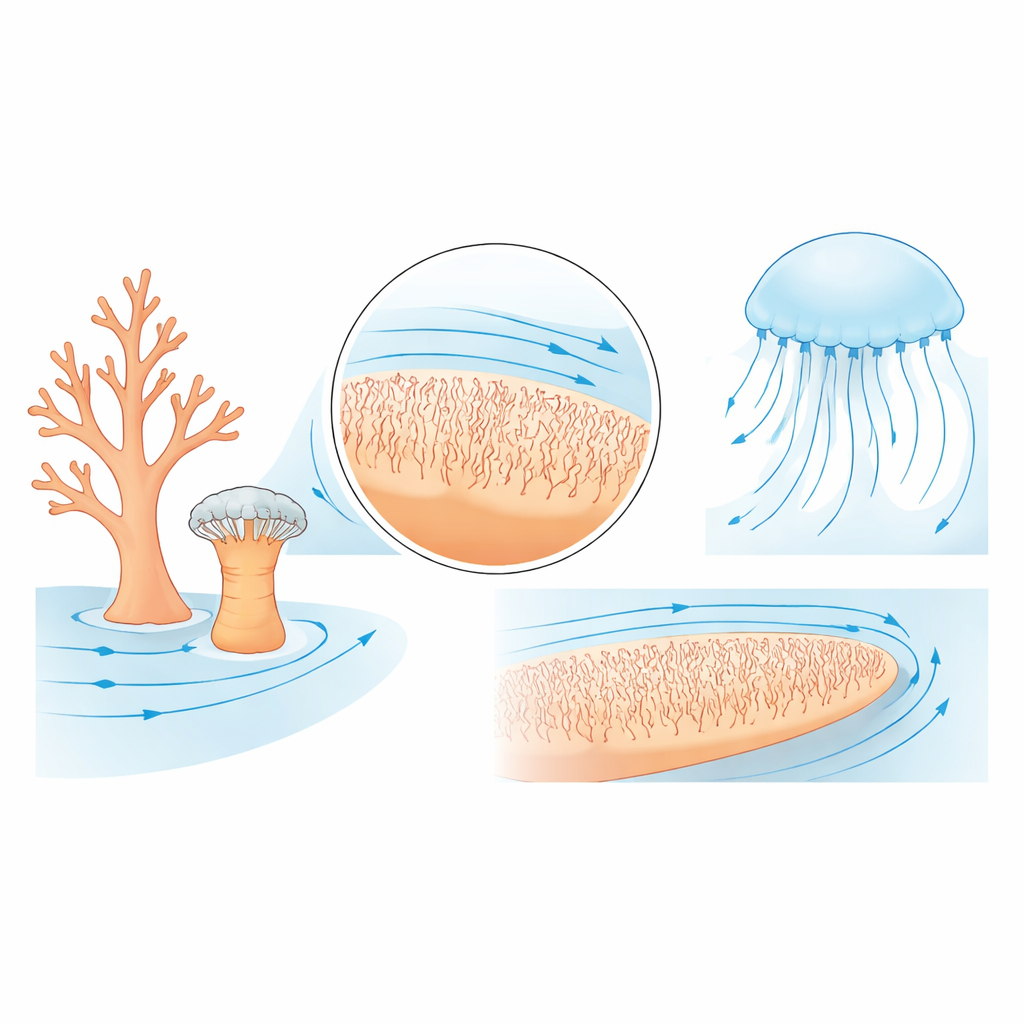
The authors focused on cnidarians—a group that includes reef-building corals, soft corals, sea anemones, and jellyfish. Many of these animals are covered in microscopic hairs called cilia that can beat in waves, pushing water and mucus along the body. Earlier work showed that hard corals use cilia to run intricate “water highways” over their colonies, improving feeding, cleaning, and gas exchange. The new study asked a broader question: are such surface currents a special trick of reef-building corals, or are they common across cnidarians with different shapes, lifestyles, and life stages?
Following glowing beads along living surfaces
To see these hidden flows, the team sprinkled fluorescent plastic beads, smaller than a grain of sand, into the thin layer of water and mucus coating live animals from aquariums and research stations. High-speed video recordings captured how beads slid, twisted, or stalled near the skin. Using tracking software, the researchers converted thousands of bead paths into numbers that described speed, straightness, turning behavior, and how paths connected over the animal’s body. They also stained tissue slices to see where cilia were present or absent on different species and life stages.
Who has surface currents—and who does not
The bead trails revealed that many anthozoans—the group that includes hard corals, sea anemones, and certain solitary or loosely colonial polyps—do generate strong, directional surface currents. In simple, flower-like animals with large single polyps, the flows often formed “stellar” patterns: beads moved from the tentacle tips toward the central mouth or away from it along star-shaped tracks. In whip-like black corals, currents ran along the main stalk and then branched toward each polyp. By contrast, soft corals and their relatives (octocorals), as well as hydrozoans such as fire corals, showed no detectable surface flows at all, even though they form dense colonies. Microscopy confirmed that these groups lack beating cilia on their outer skin, even though their internal cavities remain richly ciliated and support internal fluid transport.
Life stages that switch currents on and off
An even more striking pattern emerged in jellyfish relatives. In several box jellies and “true” jellyfish, the sessile polyp stage produced clear, orderly currents running from the base of the polyp toward its mouth and tentacles. But the free-swimming medusa stage of the same species showed no organized surface flows, only weak, local motion. Transitional stages in between, such as strobilae and baby jellyfish (ephyrae), sometimes showed modest currents. Staining revealed that medusae still carry some cilia, but at much lower density and with less organized arrangement than in polyps—apparently not enough to build strong, directed surface streams.
Patterns hidden in thousands of tiny paths
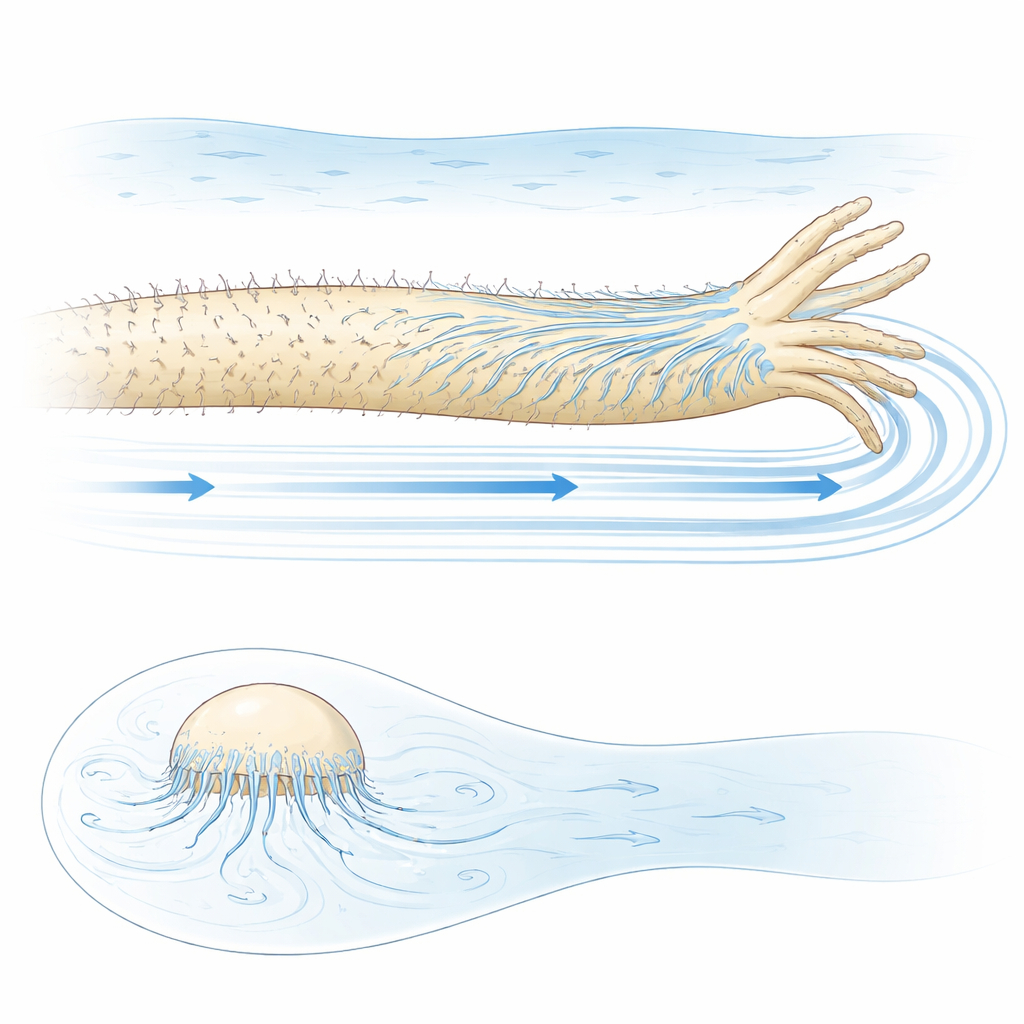
To compare species fairly, the researchers fed all bead tracks into a modern pattern-finding method that groups similar motions together in a low-dimensional map. Some cnidarians, such as certain solitary corals and black corals, displayed a mix of straight, fast flows and twisting, turning ones, hinting at flexible control of local hydrodynamics. Others, like box jellyfish and some scyphozoan polyps, produced highly stereotyped, nearly identical paths, suggesting streamlined, one-way “conveyor belt” flows along their small bodies. Additional analysis using tools borrowed from fluid physics showed how these flows carve out compartments and boundaries—regions drawing water toward the mouth, edges where water speeds up, or zones that remain relatively isolated from their surroundings.
When muscles replace microscopic rivers
Taken together, the study shows that cilia-driven surface currents are widespread but patchy across cnidarians. They appear in many, but not all, groups and can switch on or off between life stages of the same species. A key message for non-specialists is that there seems to be a trade-off: animals that are more fixed in place, often with rigid skeletons like reef-building corals, rely heavily on these microscopic rivers to move water for feeding and waste removal. Groups that can bend, pulse, or swim—such as soft corals, hydrozoans, and jellyfish medusae—tend to dispense with organized surface flows and instead reshape their surroundings with muscular motion. This work suggests that over evolutionary time, cnidarians have repeatedly gained and lost cilia-driven currents as they experimented with different ways of living in a moving sea.
Citation: Koch, T., Araslanova, K., Bouderlique, T. et al. Cilia-driven surface currents characterize specific cnidarian groups and lifecycle stages. Commun Biol 9, 579 (2026). https://doi.org/10.1038/s42003-026-09827-0
Keywords: cnidarians, coral surface flows, cilia, jellyfish life cycle, marine hydrodynamics