Clear Sky Science · en
Trophic ecology outweighed intrinsic constraints in shaping skull evolution of carnivorous Permian synapsids
Ancient Hunters with Modern Lessons
Long before dinosaurs ruled the land, fearsome mammal relatives were already top predators. This study looks at the skulls of those Permian "proto-mammal" carnivores to ask a surprisingly modern question: were their heads shaped mainly by what they ate and how they hunted, or by inner biological limits on what evolution could do? The answer helps us understand how today’s complex land ecosystems first took shape and why distant groups of predators can end up looking so similar.
Life on a Drying Planet
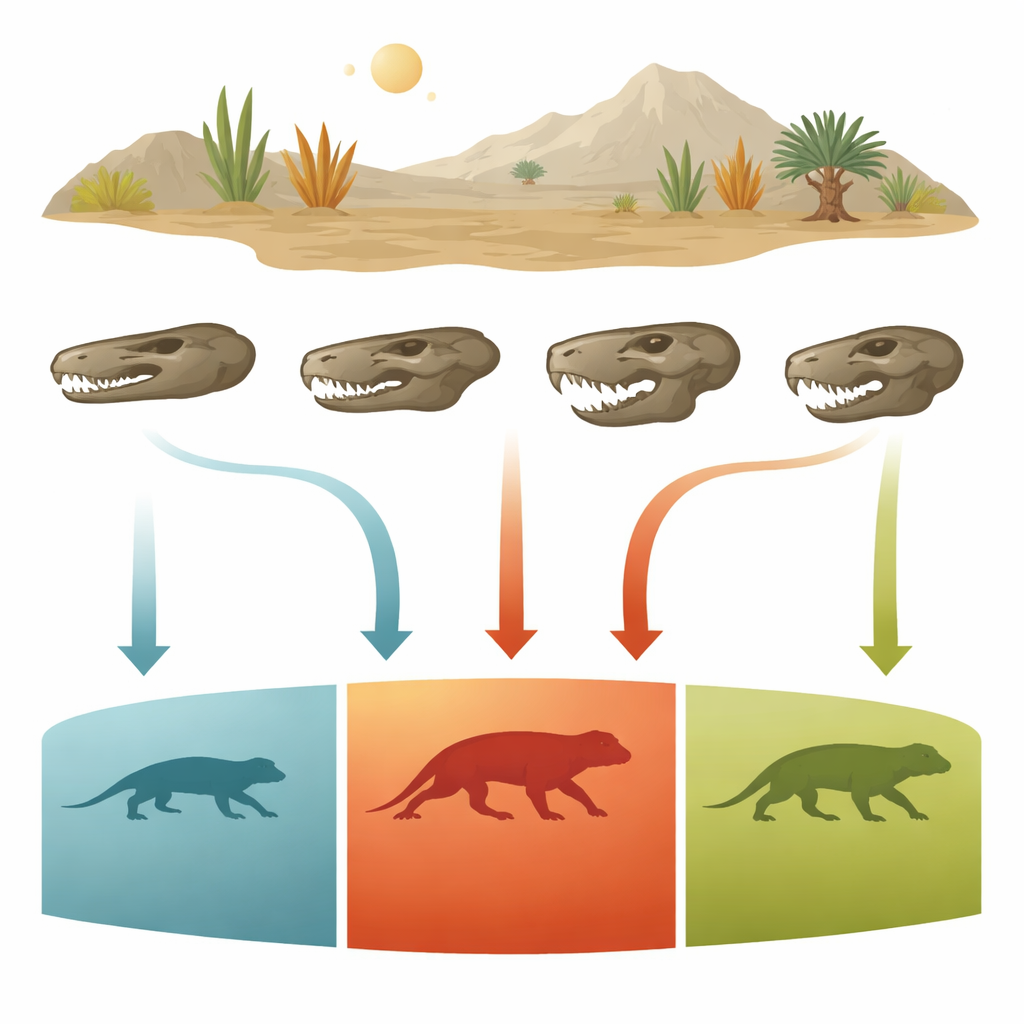
Over 260 million years ago, Earth’s great coal forests collapsed as the climate grew drier. This upheaval cleared the way for amniotes—the wider group that includes reptiles and mammals—to dominate land. Among them, early synapsids (the lineage leading to mammals) produced a variety of carnivores. The first wave, the so‑called pelycosaurs like Dimetrodon, often had long, slender jaws suited to snapping up smaller prey and sometimes relied partly on water habitats. After a major extinction, a second wave, the therapsids, appeared. These predators diversified into many roles, from fast, gracile hunters to bulky, big‑headed forms with enlarged canine teeth reminiscent of later saber‑toothed mammals.
Reading Ecosystems from Fossil Skulls
Because direct evidence of ancient predation—like bite marks in prey—rarely survives, the authors instead decode ecosystem structure from skull shape and tooth function. They digitized the outlines of 77 carnivorous synapsid skulls and used statistical techniques to map their shape differences into a “morphospace,” where nearby points represent similar skull forms. They also measured features tied to feeding, such as jaw leverage, skull width, canine length, toothrow length, and how specialized or uniform the teeth were. From these functional traits, they identified three broad feeding styles: speed specialists with light, quick jaws; power specialists with broad skulls and massive canines suited to strong bites and big prey; and generalists in between, with versatile but not extreme adaptations.
Inside the Skull’s Blueprint
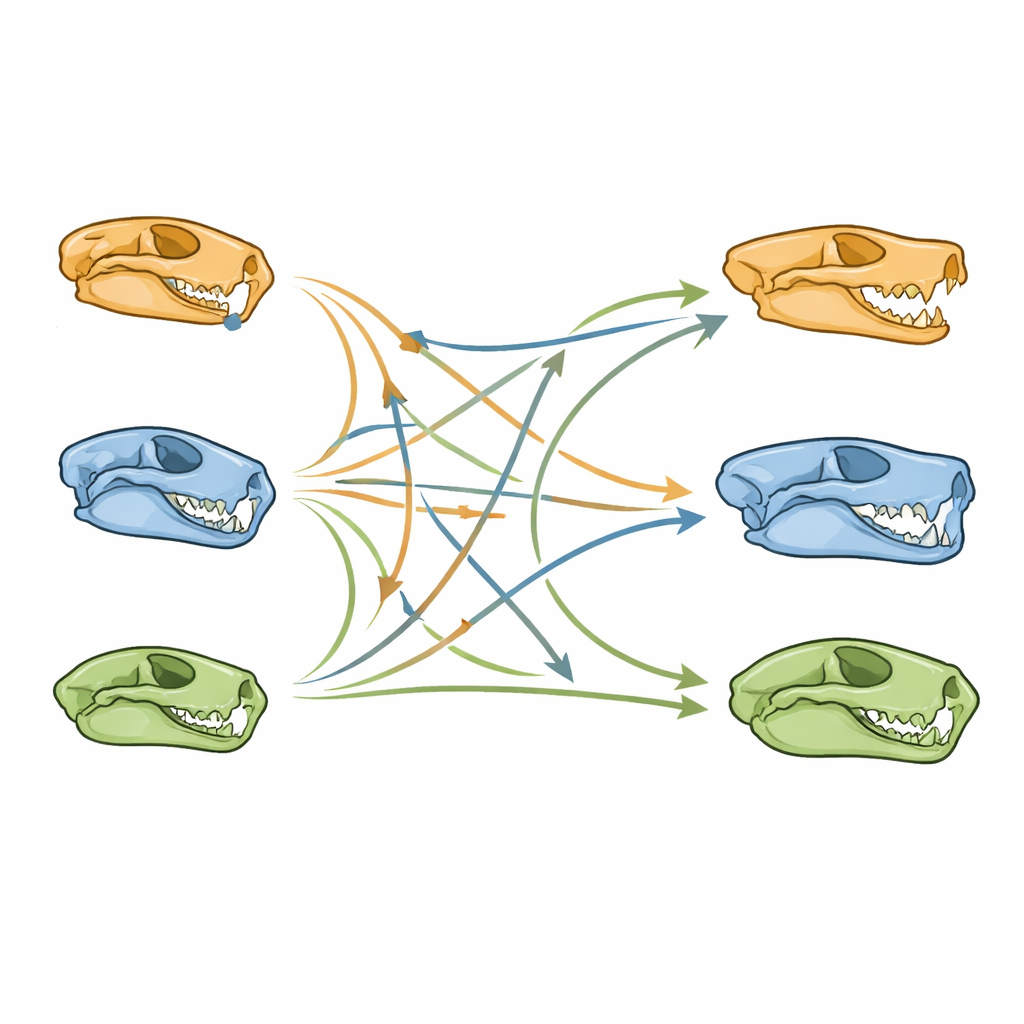
To test whether internal anatomical constraints were steering evolution, the team treated each skull as a network of bones connected at joints, then looked for modules—clusters of bones that are more tightly connected to each other than to the rest. Across very different synapsid groups, these skull modules were strikingly similar: an anterior (front) region and a posterior (back) region, echoing patterns seen in modern mammals tied to early embryonic tissue origins. Yet despite this shared “wiring diagram,” the overall skull shapes and feeding roles diverged dramatically, especially between early pelycosaurs and later therapsids. The authors found no clear link between changes in this modular blueprint and the bursts of new skull forms, suggesting the layout of the skull was not a major brake on innovation.
Competition, Convergence, and Evolutionary Speed
When the authors overlaid skull shape, feeding style, and family tree information, a consistent picture emerged. Closely related animals did not always resemble each other in skull form; instead, distantly related lineages often converged on similar predator designs when they occupied similar roles. Measures of “phylogenetic signal”—how strongly traits follow ancestry—were moderate for the entire group but weak within major predator branches, a pattern best explained by strong divergent selection. In other words, lineages branching off from a common ancestor tended to evolve in different directions to reduce competition, sometimes ending up similar to unrelated predators elsewhere. Evolutionary models further showed that most changes in skull shape and function clustered around branching points on the family tree, matching times when new species were splitting and exploiting new niches after environmental crises like Olson’s Extinction.
Why This Matters Today
This work concludes that, for these early land apex predators, what and how they ate mattered more than deep‑seated anatomical limits in shaping their skulls. The basic skull blueprint stayed broadly the same, but natural selection repeatedly sculpted it into new versions optimized for speed, power, or flexibility. The result was a predator guild that, in many ways, foreshadowed modern mammalian carnivores, with intense competition, niche partitioning by body size and hunting style, and repeated convergence on similar feeding designs. By showing that large‑scale evolutionary patterns can be traced back to everyday ecological pressures—who eats whom, and how—this study helps bridge the gap between short‑term adaptation and the grand story of life’s history.
Citation: Warshaw, E.A., Singh, S.A. & Benton, M.J. Trophic ecology outweighed intrinsic constraints in shaping skull evolution of carnivorous Permian synapsids. Commun Biol 9, 588 (2026). https://doi.org/10.1038/s42003-026-09824-3
Keywords: Permian predators, synapsid skull evolution, trophic ecology, convergent evolution, macroevolution