Clear Sky Science · en
Early postsynaptic instability and acetylcholine receptor compartmentalization precede neuromuscular synapse dismantling
Why Muscle–Nerve Contacts Matter
Every voluntary movement you make, from lifting a coffee cup to walking across a room, depends on a tiny contact point where a nerve talks to a muscle. This structure, called the neuromuscular junction, often falls apart in aging, nerve injuries, and diseases like ALS or muscular dystrophy. The study summarized here asks a crucial question: can we spot the earliest warning signs that this connection is starting to fail, before the damage becomes permanent? The answer could open a window of time in which treatments might protect or rebuild communication between nerves and muscles.
The Meeting Point Between Nerve and Muscle
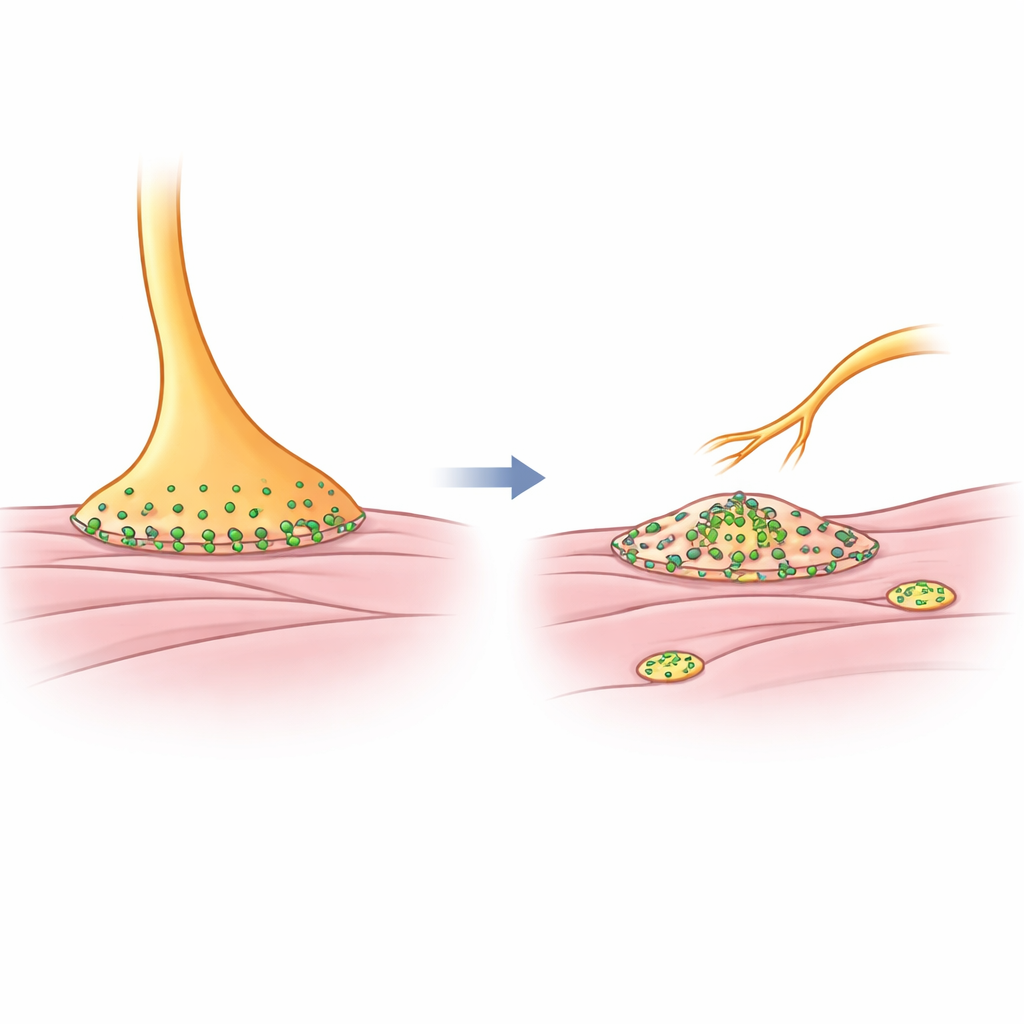
At each neuromuscular junction, a motor nerve ending sits on a specialized patch of muscle membrane that is densely packed with docking stations for the chemical messenger acetylcholine. These docking stations, or receptors, are not fixed in stone: they are continually being inserted, removed, recycled, and sometimes degraded inside the muscle cell. In healthy adult mice, the receptor-rich zone forms an intricate “pretzel-like” pattern that matches the shape of the nerve ending. Although doctors and researchers can see when these shapes fragment or shrink, those visible changes often appear late and do not always match how well the junction is actually working. The authors therefore set out to follow the receptors themselves in detail, asking how their stability, location, and movement change after the nerve is cut.
Early Hidden Changes Before the Structure Collapses
Using a small fluorescent toxin that binds tightly to acetylcholine receptors, the researchers labeled old receptors in one color and receptors added later in another color. They then cut the nerve that supplies a thin, accessible face muscle in mice and watched what happened over days to weeks. Long before the graceful pretzel pattern visibly broke down, the balance between old and new receptors shifted. The team found that many junctions became “unstable”: new receptors appeared and disappeared rapidly, giving them stronger signal than the older, long-lived receptors. As time went on, another pattern emerged at many junctions. The postsynaptic area shrank into a simpler “plaque-like” patch in which older, more stable receptors piled up in the center, while newer, more dynamic receptors formed a ring at the edges. This compartmentalized layout signaled that the junction was on a path toward dismantling, even when the overall shape still looked relatively intact under the microscope.
New Receptor Hotspots and Internal Recycling Routes
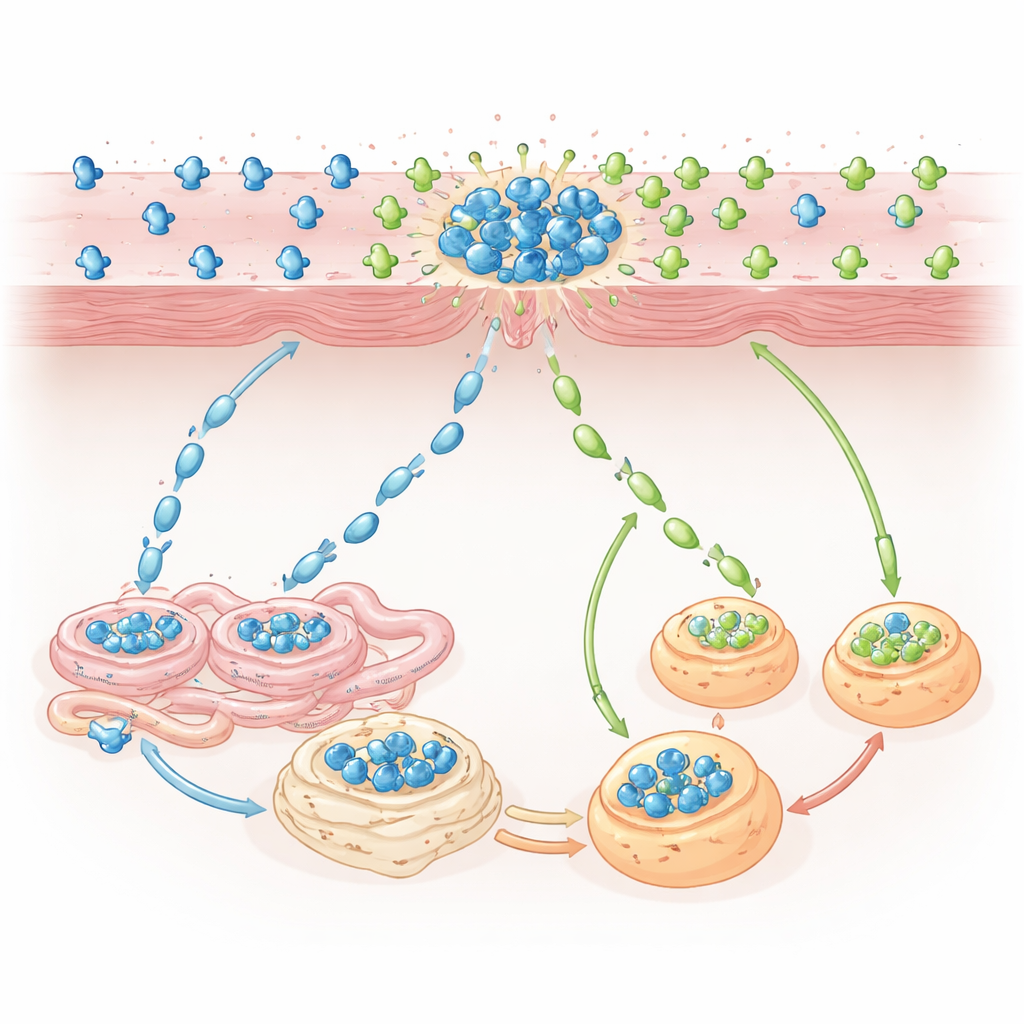
Denervation did not just reshuffle receptors at the original junction site. The authors also saw new, small receptor clusters popping up away from the synapse along the muscle fiber. These extrasynaptic clusters were highly dynamic: receptors turned over and recycled particularly quickly there, suggesting that the muscle was trying to reorganize its sensitivity to nerve signals in a more global way. By combining several rounds of labeling, the team showed that recycled receptors tended to accumulate near the center of both synaptic and extrasynaptic clusters, while newly inserted receptors were added at the periphery. This center–edge division of labor indicates that receptor renewal and reuse are organized in space, not only in time.
Ring-Shaped Receptor Aggregates Inside the Cell
The researchers then asked what happens to receptors once they leave the surface. After making the muscle fibers permeable and labeling internal receptors with a third fluorescent tag, they discovered striking ring-shaped aggregates inside the cells, positioned close to muscle nuclei. Some of these intracellular rings appeared near structures involved in building new proteins, suggesting they represent receptors in the process of being made and shipped to the surface. Others overlapped with a marker of lysosomes, the cell’s recycling centers, indicating a degradative route. These perinuclear receptor rings appeared early after denervation, even before the surface pattern had fully collapsed, and were far more common in injured than in healthy muscles. Together with the compartmentalized surface pattern, they provide an internal fingerprint of a junction that is beginning to fail.
What This Means for Protecting Movement
Overall, the study shows that subtle shifts in receptor stability, position, and trafficking occur well before the neuromuscular junction visibly falls apart. The combination of unstable receptor-rich zones, central clusters of older receptors, peripheral rings of new receptors, scattered extrasynaptic patches, and intracellular receptor rings linked to lysosomes forms a set of early warning signs for synapse dismantling. For a non-specialist, the key message is that the health of nerve–muscle communication is written in how receptors move and are handled inside muscle cells, not just in the overall shape of the junction. These newly defined patterns could help clinicians and researchers identify when a junction is still salvageable and guide therapies aimed at stabilizing receptors or modulating their degradation, potentially extending the window in which reinnervation and functional recovery remain possible.
Citation: Zelada, D., Bermedo-García, F., Mella, J. et al. Early postsynaptic instability and acetylcholine receptor compartmentalization precede neuromuscular synapse dismantling. Commun Biol 9, 576 (2026). https://doi.org/10.1038/s42003-026-09816-3
Keywords: neuromuscular junction, acetylcholine receptors, denervation, synapse degeneration, muscle regeneration