Clear Sky Science · en
Repeated evolution of cooperative breeding and life history traits in Lake Tanganyika cichlids
Fish Families That Raise Young Together
In most animals, parents raise their young on their own. But in some species, extra adults pitch in, forming something like a family daycare. This study looks at such shared parenting in colorful cichlid fishes from Africa’s Lake Tanganyika. By tracing how these fish and their lifestyles changed over millions of years, the authors reveal why some lineages repeatedly evolved to live and breed in tight-knit groups—and how this shift reshaped the way they grow and reproduce.
Why Extra Helpers Matter
In cooperatively breeding species, young receive care not only from their parents but also from “helpers,” often older offspring that stay at home instead of striking out on their own. These systems have appeared many times in mammals and birds, and a handful of times in fishes. Yet scientists still debate what pushes a species toward this kind of social life. The Lake Tanganyika cichlids are ideal for tackling this question: they share a common ancestry, live in the same lake, but differ widely in whether they breed as simple pairs or in large groups with helpers. The authors combined an up-to-date evolutionary tree with detailed field data on body size, habitat, and reproduction to uncover patterns that might not be visible from any single species alone. 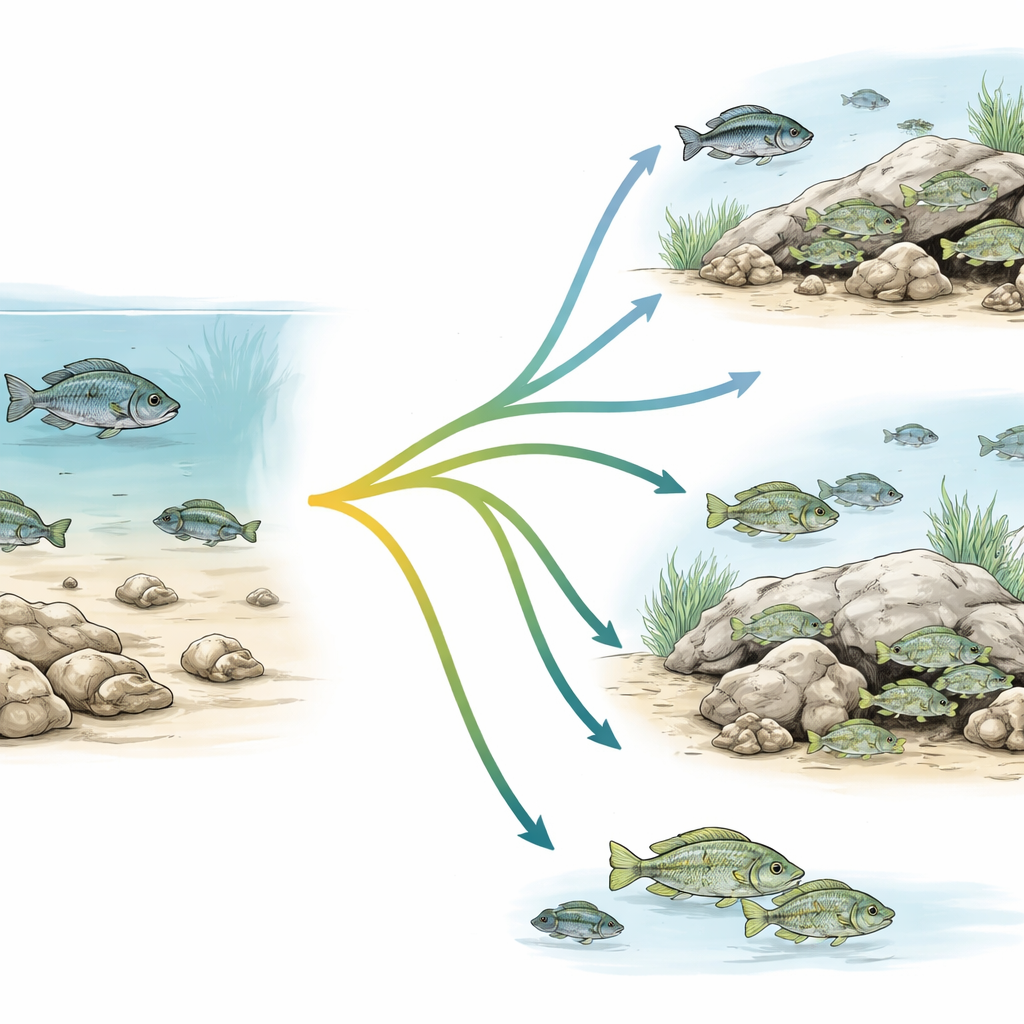
Many Paths to the Same Social Lifestyle
Using the evolutionary tree, the team reconstructed how breeding systems changed over time. They found that cooperative breeding did not arise just once. Instead, it evolved independently around eight to eleven times from ancestors that bred without helpers. The first such shift likely occurred about four million years ago, and similar changes later appeared in multiple branches of the family tree. Notably, there was no strong sign that lineages went back to non-cooperative breeding after evolving helpers, suggesting that once this social lifestyle emerges it tends to persist. Some details remain uncertain—because a few species are rare or poorly studied—but the overall picture is that shared parenting is a repeated solution, not a historical accident.
Small Bodies, High Danger, and Safer Groups
The researchers next asked what features of a species are linked to having helpers. They compared body size, nesting habitat, and diet between cooperative and non-cooperative species. Across dozens of taxa, cooperative breeders were consistently smaller than their non-cooperative relatives, even after accounting for shared ancestry. Field observations and stomach analyses of predators in the lake showed that fish-eating hunters mostly consume small cichlids, while larger adults are less frequently eaten. This supports the idea that small species face strong danger from predators throughout life. In response, many of these small cichlids build elaborate nests in rock crevices or empty snail shells and benefit when extra group members help defend and maintain these shelters. Staying at home, then, can be a better strategy than venturing out alone.
Fewer Eggs, Not Smaller Ones
Social living can also shape how parents invest in offspring. The authors measured how many eggs females laid in a single breeding attempt and how large those eggs were. After accounting for body size and habitat, cooperatively breeding species laid smaller clutches—that is, fewer eggs—than non-cooperative species, but the size of individual eggs did not reliably differ between the two social systems. Bigger females tended to have both more and larger eggs, as expected, but social lifestyle mainly affected number, not size. One possible reason is that large broods inside a group can intensify fights among siblings of different ages and sizes. When many youngsters crowd a territory, larger juveniles may bully or expel smaller ones, cutting into parents’ long-term success. Producing fewer offspring at a time may reduce such strife and match the limited room available in a shared shelter. 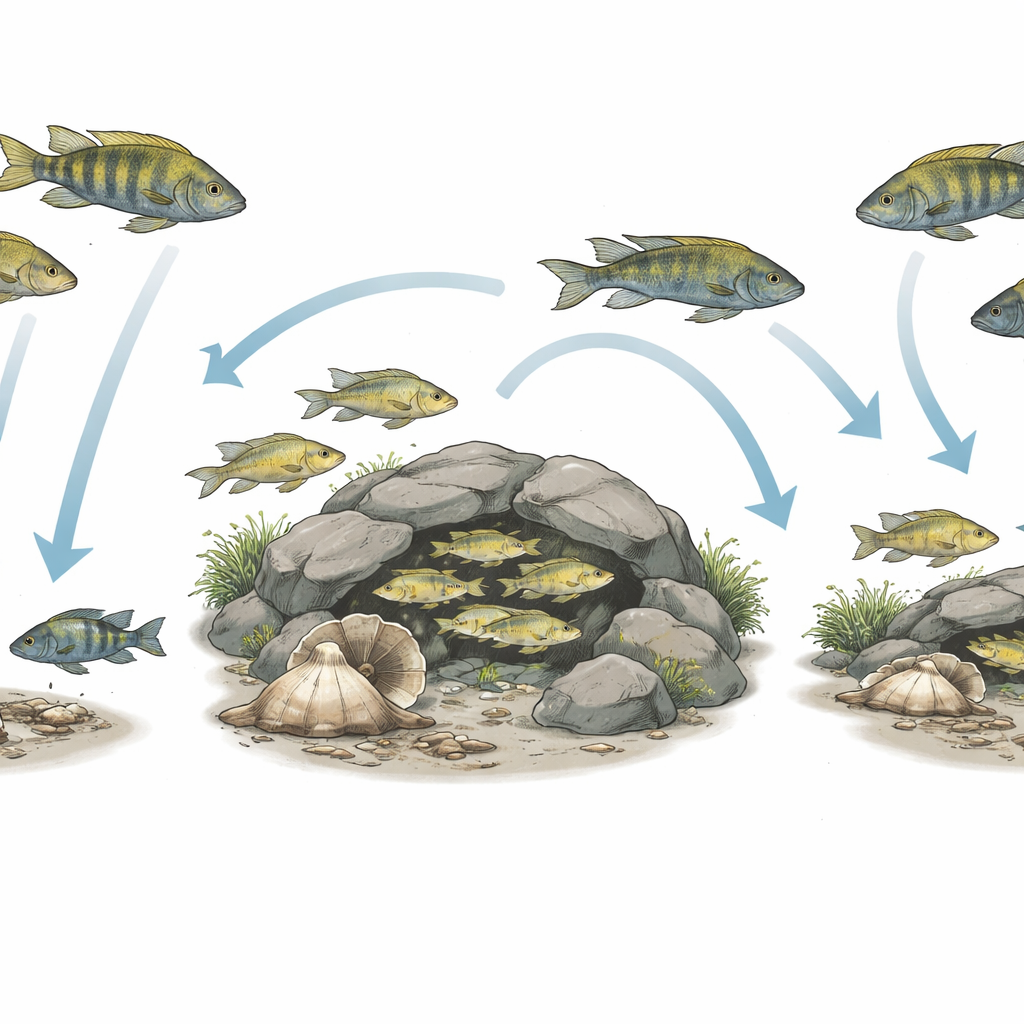
Piecing Together the Evolutionary Story
By linking all these factors in a statistical “path” model, the study suggests a simple storyline. Species that stayed small were more likely to experience heavy predation, which in turn favored the rise of cooperative groups that defend complex nests. Once helpers became part of the system, practical limits on how many young a territory could support favored smaller broods, but did not require shrinking the eggs themselves. The work shows how everyday ecological pressures—who eats whom, and where animals can safely raise their young—can drive the evolution of surprisingly complex social lives, even in a relatively small corner of the fish world.
Citation: Satoh, S., Okuno, S., Ito, T. et al. Repeated evolution of cooperative breeding and life history traits in Lake Tanganyika cichlids. Commun Biol 9, 567 (2026). https://doi.org/10.1038/s42003-026-09814-5
Keywords: cooperative breeding, cichlid fish, predation, social evolution, life history