Clear Sky Science · en
The role of white matter myelin in structural-functional network coupling
Why the Brain’s Wiring Coats Matter
The human brain works as a vast communication network, with distant regions constantly exchanging signals. Those signals travel along white matter tracts—bundles of nerve fibers wrapped in a fatty coating called myelin. This paper asks a deceptively simple question with big implications: beyond just where connections exist, does the amount of myelin on these tracts help determine how well different brain regions work together, and does this depend on the speed or "rhythm" of brain activity?
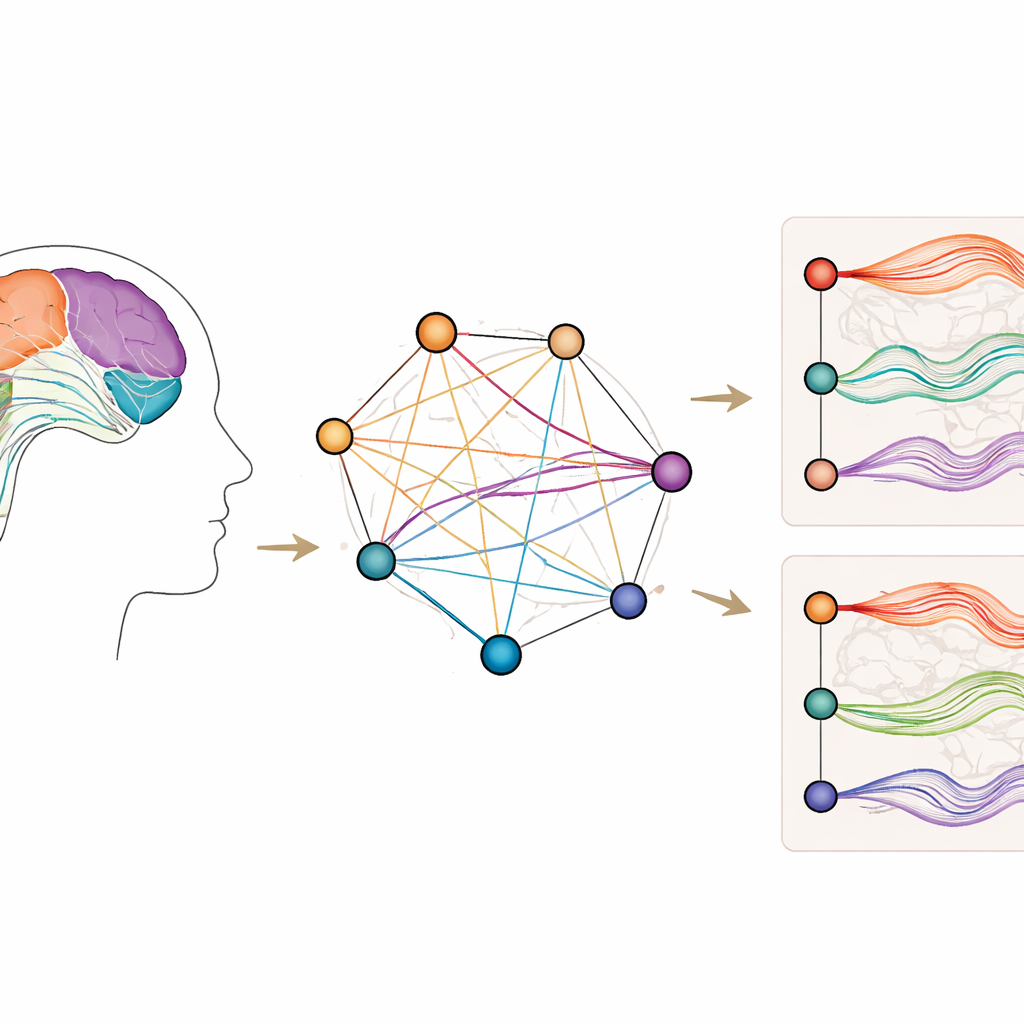
Looking at the Brain’s Highways in New Detail
Most studies of brain wiring treat each connection as a single number, like the thickness of a highway on a map. Here, the authors build a richer picture. Using several types of MRI in healthy adults, they measure three features of each white matter connection between brain regions: caliber (how much axon cross-sectional area passes along that route), myelin density (how heavily those axons are coated), and length (how far the signal must travel). They then relate this structural network to multiple kinds of functional connectivity—patterns of synchronized activity measured with fMRI, which tracks slow blood-oxygen changes, and with MEG, which captures fast electrical rhythms across a range of frequencies.
How Structure Predicts Communication
The team uses a multi-linear model that predicts the strength of functional connectivity between pairs of regions from the three white matter features and their interactions. Across the whole brain, these models reproduce the main pattern of functional connectivity quite well, for both fMRI and MEG. Myelin emerges as a robust predictor, often nearly as important as caliber and more informative than simple tract length. Yet its influence is not uniform. The contribution and even the sign of myelin’s relationship to connectivity change across the brain and across timescales—from slow, integrated signals to fast, oscillatory activity in different frequency bands.
Different Roles Across Brain Regions and Rhythms
The authors find that the tightness of the link between structure and function varies along a well-known gradient that runs from sensory regions (which process sight, sound, and touch) to high-level association areas involved in abstract thought. In general, structure and function are more tightly coupled in sensory networks and more decoupled in association networks. Myelin shows an antagonistic pattern: where white matter is more heavily myelinated, the simple relationship between macro-scale structure (caliber and length) and functional coupling weakens. When the authors explicitly sort connections from low to high myelin, they see that, as myelin increases, functional connectivity becomes progressively less tied to differences in caliber and length, especially for slow fMRI signals and for low-to-intermediate MEG frequencies.
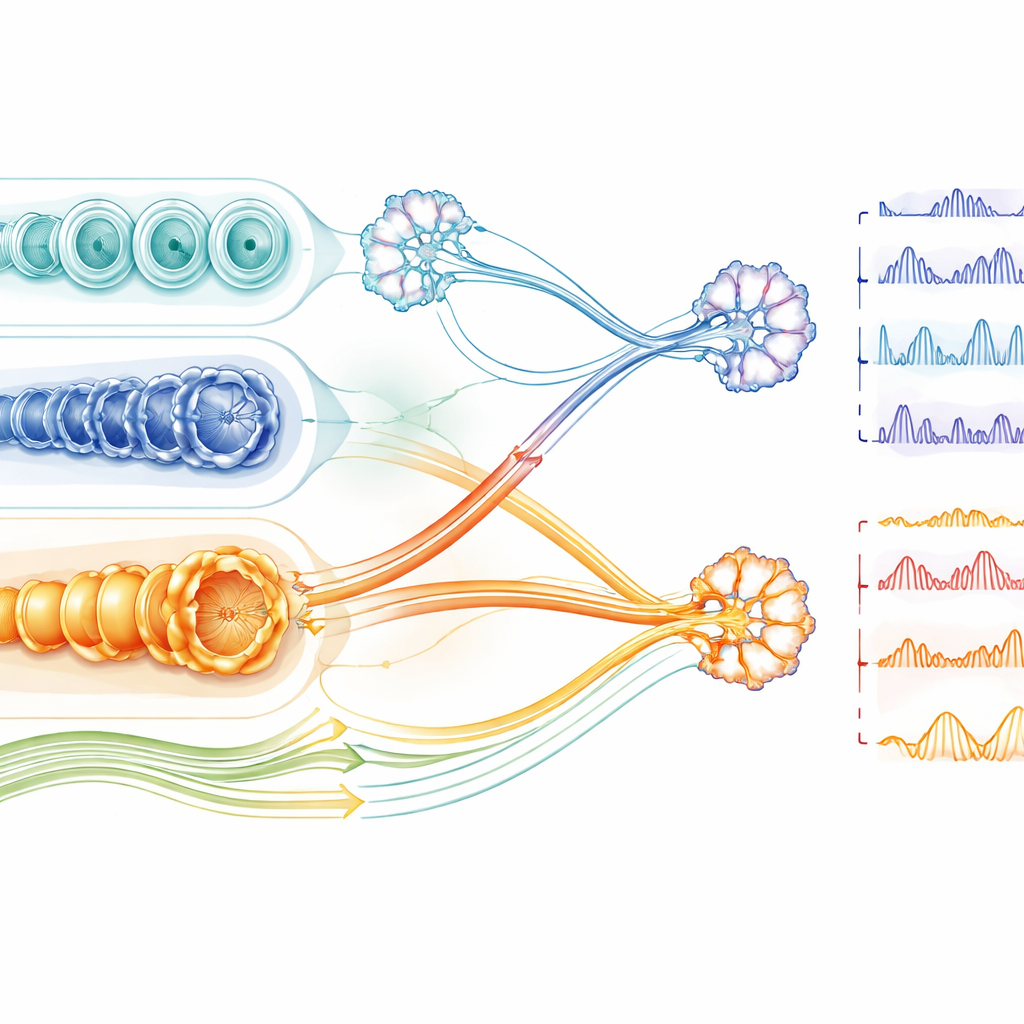
Myelin as a Tuner, Not Just an Insulator
These patterns suggest that myelin does more than speed up signals. In less myelinated tracts, functional synchrony seems strongly constrained by how thick and how long the fibers are. As myelin builds up, it appears to compensate for those physical constraints—making communication more uniform across a wider variety of tract profiles. In sensory areas and at lower frequencies, this might help maintain stable, efficient communication. In higher-order regions and at different frequencies, the same mechanism may support flexible, context-dependent coordination, with myelin enabling networks to loosen their dependence on raw wiring geometry.
What This Means for Understanding the Brain
To a lay observer, the key message is that the brain’s "insulation" is an active player in shaping how regions talk to each other, not just a passive wrapper. By modeling caliber, myelin, and length together, the authors show that myelin can modulate how closely brain function follows brain structure, in a way that depends on where you are in the cortex and what rhythm of activity you examine. This multi-feature view of white matter helps bridge cellular-scale roles of myelin—such as supporting energy use and timing—with large-scale patterns of brain networks, and it offers a new framework for thinking about how changes in myelin across development, aging, or disease might reshape the brain’s communication landscape.
Citation: Nelson, M.C., Da Lu, W., Leppert, I.R. et al. The role of white matter myelin in structural-functional network coupling. Commun Biol 9, 488 (2026). https://doi.org/10.1038/s42003-026-09813-6
Keywords: white matter myelin, brain connectivity, functional networks, neural rhythms, brain wiring