Clear Sky Science · en
Genome evolution and regulatory dynamics underlying salt stress tolerance in the halophyte Halogeton arachnoideus
Why a desert plant and salty soils matter to us
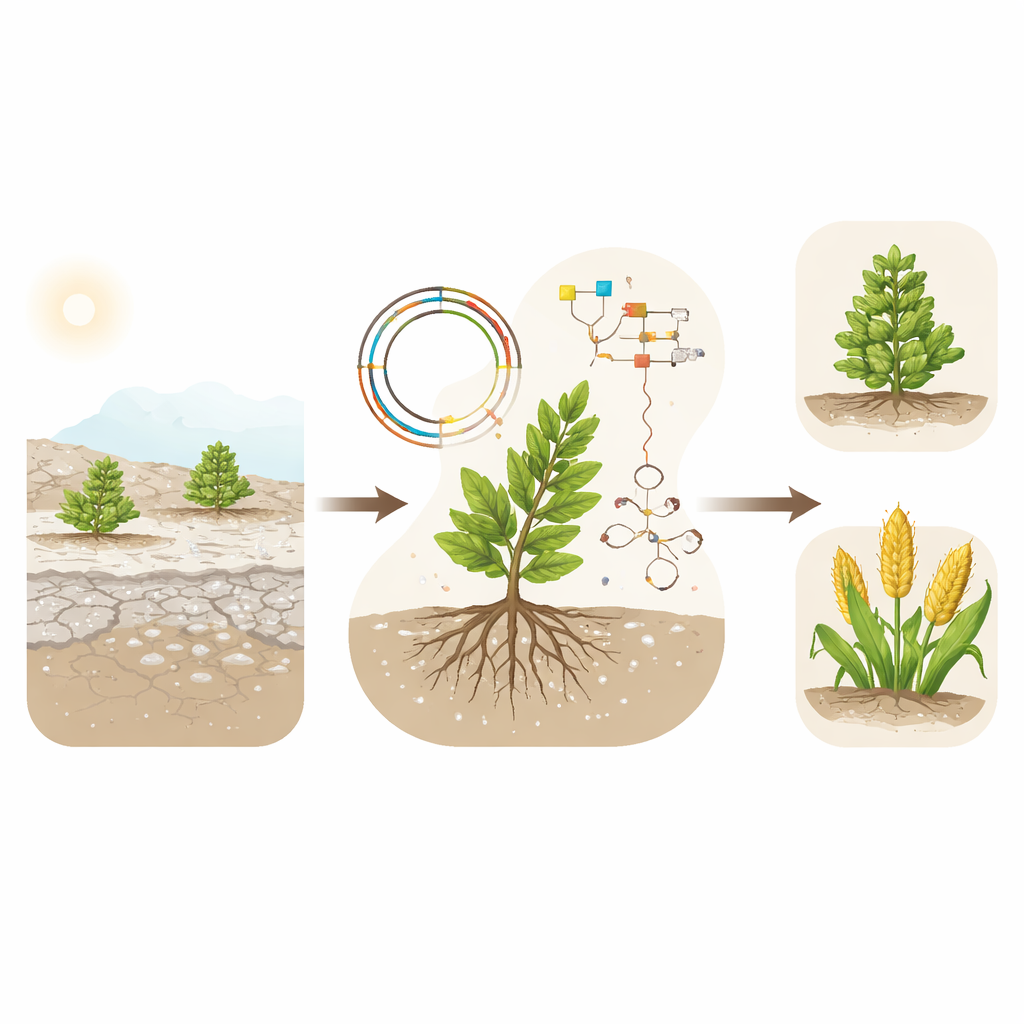
Across the globe, salty soils are quietly shrinking the world’s farmland and threatening food security. Yet some wild plants not only survive in these harsh conditions, they flourish. This study focuses on one such salt-loving species, Halogeton arachnoideus, a modest desert plant from Central Asia. By decoding its genome and tracking how its genes respond to salt, the researchers uncover design principles that could eventually help breeders build more salt-tolerant crops.
Meet the salt specialist from the desert
Halogeton arachnoideus grows in arid, alkaline regions of northwestern China, Mongolia, and Central Asia where ordinary crops struggle. It belongs to the same broad plant family as spinach and sugar beet, linking it directly to species important for human diets. The team assembled a high-quality, chromosome-level genome for this plant using state-of-the-art long-read sequencing and 3D chromosome mapping. They found about 34,000 protein-coding genes packed into nine chromosomes, along with many regulatory molecules such as transcription factors and small RNAs. This detailed genetic map provides a solid starting point for asking how its genome supports life in salty soils.
Hidden players in the genome’s “dark matter”
A striking feature of the Halogeton genome is that nearly three-quarters of it is made of repeated DNA, much of it long terminal repeat (LTR) retrotransposons—mobile elements often thought of as genomic “dark matter.” These elements have expanded recently in the species’ history and help shape chromosome structure. Yet salt-responsive genes tend to avoid them. The promoters of genes that switch on under salt stress are unusually depleted of LTRs, suggesting that Halogeton has cleared disruptive elements away from key control regions. The authors propose that LTR-rich zones help keep background activity stable, while LTR-poor regions remain flexible “hotspots” where stress-response genes can be turned on quickly and reliably when salt levels spike.
Duplicated genes as a toolkit for stress
The study also explores how gene duplication has provided raw material for adaptation. Halogeton shares an ancient whole-genome duplication with its relatives but shows no recent duplication of the entire genome. Instead, it retains a carefully pruned set of older duplicate genes and many smaller local duplications. Transcription factor families known to manage stress—such as MYB, AP2/ERF, WRKY, bHLH, and others—are especially enriched among the ancient duplicates and appear to be under strong evolutionary constraint, hinting that balanced gene dosage is crucial for their function. In contrast, genes duplicated in short runs along the chromosome have evolved faster and specialize in detoxification and oxidative stress responses, acting as a more flexible, fine-tuning toolkit across a range of salt levels.
How the plant responds in real time to salt
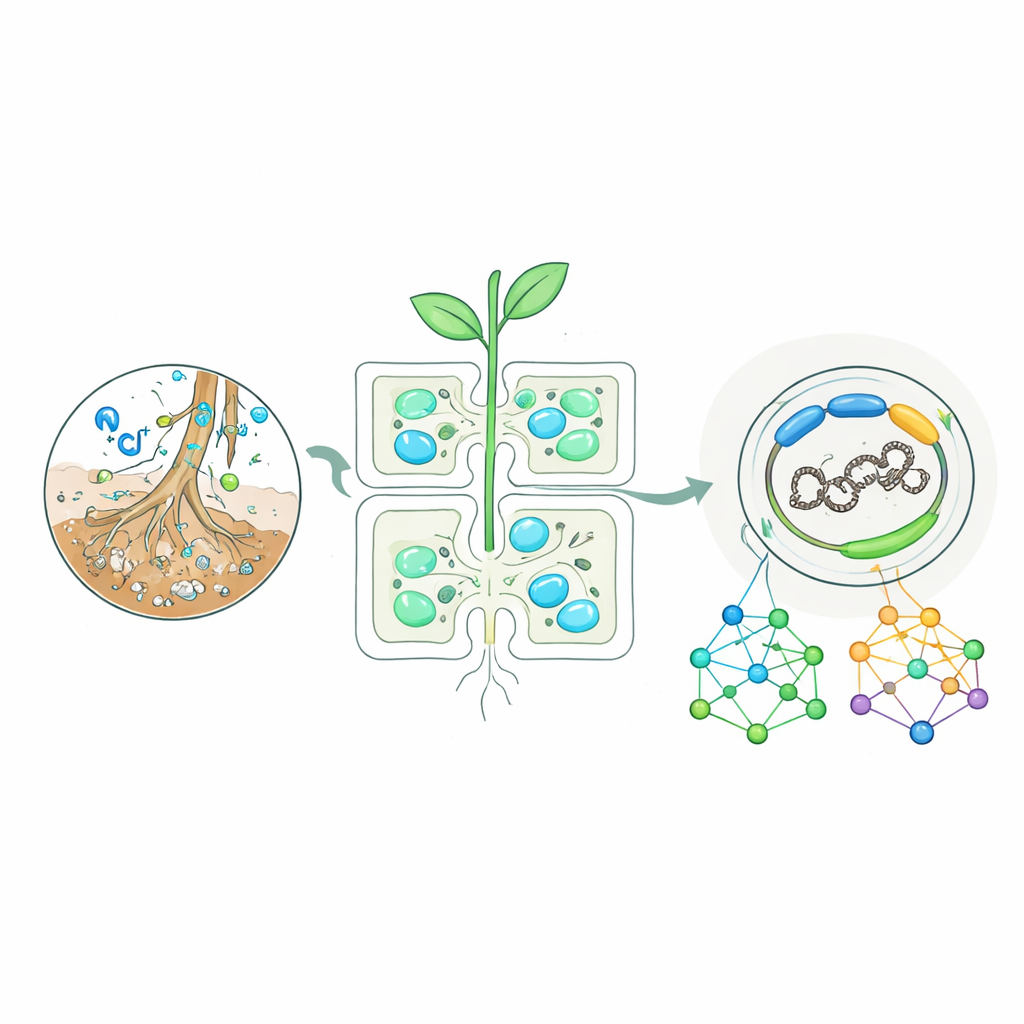
To see these genomic features in action, the researchers exposed young plants to moderate and high salt and measured both ion movements and gene activity in roots and leaves over time. Roots initially pump sodium out and later ship more of it toward the leaves, while thousands of genes in both tissues change their activity patterns. Under moderate salt, roots respond quickly and then partially settle down, whereas leaves ramp up more slowly, mirroring the shift in sodium distribution. Under high salt, both tissues show stronger and more sustained changes, but with different strategies: roots emphasize energy and ion-handling pathways, while leaves narrow their response to a smaller set of core protective processes. By inferring gene regulatory networks from these time-series data, the team finds that under severe stress, control shifts from a relatively centralized scheme to a more modular, decentralized one, with multiple transcription factor families sharing the regulatory load.
What this means for future crops
Taken together, the work paints Halogeton arachnoideus as a plant whose salt tolerance arises from a carefully organized genome: disruptive mobile elements are kept away from crucial switches, ancient regulatory genes are preserved to maintain robust control, and more recently duplicated genes add flexibility. When salt hits, this system can rapidly rewire gene activity in roots and leaves, and under extreme conditions it spreads control across many regulators rather than relying on a few key hubs. While these conclusions are based on correlations and predicted networks that still need experimental testing, the new genome and stress-response maps provide a rich resource. They outline which genes and regulatory patterns might be worth borrowing as plant breeders and biotechnologists work to engineer crops that can withstand the increasingly salty soils of a changing world.
Citation: Xu, K., Ye, P., Zhang, L. et al. Genome evolution and regulatory dynamics underlying salt stress tolerance in the halophyte Halogeton arachnoideus. Commun Biol 9, 559 (2026). https://doi.org/10.1038/s42003-026-09802-9
Keywords: salt tolerance, halophyte genome, stress-responsive genes, transcription networks, saline agriculture