Clear Sky Science · en
Mini-bacterioferritins: structural insight into a ferritin-like protein from the anaerobic methane-oxidising archaeon Candidatus Methanoperedens carboxydivorans
Why tiny iron safes in microbes matter
Iron keeps cells alive but can also be dangerously reactive, a bit like a medicine that becomes poison at the wrong dose. This study uncovers a new kind of microscopic “safe” for iron inside a methane-eating microbe that lives without oxygen. By revealing this protein’s detailed shape and behaviour, the work shows how some of Earth’s most hidden microorganisms manage their iron supply and may shed light on how similar iron-storage systems evolved across life.
A new kind of iron storage shell
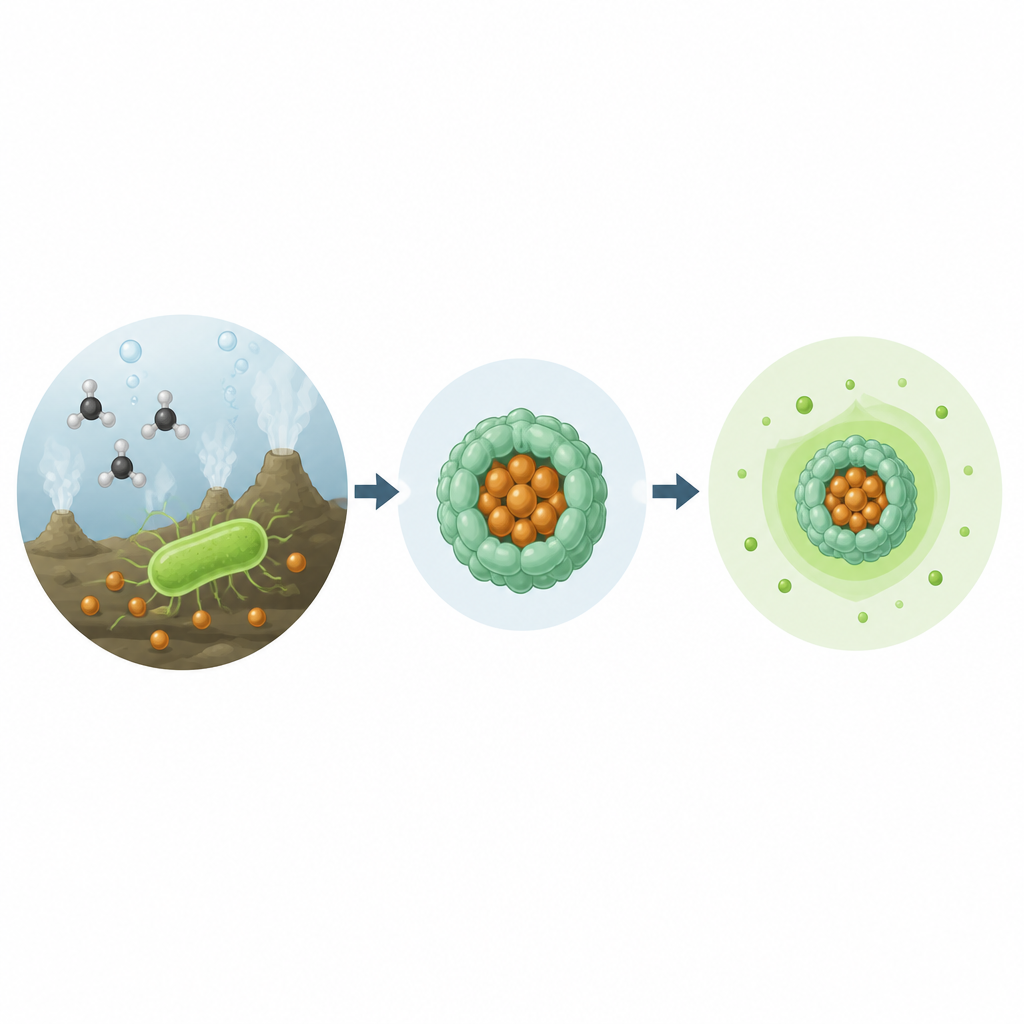
Most known iron-storage proteins form large hollow cages built from 24 copies of the same subunit. In contrast, the newly described protein, isolated from the archaeon “Candidatus Methanoperedens carboxydivorans,” assembles as a smaller 12-part shell. The researchers purified this pink-coloured protein directly from long-running laboratory cultures that mimic its natural, oxygen-free habitat where it oxidises methane while using nitrate and metals as electron acceptors. Analyses showed that, despite its compact size, the protein still forms a spherical container with an internal cavity suitable for locking away many iron atoms in a harmless form.
A compact shell with a working iron engine
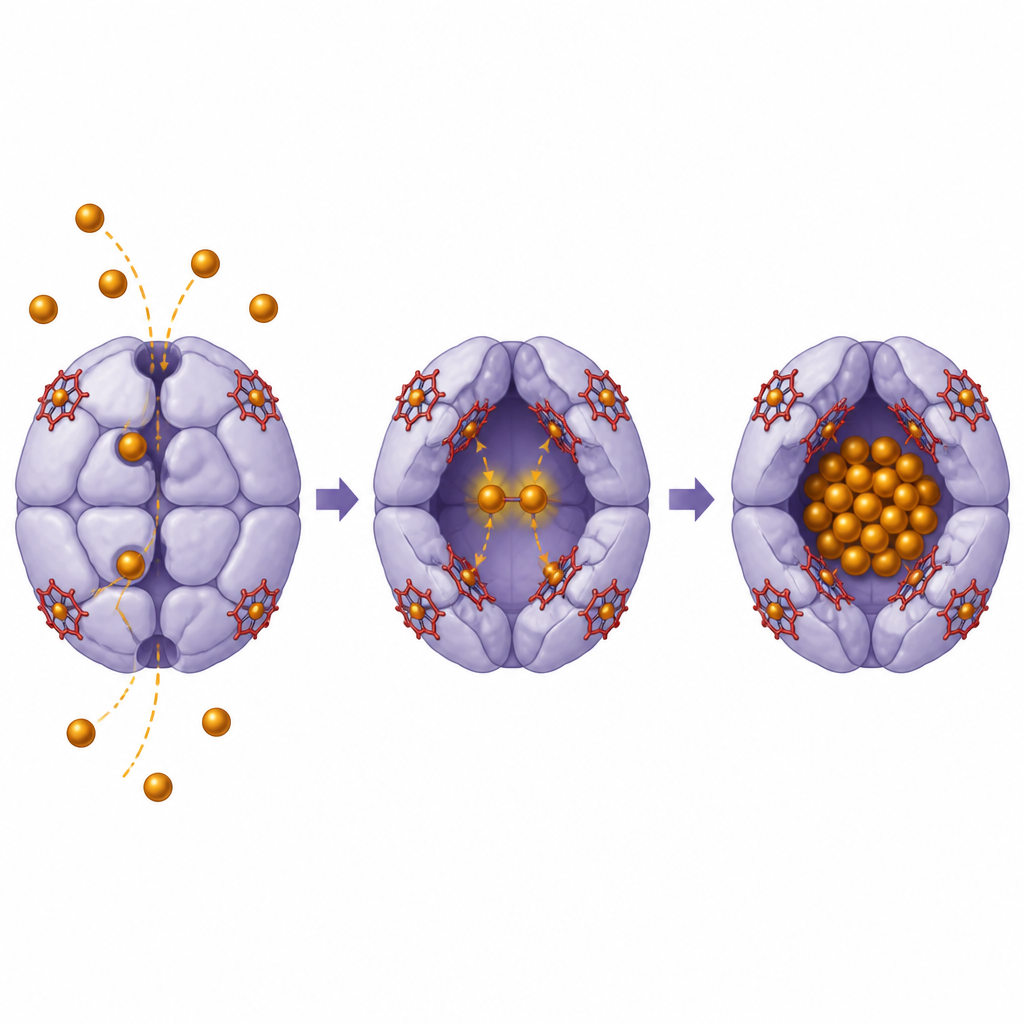
At atomic resolution, each of the 12 building blocks contains a tightly arranged bundle of four helices. Nestled inside this bundle is a special site that binds two iron atoms, which act as a tiny engine converting reactive iron into a safer stored form. The study followed this centre through controlled oxidation and reduction steps performed directly on crystals of the protein. One of the two iron atoms shifted position when exposed to oxygen and moved back again when reduced, closely matching the catalytic cycle known from other iron-storage proteins. Experiments with added iron and hydrogen peroxide confirmed that the protein can indeed capture and lock iron into its hollow core.
Unusual pigments tucked between pairs
Beyond iron storage, the protein carries a pigment called coproheme, related to the haem found in blood, but used here in a different way. Six of these flat ring-shaped molecules sit at the junctions between pairs of subunits inside the shell. They are held in place by a single sulphur-containing amino acid and several hydrogen bonds, and they adopt two slightly different orientations. This mirrored arrangement mirrors what has been seen in a few rare bacteria, suggesting it may tune how electrons move through the protein to help release stored iron when needed. The interior surface around these pigments and the shell pores is mostly negatively charged, creating a welcoming environment for positively charged iron ions to enter.
A missing link in the ferritin family tree
To see where this protein fits among known iron-storage systems, the authors compared its sequence and structure to dozens of related proteins. Most close relatives were predicted to form similar 12-part spheres and to carry a pigment-binding site, leading the team to define a new group they call mini-bacterioferritins. Unlike other family members, these proteins are stripped down to the essential four-helix core with no extra tails or helper helices. They appear across many bacteria and archaea and may preserve features of ancestral iron-storage proteins that existed before the larger 24-part shells became common.
What this means for life in hidden worlds
For non-specialists, the key message is that even microbes in dark, oxygen-free sediments rely on carefully engineered molecular cages to handle iron safely. This newly recognised class of mini-bacterioferritins combines a compact shell, an active iron-converting centre and unusual pigments to balance iron storage and release. The work broadens our picture of how iron management strategies evolved and hints that many more variants remain to be discovered in understudied microbes that quietly shape Earth’s methane and metal cycles.
Citation: Wissink, M., Engilberge, S., Leão, P. et al. Mini-bacterioferritins: structural insight into a ferritin-like protein from the anaerobic methane-oxidising archaeon Candidatus Methanoperedens carboxydivorans. Commun Biol 9, 646 (2026). https://doi.org/10.1038/s42003-026-09796-4
Keywords: iron storage, ferritin proteins, archaea, methane oxidation, protein structure