Clear Sky Science · en
Cardiometabolic adaptations in the cave nectar bat Eonycteris spelaea
How bats keep flying hearts healthy
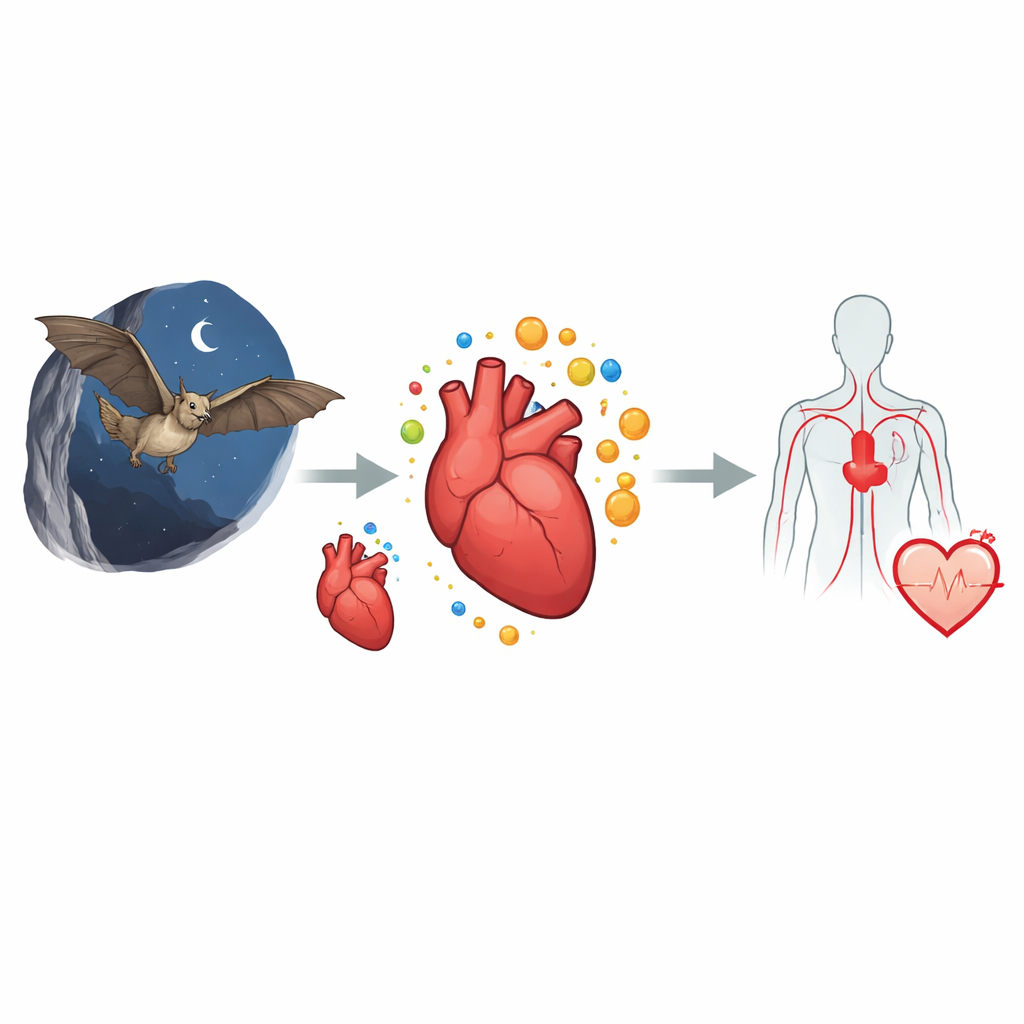
Bats are famous for their acrobatic night flights, but less obvious is the incredible strain that flight puts on their hearts. Some bats can push their heart rates close to a thousand beats per minute and ramp up their metabolism more than tenfold. This study asks a deceptively simple question with big implications for human health: how do bat hearts power such extreme exertion day after day without burning out?
Hearts built for intense effort
The researchers focused on the cave nectar bat, a medium-sized species common in Southeast Asia, and compared its heart to those of mice and humans. At the genetic level, bat hearts clearly stood apart. Their heart tissue showed strong activation of genes involved in energy production, especially those that drive the cell’s “power plants” (mitochondria) and the breakdown of fats. When the authors expanded their analysis to six additional bat species with very different diets and lifestyles, they found the same pattern: across bats, heart genes linked to burning fuel efficiently and generating large amounts of energy were consistently turned up. This suggests that, over millions of years, flight has pushed bat hearts toward a shared high-performance metabolic design.
Fuel lines wide open
To move beyond gene lists, the team measured actual small molecules related to energy use in the blood and heart tissue of bats and mice. They focused on acylcarnitines and tricarboxylic acid (TCA) cycle intermediates, chemical go-betweens that reveal which fuels the heart is burning. Bat hearts carried a distinctive signature: different patterns of short- and long-chain acylcarnitines compared with mice, and noticeably higher levels of key TCA compounds such as pyruvate, succinate, fumarate and malate. Together, these signs point to a heart that can pull in fats and sugars and push them rapidly through its energy-generating machinery. Supporting this, bat hearts produced far more of the transport proteins that shuttle glucose and fatty acids into cells, indicating unusually flexible fuel usage that likely helps them cope with feast–fast cycles and long nightly flights.
Big engines with custom plumbing
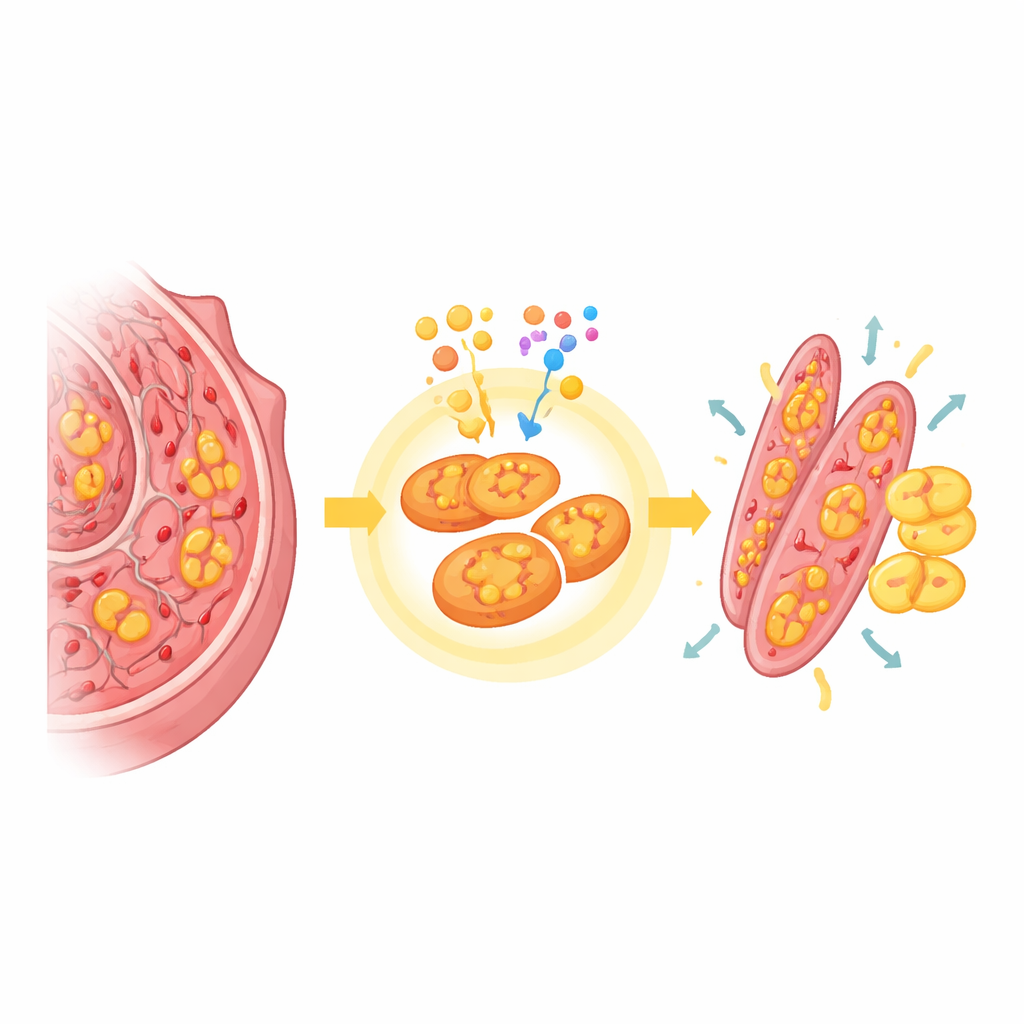
Anatomical and ultrastructural imaging showed that bat hearts are physically tuned for their demanding job. Relative to body weight, bats had hearts roughly twice the size of those in healthy mice and nearly as large as those of mice artificially forced into cardiac enlargement by constricting their main artery. Yet unlike those stressed mouse hearts, bat heart muscle cells were not enlarged, a typical warning sign of disease. Instead, bats gained size through architectural changes: thicker left ventricular walls, a more human-like heart shape, and a dense network of blood vessels. Under the microscope, their heart cells were packed with mitochondria and were surrounded by fat cells nestled next to blood vessels, hinting at local energy depots. There was some fibrous tissue, suggesting chronic mechanical stress from years of hanging upside down and flying, but without the destructive cellular changes seen in classic heart failure.
Reserves for when it really counts
Functionally, bat hearts behaved like engines idling low but ready to roar. At rest under anesthesia, their pumping efficiency looked modest compared with mice. However, when the researchers stimulated the heart with the drug dobutamine, which mimics adrenaline, bat hearts responded explosively. Measures of how much blood they pumped and how forcefully they contracted rose several-fold more than in mice, revealing a large “cardiac reserve” they can tap during intense activity. Mechanical tests on individual contractile fibers showed that bats could relax more quickly between beats, a feature that likely allows the heart to refill efficiently even at sky-high heart rates.
Built-in defenses against damage
To probe how well bat heart cells handle stress, the team exposed isolated cardiomyocytes from bats and mice to angiotensin II, a hormone that typically drives harmful enlargement of heart cells and impairs mitochondria. Mouse cells responded as expected, swelling and losing mitochondrial performance. Bat cells did not. Their size stayed stable, and their energy production remained intact. Combined with previous evidence that bats naturally limit damaging reactive oxygen molecules and maintain strong antioxidant defenses, these results suggest that bat hearts possess layered protection against the wear and tear that would normally accompany such extreme workloads.
What this means for human hearts
In plain terms, this study shows that bat hearts act like finely tuned long-distance engines: they are relatively large, densely supplied with fuel and oxygen, able to switch between energy sources, and equipped with strong safety systems that prevent overuse damage. These traits help bats sustain the enormous energy demands of flight for years while keeping their hearts functional. By mapping how evolution solved the problem of powering a tiny flying mammal without destroying its heart, the work offers clues that could one day inspire new strategies to protect human hearts from stress, improve recovery after cardiac injury, or boost resilience in people with heart disease.
Citation: Yu, F., Gamage, A.M., Kp, M.M.J. et al. Cardiometabolic adaptations in the cave nectar bat Eonycteris spelaea. Commun Biol 9, 569 (2026). https://doi.org/10.1038/s42003-026-09792-8
Keywords: bat heart, cardiac metabolism, mitochondria, flight adaptation, cardioprotection