Clear Sky Science · en
A long noncoding RNA modulates anthocyanin biosynthesis in Camellia sinensis
Why some tea leaves turn purple
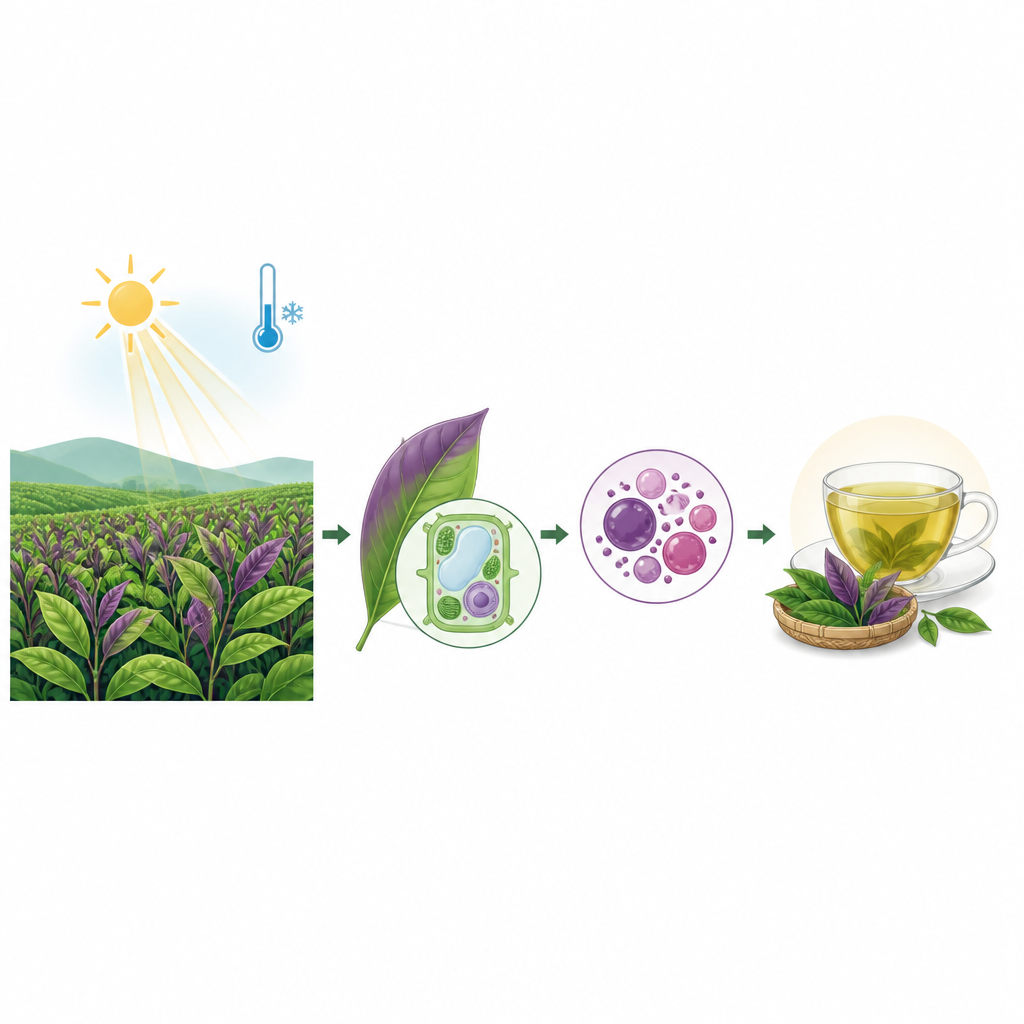
Tea drinkers may have noticed that some special teas are made from leaves with a deep purple color rather than the usual green. These striking leaves are rich in natural pigments called anthocyanins, which are linked to flavor, nutritional value, and higher prices for farmers. This study asks a simple question with a complex answer: what switches on the purple color in tea leaves, and could that switch be used to breed better teas?
The color behind purple tea
The authors begin by explaining how tea plants make anthocyanins. Inside the leaf, a production line of enzymes slowly transforms simple building blocks from the plant’s basic metabolism into colorful molecules that collect in cell storage compartments. Many of the protein-coding genes for this pathway are already known, especially a key enzyme called UFGT that locks unstable pigments into stable, sugar-linked forms. Purple tea varieties tend to build up much more of these pigments than ordinary green teas, but the fine control of this pathway has been unclear, particularly the role of noncoding pieces of RNA that do not make proteins.
A closer look at purple and green leaves
To uncover hidden regulators, the team compared three types of purple tea trees grown under the same field conditions. Two commercial cultivars start out with purple young leaves that later turn green, while a wild-derived variety starts green, becomes purple, and then fades back to green. By sampling leaves at these different color stages and sequencing their RNA, the researchers could see which genes and long noncoding RNAs changed together as the color shifted. They identified tens of thousands of candidate long noncoding RNAs and then narrowed these down to those that strongly tracked with genes in the flavonoid and anthocyanin pathways.
A special RNA inside a key pigment gene
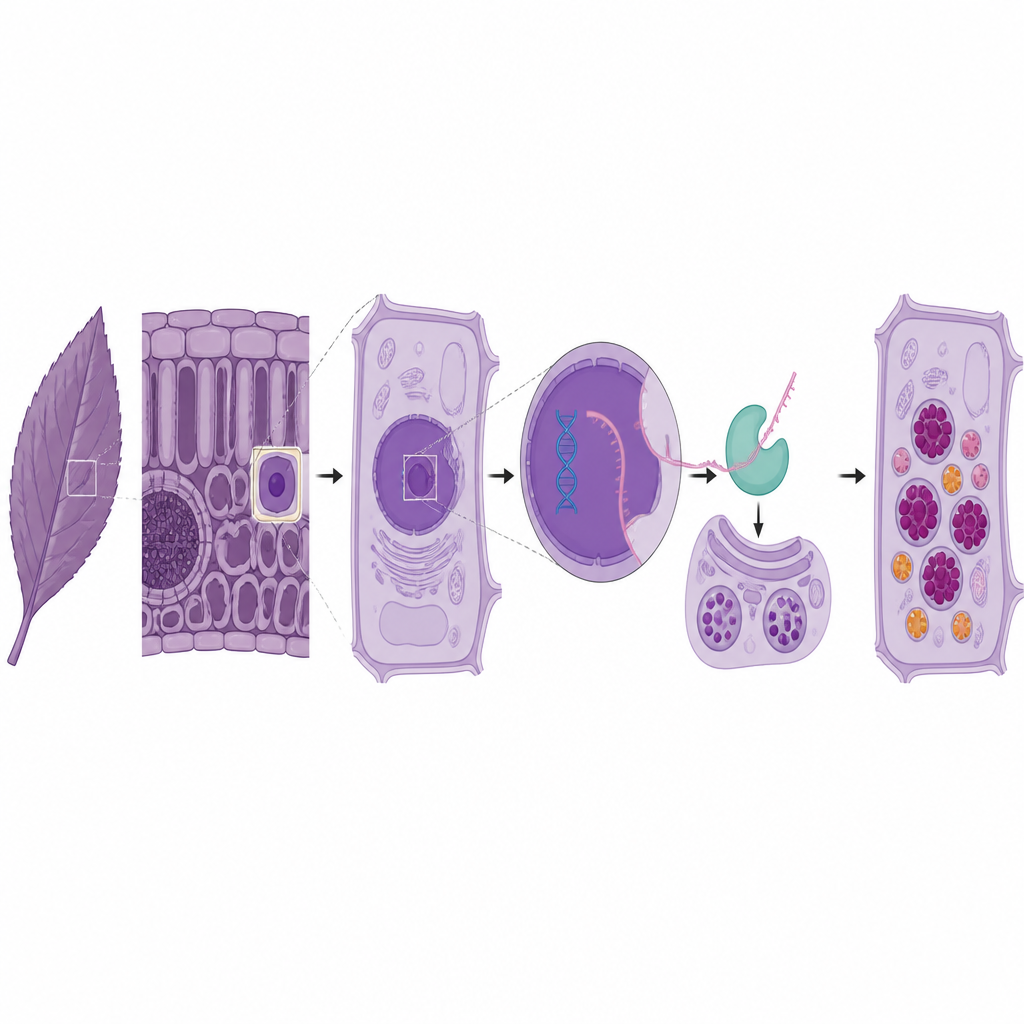
From this network, one long noncoding RNA stood out. Named Cs_lncRNA.18443.6, it sits inside the intron of the UFGT gene itself and is produced from the same stretch of DNA. Its activity rose and fell in step with UFGT during the transitions between green and purple leaves in all three tea types. Follow-up experiments confirmed this partnership: a technique that lights up specific RNA molecules in thin leaf sections showed that this RNA is strongly expressed in the upper surface cells and in the phloem, the same regions where purple pigment accumulates most.
Testing the pigment switch in another plant
The scientists then asked whether this long noncoding RNA can influence pigment-related genes when moved into another species. They introduced Cs_lncRNA.18443.6 into tobacco leaves, a standard laboratory plant. The leaves did not turn visibly purple, but the tobacco version of the UFGT gene became more active, while earlier steps in the pathway did not change much. In separate tests using plant cells, the team showed that a known tea transcription factor, CsMYB12, directly binds the UFGT control region and activates it. When Cs_lncRNA.18443.6 was added to this system, the activation by CsMYB12 became even stronger, suggesting that the RNA helps the protein switch UFGT on more efficiently.
What this means for future tea
Taken together, the results point to a three-part control module in purple tea leaves: a transcription factor that recognizes the pigment gene, a long noncoding RNA made from inside that gene, and the UFGT enzyme that performs the final stabilizing step in anthocyanin production. While the exact molecular details still need to be pinned down, this work shows that a previously overlooked RNA molecule helps tune how much purple pigment accumulates in tea leaves. In the long run, understanding and using this natural switch could help breeders develop new purple teas that combine attractive color, potential health benefits, and improved economic value for tea-growing regions.
Citation: Xiong, B., Zhang, L., Li, Q. et al. A long noncoding RNA modulates anthocyanin biosynthesis in Camellia sinensis. Commun Biol 9, 675 (2026). https://doi.org/10.1038/s42003-026-09785-7
Keywords: purple tea, anthocyanin, long noncoding RNA, Camellia sinensis, plant pigmentation