Clear Sky Science · en
Protocadherin γC4 regulates neuronal survival and dendritic self-avoidance
Why this brain study matters
Many children with rare genetic conditions develop small brains, seizures, and learning difficulties, yet the step-by-step causes inside the brain remain mysterious. This study focuses on one such gene, called protocadherin gamma C4, that helps brain cells recognize each other and build orderly connections. By designing precise mouse models that alter only this gene, the researchers show how it keeps nerve cells alive and their branches neatly arranged, pointing toward new ways to understand and eventually treat certain neurodevelopmental disorders. 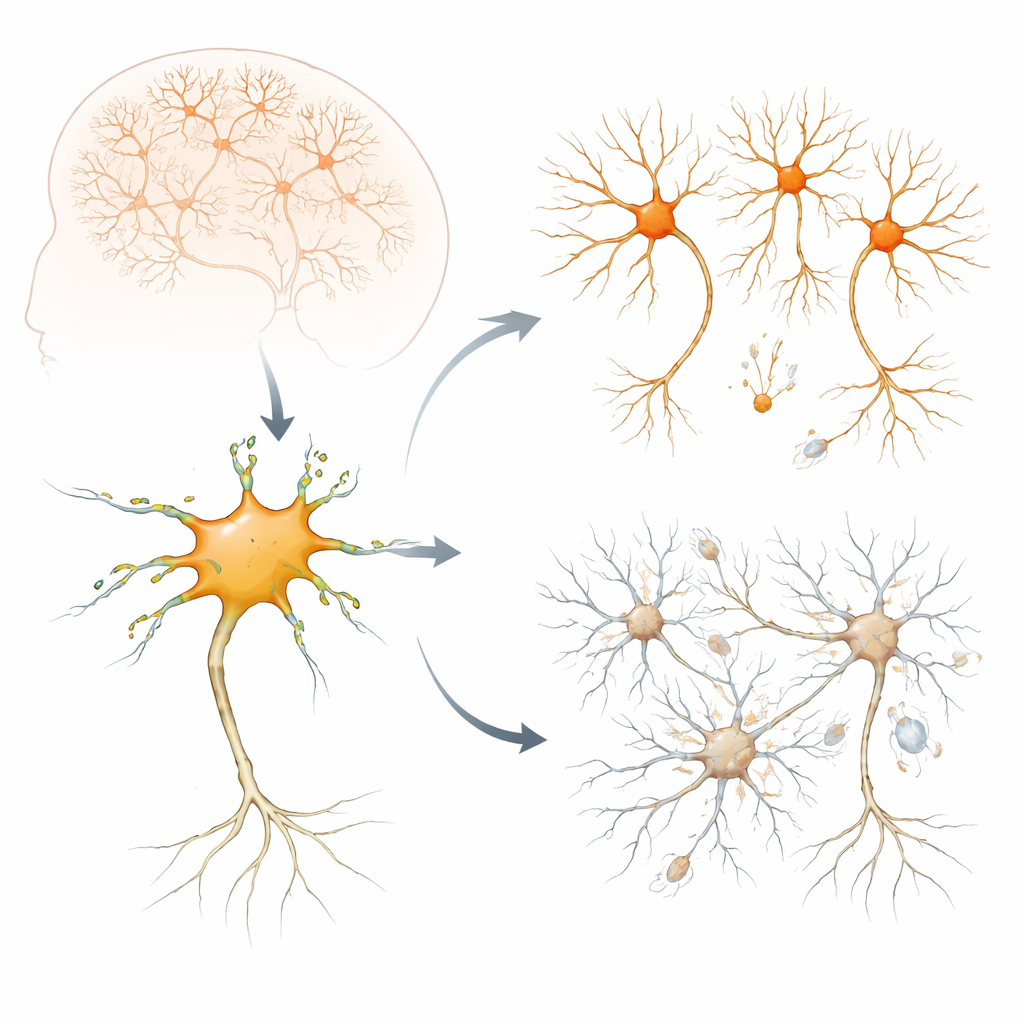
A single building block with big impact
Brain cells rely on surface molecules that let them “shake hands,” recognize neighbors, and avoid crashing into their own branches. Protocadherin gamma C4 is one of 22 related proteins in a larger cluster, but human genetic studies suggested that this one member is especially important. People who inherit faulty versions of the human PCDHGC4 gene develop a syndrome with progressive microcephaly (small brain size), seizures, and intellectual disability. Until now, scientists did not know exactly how this single molecule shapes brain development in a living animal, or whether it simply acts as part of a team of many protocadherins.
Engineering mice to isolate one key player
The team used CRISPR genome editing to build several kinds of mice that differ only in how they make protocadherin gamma C4. One line, called γC4nmd, carries a tiny deletion that causes most full-length γC4 protein to be lost, leaving only a truncated version lacking its shared “constant” tail region. Another line, called γC4fl-only, was created with a two-step method dubbed DOMINO, which rewires the genetic code so that among all 22 related genes, only full-length γC4 remains intact and the others are cut short. This clever strategy allowed the researchers to ask whether γC4 alone can support life when the rest of the cluster is disabled, and how different kinds of damage to γC4 affect the brain.
Keeping neurons alive during early brain growth
When the scientists examined embryos just before birth, they found that removing the constant region from all 22 protocadherins caused widespread activation of a cell-death marker across many brainstem regions, especially in inhibitory neurons. Mice with the γC4nmd mutation, which largely remove full-length γC4 but leave other family members intact, also showed increased cell death, though over a smaller area. By contrast, γC4fl-only embryos, which express only intact γC4 and truncated versions of the other isoforms, had cell-death levels close to normal. In newborn and young mice, those lacking clean γC4 protein died shortly after birth, whereas many γC4nmd animals survived but had smaller brains, seizures, and poor movement. These results indicate that full-length γC4 is uniquely able to prevent excessive neuron loss in key brainstem areas and to support survival, even when other related molecules are crippled. 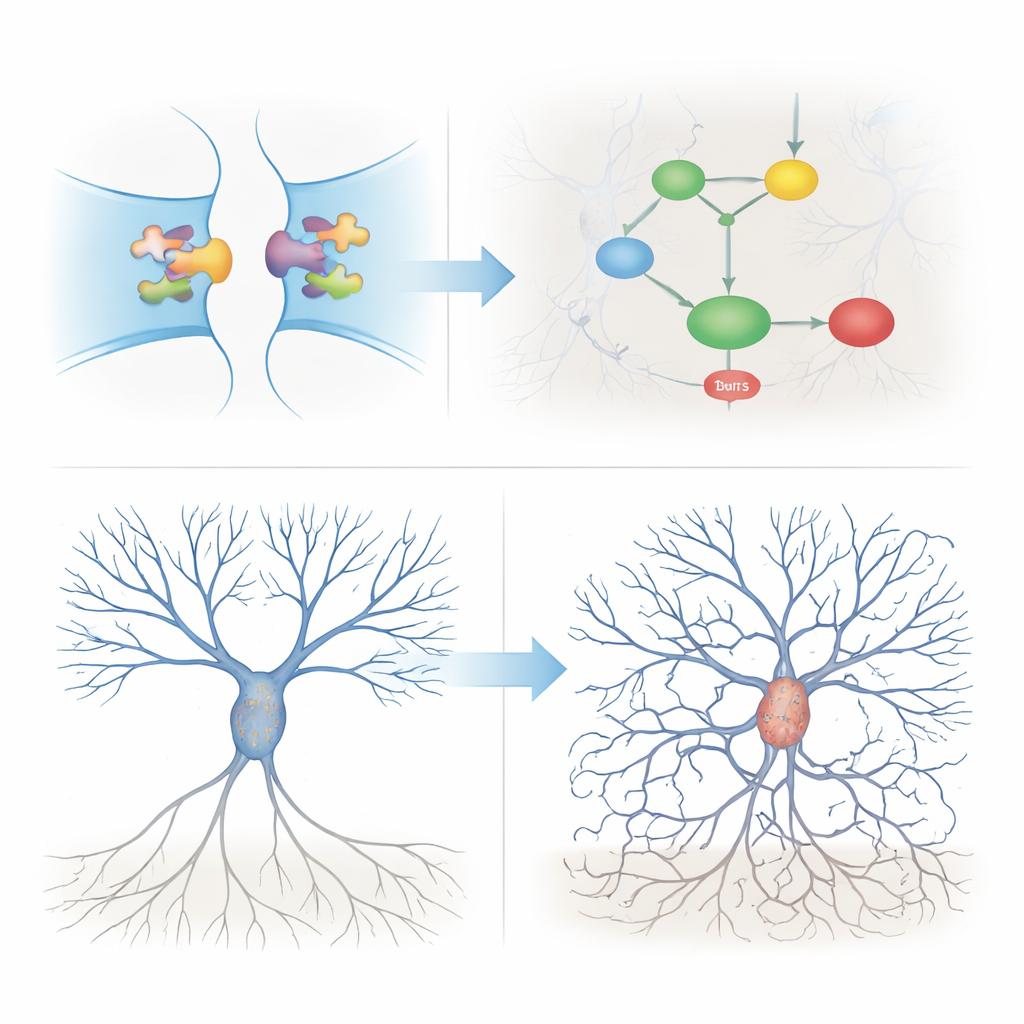
Guiding the shape of brain cell branches
The study also zoomed in on Purkinje cells, large neurons in the cerebellum that coordinate movement and learning. In healthy mice, each Purkinje cell spreads a flat fan of branches that carefully avoid crossing over themselves, a pattern called dendritic self-avoidance. In surviving γC4nmd mice, Purkinje cell trees were more disorganized: they had fewer branches overall, but those branches crossed over each other more often, forming tangles. When only full-length γC4 was left intact (γC4fl-only mice), Purkinje cell trees looked normal, showing that this single isoform is enough to maintain orderly spacing of branches. By turning γC4 on or off only in Purkinje cells using a Cre-based system, the team confirmed that this effect is cell-intrinsic—each neuron needs its own γC4 to wire itself properly.
Testing repair after birth
Finally, the researchers asked whether boosting γC4 after birth could improve faulty wiring. In mice where all 22 protocadherins were switched off in Purkinje cells, the team used a virus to deliver extra γC4 during the first days of life. Weeks later, these cells showed larger, richer branching trees and fewer self-crossings compared with untreated knockout cells, although they did not fully return to normal. This partial rescue shows that enhancing γC4 function, even after early development has started, can still improve the organization of nerve cell branches and suggests that future treatments might target this pathway.
What this means for brain disorders
To a lay reader, the main message is that one specific cell-surface molecule, protocadherin gamma C4, acts as a master organizer that helps neurons stay alive and prevents their branches from becoming tangled. When this molecule is missing or damaged, certain brain regions shrink, seizures appear, and key cells like Purkinje neurons lose their neat wiring patterns—all features that mirror a human neurodevelopmental syndrome caused by PCDHGC4 mutations. By designing mice where only this molecule is altered, and showing that restoring it can partially repair the wiring, the study offers a powerful model for understanding how small genetic changes can reshape entire brain circuits and hints at future strategies for protecting or rebuilding them.
Citation: Higuchi, R., Tatara, M., Horino, S. et al. Protocadherin γC4 regulates neuronal survival and dendritic self-avoidance. Commun Biol 9, 546 (2026). https://doi.org/10.1038/s42003-026-09778-6
Keywords: protocadherin gamma C4, neuronal survival, dendritic self-avoidance, Purkinje cells, neurodevelopmental disorders